By Ilane Tall · Updated November 18, 2026 · Research-based.
Reader-supported: we may earn a commission when you buy through the links on this page, at no additional cost to you. It never changes which product we recommend. Prices quoted below were correct at the time of writing and move often.
Quick answer
All three heaters on this page use the same oil-filled design your parents' radiator used — sealed oil inside metal fins, heated electrically, with no fan moving air across a hot element. The difference is the panel on top of it. The COMFORT ZONE 1500W Digital Oil-Filled Radiator ($59.20) is our pick if you want the simplest version of that upgrade: an adjustable digital thermostat and a remote, at the lowest price of the three.
If a child or a curious pet is in the house, the hykolity 7-Fin Oil Filled Radiator ($74.99) adds a child lock and overheat/tip-over protection on top of a 24-hour timer. The DREO Oil Filled Radiator ($104.23) matches that safety set, is marketed specifically as quiet, and is built for a larger room. None of the three will warm a cold room in the first five minutes — that's not what this heating method does, and the section below on timers explains why that's less of a problem than it sounds.
Why oil-filled radiators are getting digital controls now
The oil-filled radiator is one of the oldest designs in the space heater category, and for decades it didn't need a control panel to speak of. A dial set a rough low/medium/high position, maybe a mechanical thermostat knob with numbers that meant nothing precise, and that was the entire interface. The heating method itself — electrically heating sealed thermal oil inside a column of metal fins, then letting that oil radiate heat into the room as it slowly cools — hasn't needed to change, because it still does the one thing people buy this category for: quiet, fan-free, steady heat that doesn't stir up a room's air or dry it out the way some other heater types do.
What's changed is everything wrapped around that core design. All three heaters here — the COMFORT ZONE, the hykolity, and the DREO — ship with a digital thermostat in place of the old analog dial, and all three include a remote control, letting you adjust the temperature from a couch rather than walking over to a knob on the floor. That's not a change to how the heater heats; it's a change to how precisely and conveniently you can tell it what to do. A digital readout can hold a specific setpoint instead of an analog position that drifts depending on how far you happened to turn the dial, and a remote means the thermostat setting doesn't require bending down to a unit that's often tucked against a wall or under a window.
This matters more for oil-filled radiators specifically than for some other heater types, because of how slowly this design responds. A ceramic or ptc heater can react to a thermostat adjustment in a minute or two; an oil-filled radiator's thermal mass means a setpoint change takes longer to show up as a felt difference in the room. A precise digital setpoint, set once and left alone, suits that slow-reacting physics better than a dial you're nudging every few minutes expecting an immediate result that was never coming.
No fan, same 1,500 watts: what stays slow
Here's what the digital control layer does not change: all three heaters are built around the same roughly 1,500-watt ceiling that applies to virtually every plug-in electric space heater sold for a standard US wall outlet, and the DREO states this figure directly in its own listing. A digital thermostat doesn't let a heater produce more heat than its wattage allows; it only lets you ask for a specific amount of that fixed output more precisely.
And none of the three uses a fan to move that heat. That's the defining trait of the oil-filled category, not an afterthought: heat radiates off the fin surfaces and rises by convection on its own, the way heat rises off a radiator in an old building, rather than being blown across the room. The upside is genuinely quiet operation — there's no fan motor noise, which is also why dust-sensitive households often prefer this design, since there's no airstream constantly lifting dust and allergens off surfaces and recirculating them. The DREO leans into this directly, marketing itself as quiet.
The cost of skipping the fan is speed. Without moving air, heat has to radiate outward and let the room's own air currents do the circulating, which takes meaningfully longer than a fan-forced heater to raise the temperature you feel a few feet away. The hykolity's 7 fins and the DREO's "Large Room" sizing both point to the usual compensation strategy for this trade-off: more fin surface area and more cabinet to radiate from, rather than a fan to push the same heat further and faster.
A digital thermostat and a child lock, next to the dial your parents had
Line the three up by what their control panels actually include, and a clear split appears. The COMFORT ZONE keeps things closest to the category's traditional simplicity: an adjustable digital thermostat and an included remote, full stop — no child lock or tip-over protection is listed for this unit, so if either of those matters to your household, that's a reason to look at the other two rather than assume this one has them.
The hykolity and the DREO both add a child lock on top of the same digital-thermostat-plus-remote baseline, along with overheat and tip-over protection and a four-mode heat setting. A child lock on a space heater does one specific job: it disables the physical buttons on the unit itself so a curious toddler can't change the setting or power the heater off and on by pressing the panel, while the remote still works for an adult. Tip-over protection is a mechanical or sensor-based cutoff that shuts the heater off if it's knocked over, which matters more for a floor-standing radiator with a tall, narrow profile than for a squat tabletop unit, simply because it has more height to tip from. Overheat protection cuts power if the internal temperature exceeds a safe threshold, independent of the thermostat setting, as a backstop rather than the normal control mechanism.
None of this is unique to oil-filled radiators — these are standard safety features across modern electric space heaters generally, not a distinguishing claim one brand invented. What's worth noting is that they're not universal even at similar price points: the COMFORT ZONE, the lowest-priced of the three, is the one listing here that doesn't carry them. If you're shopping with a child or a pet in the house, read the specific listing's safety features rather than assuming every oil-filled radiator at a similar price includes the same set.
| Feature | COMFORT ZONE | hykolity | DREO |
|---|
| Digital thermostat | Yes | Yes | Yes |
| Remote control | Yes | Yes | Yes |
| Timer | 12-hour | 24-hour on/off | 24-hour |
| Child lock | Not listed | Yes | Yes |
| Overheat / tip-over protection | Not listed | Yes | Yes |
Reading a 24-hour timer on a radiator meant to run for hours anyway
The hykolity and the DREO both advertise a 24-hour on/off timer; the COMFORT ZONE's listing specifies a 12-hour timer. On a heater you might run for twenty minutes, a long timer window wouldn't mean much. On an oil-filled radiator, it fits the way the category is actually used.
Because this design heats slowly and holds heat for a while after it's switched off — the oil retains warmth and keeps radiating it even once the element stops drawing power — oil-filled radiators are generally bought to run for extended stretches: a home office for a full workday, a bedroom overnight, a drafty room all evening. A 24-hour timer lets you schedule that stretch once — on in the early morning before you're up, off after you've left for work, say — rather than remembering to flip a switch at a specific hour every day. A 12-hour window, as on the COMFORT ZONE, still comfortably covers a work-from-home day or an overnight run; it just can't be set once for a full 24-hour cycle without a second adjustment.
This is also where the slow-to-respond physics from earlier works in the radiator's favor rather than against it. Switching it on for ten minutes at a time punishes a slow-warming design, since you pay the warm-up penalty repeatedly without ever getting the steady-state benefit. Left running for hours on a timer, that cost is paid once per cycle — which is exactly the use case this category and its timers are built around. None of the three listings we have gives a specific decibel figure, so if a precise quiet-operation number matters, check the current listing rather than relying on the word "quiet" alone.
The picks
Three different answers to who should buy an oil-filled radiator, not a strict best-to-worst ranking — the right one depends mostly on whether a child or pet shares the room, and how large that room is.
01Best simple digital upgrade
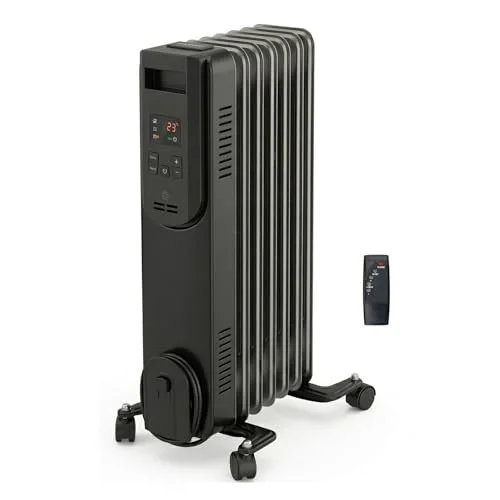
COMFORT ZONE 1500W Digital Oil-Filled Radiator Heater with Remote
The straightforward pick: thermostat and remote, nothing extra, lowest price
1,500 Watt·Adjustable digital thermostat·12-hour timer·Remote included
An adjustable digital thermostat and an included remote on a 1,500-watt oil-filled radiator, at 13.2 by 9.8 by 23.6 inches — a footprint that fits a bedroom corner or under a desk without dominating the room. The listing we have doesn't mention a child lock or overheat/tip-over protection, so we're treating that as a gap rather than assuming either feature is present; if either matters to you, the hykolity or DREO below list both explicitly. At $59.20, this is the pick for a household without small children or pets in the room, where the simplest version of the digital upgrade — a precise setpoint and a remote — is the whole ask.
The pick if you just want the dial replaced with a number, and nothing more to configure.
02Best with kids or pets in the house
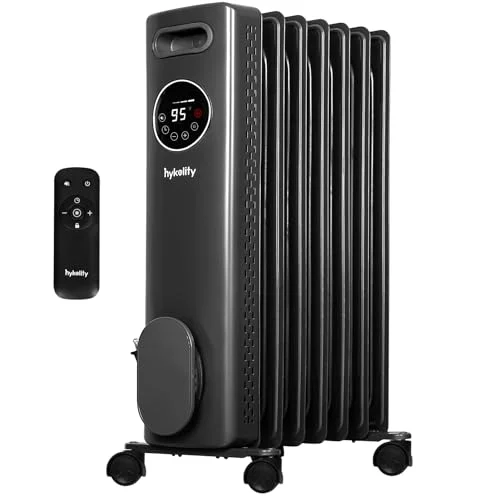
hykolity 7-Fin Oil Filled Radiator Heater with Remote & 24H Timer
The safety-equipped pick: child lock plus overheat and tip-over protection
7 fins·4 heat modes·Child lock·24-hour on/off timer
Seven fins of radiating surface, a 24-hour on/off timer, four heat modes, and the safety set the COMFORT ZONE skips: a child lock that disables the unit's own buttons, plus overheat and tip-over protection. At 24 inches, it's a taller, more substantial cabinet than the COMFORT ZONE, which fits the more fin surface this model carries. The 24-hour timer suits the extended-run use case this category is built for — set once in the morning, off again after the day's done — without a second daily adjustment. At $74.99, the roughly $16 premium over the COMFORT ZONE buys the child lock and tip-over protection outright.
Buy this one if a toddler or a curious dog shares the room the heater runs in.
03Best for a larger, quieter room
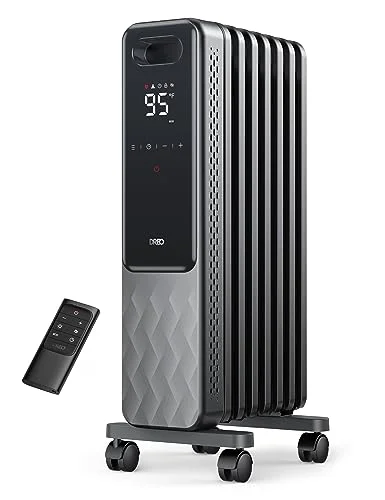
DREO Oil Filled Radiator Heater, Large Room
The large-room pick: marketed specifically as quiet, with the full safety set
1,500 Watt·Large room sizing·Quiet·Child lock · 24h timer
The same digital-thermostat, remote, child-lock and overheat/tip-over protection set as the hykolity, but sized and marketed specifically for a large room, with "Quiet" stated directly in the product name — a reasonable claim for this fan-free category generally, though we don't have an independent decibel figure to confirm how it compares to the other two. Four heat modes and a 24-hour timer carry over from the same feature set as the hykolity, and the stated 1,500-watt output confirms it sits under the same wall-outlet ceiling as the rest of the category rather than drawing more power to cover more floor space. At $104.23, it's the most expensive of the three, which buys a larger-room rating and an explicit quiet claim on top of the hykolity's safety features.
The pick for an open bedroom or living area where quiet operation and covering more floor space both matter.
What oil-filled still won't do: heat a room before you've made coffee
Whatever control panel sits on top of it, the oil-filled design has a floor it cannot drop below: it is not a fast heater, and no digital thermostat changes that. The physical reasons any space heater takes the time it takes apply doubly here, because this category's entire design — heating a mass of sealed oil, then radiating that heat off metal fins with no fan to push it — trades speed for quiet, even heat on purpose. If you want a room noticeably warmer in the few minutes it takes to make coffee, this is the wrong category regardless of which of these three you pick; a fan-forced ceramic heater or an infrared unit like the ones covered in our infrared quartz roundup will get there faster, at the cost of the quiet these radiators offer.
What all three digital controls genuinely buy you is precision and convenience around a heating method whose core speed was never going to change: a thermostat that holds an exact number, a remote so you're not bending down to adjust it, a timer sized to how long the category actually runs, and on two of the three, a child lock and tip-over protection that matter specifically because this is a tall unit that runs hot for hours unattended. None of that makes the radiator faster. It makes the slow, steady heat it was always going to deliver easier to live with.
That slow, fan-free profile is also why this category turns up often as a secondary heater: a quiet unit for a home gym you're in for an hour at a time, or for a sunroom or enclosed porch that needs steady background warmth rather than a fast blast of heat. If remote scheduling and app-based control matter more to you than a physical remote, it's worth reading our look at app- and Alexa-controlled heaters before you buy, since none of the three radiators here connect to a phone app — the remote is infrared or RF, not Wi-Fi.
How we picked
We started from our own database of space heaters listed for sale in the US and filtered specifically for oil-filled radiators carrying a digital thermostat, rather than the older analog-dial versions still sold alongside them. The three products here cover the real spread within that filtered set: a no-frills baseline at the lowest price, a mid-price unit that adds the full safety feature set, and a large-room unit that adds sizing and a quiet claim on top. We excluded analog-only radiators and radiators without a stated wattage.
How we compared
We compared the three heaters on their published titles, listed specifications and current Amazon prices. Where a listing states a figure — the COMFORT ZONE's 1,500 watts and 12-hour timer, the hykolity's 7 fins and 24-hour timer, the DREO's 1,500 watts and large-room sizing — it comes directly from that product's own listing data. Where a listing doesn't state something, such as a decibel figure for any of the three or a child lock for the COMFORT ZONE, we say so rather than estimate a number or assume a feature to fill the page.
We do not run a testing lab. We do not own these three heaters and have not run them in a room ourselves, so you won't find an invented decibel reading, a warm-up time we timed ourselves, or a score out of ten anywhere on this page. We also don't show star ratings, review counts or paraphrased owner sentiment, because we don't have manufacturer-published figures for these specific listings — a limitation of the data available to us, not a judgment on the heaters themselves.
Frequently asked questions
Does a digital thermostat make an oil-filled radiator heat faster?
No. A digital thermostat changes how precisely you can set and hold a temperature, not how quickly the heater reaches it. Oil-filled radiators heat slowly by design — sealed oil inside metal fins, warmed electrically, with no fan to speed up the process — and that physics is identical whether the control is a 1970s dial or a current digital display. All three heaters here still take real time to warm a cold room.
Which of these oil-filled radiators has a child lock?
The hykolity 7-Fin Oil Filled Radiator and the DREO Oil Filled Radiator both list a child lock, along with overheat and tip-over protection. The COMFORT ZONE 1500W Digital Oil-Filled Radiator's listing does not mention a child lock or tip-over protection, so if either feature matters to your household, the hykolity or DREO is the safer choice between the three.
Why do oil-filled radiators have such long timers, like 24 hours?
Because of how the category is actually used. Oil-filled radiators are generally run for extended stretches — a full workday, overnight, an entire evening — rather than switched on for a few minutes at a time, since their slow warm-up punishes short, repeated use. A 24-hour timer, as on the hykolity and the DREO, lets you set a single daily on/off schedule once rather than adjusting it every day; the COMFORT ZONE's 12-hour timer still comfortably covers a workday or an overnight run.
Are oil-filled radiators actually quieter than other space heaters?
Generally yes, for one structural reason: none of the three heaters here uses a fan. Heat radiates off the metal fins and circulates by natural convection instead of being blown across the room, which removes fan motor noise entirely. The DREO markets itself specifically as quiet, consistent with the category, though we don't have an independent decibel figure for any of the three to confirm an exact number.
Written by Ilane Tall. Research-based comparisons of published specifications, current prices and public product data — we do not physically test these units and we do not publish invented scores.