By Ilane Tall · Updated November 16, 2026 · Research-based.
Reader-supported: we may earn a commission when you buy through the links on this page, at no additional cost to you. It never changes which product we recommend. Prices quoted below were correct at the time of writing and move often.
Quick answer
Carbon monoxide is a byproduct of incomplete combustion — it only exists where something is being burned. Every heater in this catalogue, from the 500-watt Amazon Basics Ceramic Mini Heater ($18.39) to the 1,500-watt DREO Quiet Space Heater ($59.40), runs on electric resistance: a current passes through a heating element and that element gets hot. There's no flame, no fuel and nothing to burn, so there's no combustion byproduct to leak. Kerosene and propane heaters burn fuel to make heat, and that's a genuinely different risk profile — one this category doesn't carry, by design rather than by luck.
That doesn't mean an electric heater has no risks at all. The risk that remains is fire from overheating, not gas poisoning, and the fixes look completely different. And the reassurance has one real limit: if you ever power one of these from a portable generator during an outage, keep the generator itself outdoors — that engine burns fuel even though the heater plugged into it doesn't.
Combustion versus electric resistance: the distinction that actually matters
Every heater sold for home use falls into one of two mechanical categories, and that category — not the brand, not the price, not how "powerful" it sounds — is what determines whether carbon monoxide is even possible. The first category burns a fuel: kerosene, propane, natural gas, heating oil or wood. Under perfect conditions, combustion turns fuel and oxygen into carbon dioxide and water vapor and nothing more sinister. Real-world combustion is never perfect: any time a flame burns with too little oxygen, or through a mechanism that isn't perfectly tuned, some of that carbon pairs with only one oxygen atom instead of two. That incomplete product is carbon monoxide — odorless, colorless, and dangerous well before anyone can smell or see it.
The second category is electric resistance, a completely different physical principle. Current flows through a conductor — a ceramic plate, a metal coil, a quartz tube — that resists that flow, and resistance converts electrical energy directly into heat. The Amazon Basics Ceramic Portable Mini Space Heater states this plainly in its own title: a 500-watt ceramic element with no flame, no fuel line and no exhaust path. The AUBKN and DREO Quiet heaters work the same way at larger scale, 1,500 watts in the DREO's case. None of the three has anything to burn, so none has a byproduct of burning to worry about — not a safety feature any brand added on top, but a direct consequence of the design itself.
It's worth being precise about why that matters. A lot of comparisons frame electric versus fuel-burning heat as a matter of degree — electric is "safer," fuel-burning is "riskier," as if it's a spectrum. For carbon monoxide specifically, it isn't. A heater either has a combustion process inside it or it doesn't, and every model named in this piece doesn't. That's a categorical difference, not a matter of one brand burning a little cleaner than another.
Why kerosene and propane heaters carry a real carbon monoxide risk — and electric heaters structurally can't
Kerosene and propane space heaters are built specifically to burn fuel indoors, and that single fact is the entire source of the risk this article exists to explain. Both fuels produce carbon monoxide as a normal byproduct of combustion, and the amount produced climbs sharply when ventilation is restricted or the unit runs in a small, sealed room — exactly the conditions a cold night tends to create, since the instinct when it's freezing outside is to close every window and door. Public safety guidance from fire and poison-control organizations is consistent and blunt here: unvented kerosene and propane heaters are a leading cause of accidental carbon monoxide poisoning in homes during winter months, and the warning exists because the risk is real, not theoretical.
The mechanism is straightforward. A fuel-burning heater draws the oxygen it needs for combustion from the room it's heating. In a well-ventilated space with the burner tuned correctly, that combustion mostly stays complete and the carbon monoxide produced is minimal. Shrink the room, seal the doors and windows for warmth, or let the burner run a little rich on fuel, and the available oxygen drops while the heater keeps burning at the same rate — producing more carbon monoxide as a direct result. The heater doesn't need to malfunction for this to happen; it can be operating exactly as designed and still be the source of a rising carbon monoxide level, because the risk is baked into burning fuel in a room with finite air, not into any one unit's defect.
This is also why building codes single out fuel-burning space heaters for restrictions electric heaters never face. Most college dorms ban exposed-flame and fuel-burning heaters outright while allowing enclosed-element electric heaters under a wattage cap — a distinction that only makes sense once the ban is understood as being about combustion byproducts in a sealed, shared building, not about heat output. No fire code in the country treats a 1,500-watt electric heater the same as a kerosene heater of equivalent output, and the carbon monoxide risk underneath that gap is the reason.
What electric heaters still risk instead: overheating, not asphyxiation
Removing combustion from the picture doesn't remove risk from the picture — it changes which risk you're actually managing. The honest failure mode for an electric space heater is fire from overheating, tip-over or a fault in the circuit it's plugged into, not gas buildup in a closed room. That's a meaningfully different kind of problem, and it comes with meaningfully different safeguards.
The Amazon Basics Ceramic Portable Mini Space Heater states tip-over protection directly in its title, on a 1.4-pound unit small enough to be knocked off a desk. A tip-over switch is a mechanical sensor that cuts power the instant the unit is no longer upright — it has nothing to do with gas and everything to do with a heating element no longer facing a safe direction. That's the risk electric heaters actually carry: a hot element against something flammable, or a cord carrying more current than it was built for, not an invisible gas accumulating while nobody notices.
Overheat protection is the second, related safeguard. Where a tip-over switch watches orientation, an overheat cutoff watches temperature directly — a thermal sensor that interrupts power if the element or housing runs hotter than its design allows, whether from a blocked vent, dust buildup, or a fan that's stopped moving air across the element. A heater can be standing exactly upright and still need this cutoff to activate. A handful of heaters in this category add app or voice control on top of these cutoffs, but the cutoffs themselves, not the remote convenience, do the safety work.
The practical habits that follow have nothing to do with ventilation, which is the biggest mental adjustment worth making. A fuel-burning heater needs fresh air moving through the room; an electric heater needs clearance from anything flammable, a hard level surface, and a direct wall outlet rather than an extension cord. Closing a door around an electric heater doesn't create the risk closing a door around a kerosene heater does — there's no combustion to starve of oxygen. What to actually watch is physical: distance from curtains, a cord that stays cool to the touch, and a unit that sits flat on a floor that won't tip it.
The picks, across three different sizes, to make the point concrete
The cleanest way to show that carbon monoxide risk tracks the fuel and not the wattage is to look at heaters that span a real size range and notice that the mechanism — and therefore the carbon monoxide answer — doesn't change at all across them. A 500-watt desk heater and a 1,500-watt room heater are both electric resistance, so both get the identical, unconditional answer: zero combustion, zero carbon monoxide, regardless of how long either one runs.
01Smallest in the catalogue
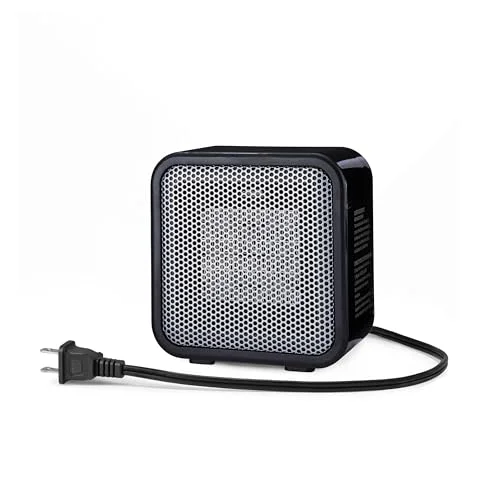
Amazon Basics Ceramic Portable Mini Space Heater
500 watts, electric resistance, same answer as every heater here
Ceramic, 500W·Tip-over protection·1.4 lbs·3.4 x 5.8 x 6 in
The smallest and lowest-wattage heater in this piece, built for a desk rather than a room, and the clearest illustration of the whole argument: at 500 watts, roughly a third of what the other two picks draw, it's still an electric-resistance heater with nothing to burn. Lower wattage doesn't make it "more" safe from carbon monoxide, because the risk was never a function of wattage — it's a function of whether anything is being combusted, and here nothing is. The stated tip-over protection addresses the risk actually relevant to a unit this light and this close to a desk edge.
The point it makes: carbon monoxide risk doesn't scale with power draw, because electric heaters don't carry it at any wattage.
02Small, with remote control
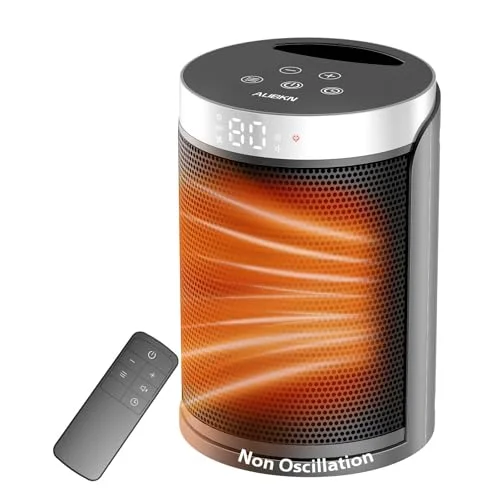
AUBKN Space Heater
A step up in footprint, the same electric-resistance answer
Electric resistance·Remote included·Small·Indoor use
A small portable heater with a remote, sitting between the desk-sized Amazon Basics unit and the larger DREO tower in footprint and typical use — a bedroom nightstand or home office rather than a single desk corner. The listing doesn't state a specific wattage figure, and we're not going to invent one to fill the gap; what it does confirm is an electric heater built for indoor use with no fuel component, which is the only fact this question turns on. Whatever its exact draw, the combustion answer matches the heater half its size and the one triple its price.
Size and remote convenience change the use case. They don't touch the carbon monoxide answer, because that answer was never about size.
03Largest, full 1,500W output
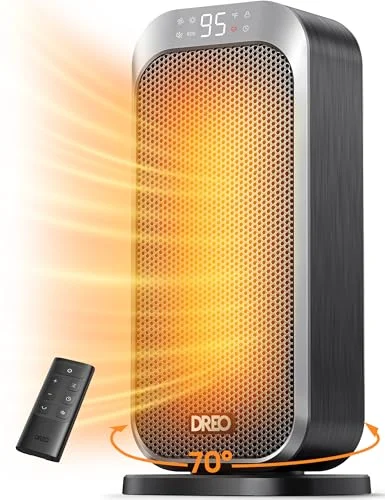
DREO Quiet Space Heater
Three times the wattage of the mini pick, identical mechanism
1,500W·15-inch tower·Remote included·Indoor use
A 15-inch tower running at the full 1,500-watt ceiling most plug-in electric heaters are built to — three times the output of the mini pick and the largest footprint of the three. If carbon monoxide risk scaled with power the way heat output does, this would be the pick to worry about. It isn't, for the same reason the 500-watt desk heater isn't: electric resistance at 1,500 watts produces exactly as much carbon monoxide as electric resistance at 500 watts, which is to say none, because wattage describes current flow, not whether anything is being burned.
The heater drawing the most power in this piece and the one drawing the least share the identical answer to this specific question — which is the whole argument in one comparison.
The decision between a small desk unit and a larger tower is really about coverage and placement — whether one heater in one zone is enough, or two smaller units covering two zones serves a room better — never about reintroducing a combustion risk none of these units carry. Pick based on the room; the safety answer doesn't change with the size.
The one gas appliance in most homes that does still warrant a CO detector
None of this means a home with only electric space heaters can skip carbon monoxide detectors altogether, since the honest caveat matters as much as the reassurance. Most US homes still run at least one appliance that burns fuel for an entirely different purpose than space heating: a gas furnace, a gas water heater, a gas range, or a wood-burning or gas fireplace. Any one of those is a genuine combustion source in the same building, carrying the same mechanism described above — incomplete combustion, restricted ventilation, a byproduct unrelated to whatever's plugged into the wall outlet across the room.
The gas furnace is the one most worth naming, because it's doing the same job — heating the home — as the heaters this site covers, just through combustion instead of resistance, and it runs for long, unattended stretches the same way a space heater does. A furnace with a cracked heat exchanger or a blocked flue can introduce carbon monoxide into a home's air supply over hours or days without any obvious sign, which is precisely what detectors near sleeping areas exist to catch. A space heater supplementing that furnace on a cold night doesn't add to or subtract from that risk — the furnace's risk is entirely its own.
The practical takeaway: if your home has a gas furnace, a gas water heater, a gas range or any fuel-burning fireplace, that's the appliance a carbon monoxide detector is protecting against, and it needs one whether or not you also own an electric space heater. If your home has none of those — fully electric heating, water heating and cooking — the detector becomes less load-bearing, though many local codes require one near sleeping areas regardless, as a backstop against whatever a future appliance swap might introduce.
Where this stops being reassuring: never run a generator indoors to power any of them
Here's the one scenario where the clean electric-resistance answer above stops applying, and it's worth stating without softening it: a portable generator burns gasoline, propane or diesel to produce the electricity that then powers whatever you plug into it — including every heater named in this piece. The heater itself still isn't producing carbon monoxide. The generator feeding it is, in exactly the way the kerosene and propane heaters discussed earlier do, and often in larger quantities over a shorter time.
This matters specifically because of when generators get used: a winter power outage, the exact moment someone reaches for a space heater to stay warm. Fire and poison-control guidance here is unambiguous and admits no exceptions for convenience — a generator needs to run outdoors, far from windows, doors and vents, regardless of the weather, the outage's length, or whether the garage door is cracked open. Carbon monoxide from a generator in an attached garage, even with the big door up, has reached fatal concentrations inside the connected house in documented cases, because the gas moves through the structure faster than an open door clears it.
Where the electric-only answer holds
Any of these three heaters, or any similar electric-resistance heater, plugged directly into a wall outlet powered by the normal utility grid. No combustion anywhere in that chain, so no carbon monoxide from the heater, full stop.
Where it stops holding
The same heater plugged into a portable generator running indoors, in a garage, on a porch, or anywhere near an open window or vent. The generator is now the combustion source, and it carries the same risk a fuel-burning heater does — sometimes worse, given typical generator output.
The fix isn't to avoid generators during an outage — it's to place the generator far outside the living space, run an outdoor-rated extension cord back to the heater, and keep battery-backed CO detectors installed so they work through the exact outage that prompted the generator. The space heater doesn't change any of that math; it's not the part of the setup that needs watching. The engine outside is.
How we researched this
We compared the mechanism, wattage and safety features stated in each product's own listing against widely published fire-safety and poison-control guidance on combustion byproducts, unvented fuel heaters and generator placement — we did not run any combustion or air-quality testing ourselves. We don't run a testing lab, we don't own these three heaters, and nothing here is an invented decibel reading or a score out of ten. Where a listing didn't state a figure — the AUBKN's exact wattage, for instance — we said so plainly rather than estimate one. We also don't show star ratings, review counts or paraphrased owner sentiment anywhere on this page, since we don't have manufacturer-published figures for these listings — a limitation of the data, not a judgment on the heaters. The combustion-versus-resistance distinction and the generator warning reflect general, widely published safety information, not a claim specific to any one brand here.
Frequently asked questions
Can an electric space heater produce carbon monoxide?
No. Carbon monoxide is a byproduct of incomplete combustion, and electric resistance heaters — which is what every heater in this catalogue is, including the three named above — don't burn any fuel. There's no flame and nothing to combust, so there's no combustion byproduct to produce, regardless of the heater's wattage or how long it runs.
Why do kerosene and propane heaters carry a carbon monoxide risk that electric heaters don't?
Because they burn fuel indoors to produce heat, and combustion that runs with restricted oxygen — which happens easily in a small or sealed room — produces carbon monoxide as a normal byproduct, not a malfunction. Fire and poison-control guidance treats unvented kerosene and propane heaters as a known winter hazard for exactly this reason. Electric heaters have no combustion process anywhere in the chain, so this specific failure mode can't occur in them at any wattage.
If not carbon monoxide, what should I actually worry about with an electric space heater?
Fire from overheating, tip-over, or a cord and outlet carrying more current than they're rated for — a completely different risk profile than gas poisoning, and one that tip-over switches, overheat cutoffs, a hard level floor and a direct wall-outlet connection are specifically built to manage. Ventilation, which matters enormously for fuel-burning heaters, isn't the relevant safeguard here.
Do I still need a carbon monoxide detector if I only use electric space heaters?
Yes, if your home has any other fuel-burning appliance — a gas furnace, gas water heater, gas range, or a wood-burning or gas fireplace — because that appliance carries its own combustion risk entirely independent of the electric heater. And if you ever power an electric heater from a portable generator during an outage, the generator itself burns fuel and must run outdoors, never in a garage or near a window, regardless of the heater plugged into it.
Written by Ilane Tall. Research-based comparisons of published specifications, current prices and public safety guidance — we do not physically test these units and we do not publish invented scores.