By Ilane Tall · Updated November 12, 2026 · Research-based.
Reader-supported: we may earn a commission when you buy through the links on this page, at no additional cost to you. It never changes which product we recommend. Prices quoted below were correct at the time of writing and move often.
Quick answer
A sunroom or enclosed porch loses heat through its walls faster than almost any other room in the house, because most of those "walls" are glass. Of the heaters in our database, the DREO 16 Inch Electric Heater for Large Room ($59.46) is our top pick here: it states a 250-square-foot coverage figure and a 70° oscillation range built to spread heat along a long run of windows rather than pool it in one corner.
If your sunroom is smaller and closer to square than long and narrow, the DREO Space Heater with Thermostat ($63.74) states a higher 270-square-foot coverage rating and is the quietest of the three at a stated 34 dB — worth it if the room doesn't need the heat spread lengthwise. The WINHL Space Heater ($37.96) is the budget and flexibility pick, with three power settings and its own 70° oscillation. None of the three fixes a cold window; for that, see the honest answer further down.
Why a sunroom loses heat faster than its square footage suggests
A 150-square-foot bedroom and a 150-square-foot sunroom are not the same heating problem, even though a heater's coverage rating treats them identically. What a square-footage rating can't see is the material the room is actually built from. A standard framed exterior wall, filled with fiberglass batt insulation, resists heat flow at somewhere around R-13. A dual-pane window sits closer to R-2, and a single-pane sheet of glass — still common in older sunroom and porch conversions — barely clears R-1. That is roughly an order of magnitude more heat escaping through a given square foot of glass than through the same square foot of insulated wall.
A sunroom typically replaces most of two or three exterior walls with exactly that glass. The floor area might read the same as a bedroom down the hall, but the exposed surface losing heat to the outside air is far larger relative to the room's volume, and far worse at holding onto whatever a heater adds to it. That's before counting the aluminum or vinyl window frames themselves, which conduct heat directly and often sit at the thinnest, least-insulated point in the whole envelope.
None of this means a sunroom can't be heated. It means the square-footage number on a heater's box, which assumes a room built mostly from insulated wall, is optimistic for a room built mostly from glass. Plan to need more margin than the rating implies, not less.
Single-pane glass, cold radiant surfaces, and what a heater can't fix
There's a second effect here that a thermostat reading won't show you. The air in a sunroom can register 68°F on a thermometer and the room can still feel cold, because the body loses heat to cold surfaces around it through radiation, not just through the air it's breathing. Sit a few feet from a large single-pane window on a winter night and that pane of glass, chilled by the outdoor air on its other side, is pulling warmth off your skin the same way a cold wall would — just faster, because glass conducts heat so efficiently.
This is the limit every heater in this guide runs into, and it's worth saying plainly rather than glossing over: all three picks below are PTC ceramic convection heaters. They heat the air in the room and move it with a fan. None of them is a radiant or infrared design built to warm a person directly the way the glass is cooling them. A convection heater can raise the air temperature in a sunroom; it cannot change the fact that a cold pane of glass two feet from your chair is still radiating that cold at you. Pushing more hot air into the room helps, but it is treating a symptom a glass wall creates, not removing the cause.
Practically, this means seating placement does real work that a heater's wattage can't substitute for. Moving a chair even a few feet back from the largest expanse of glass, or angling it away from a single-pane run, reduces the radiant heat loss directly — something no amount of additional heater output fixes if the chair stays put against the window.
Coverage ratings: 250 and 270 square feet, and what they assume
Two of the three heaters here carry the highest stated coverage figures in our database for this category: the DREO 16 Inch Electric Heater states it covers up to 250 sq.ft., and the DREO Space Heater with Thermostat states 270 sq.ft. Both are manufacturer figures, and both are measured the way every heater coverage rating is measured — in a closed room with four insulated walls, not a room that trades two of those walls for glass.
That gap matters more here than almost anywhere else in this guide. A 250-square-foot rating earned in a well-sealed interior room doesn't transfer cleanly to a 250-square-foot sunroom losing heat through single-pane glass on three sides. Treat both numbers as the best case a sealed, insulated room of that size would see, then discount it for how much of your room's perimeter is actually glass rather than wall. A small sunroom with one glass wall will get much closer to the rated coverage than a wraparound porch enclosed almost entirely in windows.
The WINHL heater doesn't state a square-footage coverage figure at all in its listing, and we're not going to invent one to fill the gap. What it does state is three power levels — 700W, 1000W and 1500W — and a smart thermostat that adjusts output to the room's measured temperature, which is a different kind of flexibility than a single coverage number: useful in a smaller or partially-enclosed porch where you want to dial output down rather than run a fixed wattage all evening.
Oscillation across a long, narrow glass-walled room
A sunroom or enclosed porch is frequently a long, narrow shape — a run along the back of a house, glass on one or two long sides, seating spread from one end to the other rather than clustered in a square footprint. That shape punishes a heater that throws heat in one fixed direction, because the far end of the run simply doesn't get any.
Two of the three picks here state an oscillation figure built for exactly that problem. The WINHL heater and the DREO 16 Inch Electric Heater both state a 70° oscillation range, sweeping the heated airflow side to side rather than aiming it at a single fixed point. For a long glass-walled run, that sweep is what gets warm air to both ends of the room instead of concentrating it where the heater happens to be sitting.
The DREO Space Heater with Thermostat — the one with the higher 270-square-foot coverage figure — does not state an oscillation range in its listing. That's not a flaw, it's a different design intent: a higher coverage rating aimed at filling a more contained, squarer room with warm air generally, rather than sweeping heat along a length. If your enclosed porch is long and narrow, the oscillating DREO 16 Inch or the WINHL is the better physical match for the shape of the problem; if it's closer to a small, enclosed square room, the higher-coverage DREO without oscillation is a reasonable trade for its lower stated noise.
It's worth reading our breakdown of how DREO's different heater models differ before buying either DREO unit here, since the brand sells several similarly-named 16-inch models with different feature sets and it's easy to end up with the wrong one on a quick search.
The picks
Three heaters, matched to how enclosed and how long your glass-walled room actually is — not a strict ranking, since the right pick here depends more on room shape than on any other factor in this guide.
01Best for a long, narrow porch
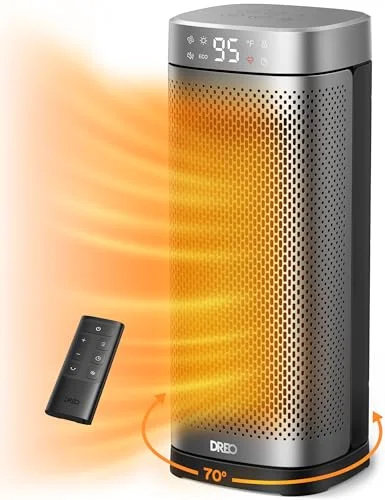
DREO 16 Inch Electric Heater for Large Room
The oscillating pick: built to spread heat along a glass run
1,500W PTC ceramic·70° oscillation·250 sq.ft. stated·Shield360° tip-over + overheat
DREO states a 250-square-foot coverage figure for this heater alongside a 70° wide-angle oscillation range and what the brand calls Hyperamics heating, rated to move warm air at 11.8 feet per second. For a sunroom or porch that runs long rather than square, that sweep is the feature that matters most here — it's built specifically to reach both ends of a room rather than warm one fixed spot. Safety features are stated as Shield360° tip-over and overheat protection, a 24-hour auto-off, V-0 flame-retardant housing and an ETL listing. Treat the 250 sq.ft. figure as a best case for a sealed room; a glass-walled porch of that size will fall short of it.
The pick if your enclosed porch is a long run along the back of the house rather than a contained square room.
02Best for a smaller, enclosed porch
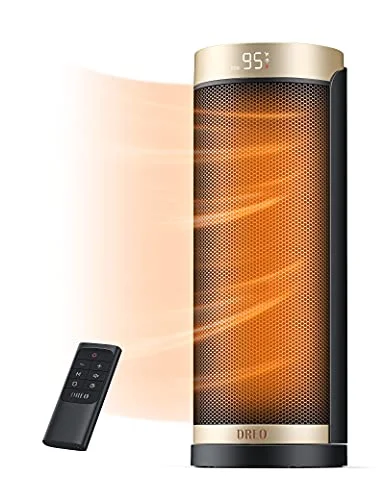
DREO Space Heater with Thermostat
The quiet pick: higher stated coverage, no oscillation
1,500W PTC ceramic·270 sq.ft. stated·34 dB stated·12-hour timer
This DREO model states the highest coverage figure of the three at 270 sq.ft., with a stated noise level of 34 dB — the quietest of the picks here, which DREO attributes to an oblique airflow fan design. It does not state an oscillation range, so it's better matched to a sunroom that's enclosed and roughly contained rather than a long narrow run. ETL certification, V0 flame-retardant housing, smart tip-over and overheat protection, a 12-hour timer and a 24-hour automatic power-off round out the safety features, and DREO specifically instructs plugging directly into a wall outlet rather than using an extension cord.
Price checkThis one’s price moves around the $70 line and has been listed above it. Check the live price: if it’s over $70 when you look, the DREO 16 Inch Electric Heater for Large Room is the pick that stays inside the budget.
Buy this for a compact, enclosed porch where you want quiet background heat rather than a heater that visibly sweeps the room.
03Best budget / adjustable-wattage pick
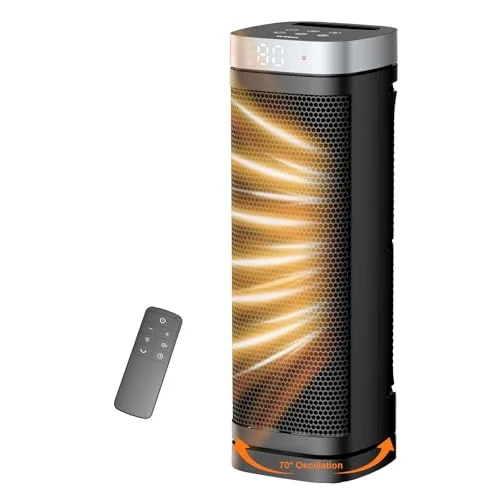
WINHL Space Heater with Thermostat
The flexible pick: three power levels plus oscillation, at the lowest price
700W / 1000W / 1500W·70° oscillation·Smart thermostat·Remote included
At $37.96, the WINHL is the least expensive of the three and the only one offering three separate power settings rather than a single fixed output, alongside its own 70° oscillation range. The built-in thermostat is stated to detect room temperature and adjust output automatically, and a remote is included. WINHL does not state a square-footage coverage figure for this model, which we're not going to estimate on its behalf — if a specific coverage commitment matters to you, this isn't the listing that provides one. What it does offer is the ability to run at 700W on a mild evening rather than 1,500W, which matters on a porch where you don't want to overshoot a small enclosed space.
The pick if you want to run less than full power on a mild night, or you're not ready to spend $70 to find out whether a heater even solves this room.
If none of these three oscillating or high-coverage heaters feels like enough for a genuinely large glass-walled porch, it may be a case for running two smaller units rather than one bigger one — see our full breakdown of when that trade makes sense before assuming a single heater, however it's rated, will do the whole room.
When the honest answer is weatherstripping, not another heater
There's a point in a cold sunroom where buying a stronger heater stops being the answer, and it arrives sooner than most buyers expect. A heater adds heat to a room; it does nothing about heat leaving that room through a gap around a window sash, a door that doesn't seal, or a frame that was never properly caulked. If the room is losing warm air as fast as a heater can produce it, a bigger or second heater just raises the electric bill without raising the temperature by much — the leak, not the heater, is the bottleneck.
The fix for that is cheap and unglamorous compared to a new heater: weatherstripping around door and window frames, a draft-blocking door sweep, and clear plastic window insulation film pulled taut with a hair dryer over single-pane glass for the season. None of that shows up on a product listing and none of it is as satisfying to buy as a heater with a remote control, but it addresses the actual cause of a cold sunroom rather than compensating for it after the fact.
A rough way to tell which problem you have: hold a hand a few inches from a window frame or door edge on a windy day. A heater can't fix what you feel there. If the draft is obvious at the frame but the glass itself feels merely cold rather than drafty, weatherstripping and window film will do more for the room than any heater upgrade will.
This matters even more if you're renting the space rather than owning it, since permanent fixes like replacing single-pane glass are rarely on the table. Temporary weatherstripping, removable window film and draft stoppers are specifically suited to that situation — see our guide to heating a rental for what else is worth doing before or alongside buying a heater when you can't change the windows themselves.
None of this is an argument against buying one of the three heaters above. It's an argument for sealing the room first, or at least alongside the purchase, rather than expecting a heater alone to overcome a draft it was never built to fight.
How we picked
We started from our own database of space heaters listed for sale in the US and filtered for the models with the highest stated coverage areas and, separately, for stated oscillation ranges — the two specifications that matter most for a room built mostly from glass rather than insulated wall. That filter surfaced the two DREO models and the WINHL model covered here. We did not pull a fourth or fifth heater simply to round out the list; three heaters that genuinely differ in coverage, noise and oscillation told the fuller story for this specific room type.
How we compared
We compared the three heaters on their published titles, listed features and current Amazon prices. Where a specification is stated — the 250 and 270 square-foot coverage figures, the 70° oscillation ranges, the 34 dB noise figure, the three WINHL power levels — it comes directly from the product's own listing. Where a listing doesn't state a figure, such as WINHL's coverage area or the thermostat DREO's oscillation range, we say so rather than estimate one to fill the page.
We do not run a testing lab. We do not own these three heaters and have not run them in a sunroom ourselves, so you will not find an invented decibel reading, draft-test result or score out of ten anywhere on this page. We also don't show star ratings, review counts or paraphrased owner sentiment, because we don't have manufacturer-published figures for these specific listings — a limitation of the data available to us, not a judgment on the heaters themselves.
Frequently asked questions
Why does my sunroom feel so much colder than other rooms the same size?
Because a sunroom's exterior surface is mostly glass rather than insulated wall. A standard framed wall resists heat loss at roughly R-13; a dual-pane window is closer to R-2, and single-pane glass barely clears R-1. A room with that much glass loses heat through its envelope far faster than the same square footage built from wall, so a heater has to work harder just to hold steady, let alone warm it up.
Can I trust a 250 or 270 square foot coverage rating for my sunroom?
Treat it as a best case, not a guarantee. Coverage ratings are measured in a closed, insulated room, not one with single-pane glass on two or three sides. A small sunroom with one glass wall will get closer to the rated figure than a wraparound porch enclosed almost entirely in windows. Discount the number based on how much of the room's perimeter is actually glass.
Does oscillation actually matter for a long, narrow porch?
Yes, more than in most rooms. A long, narrow sunroom or porch punishes a heater that throws heat in one fixed direction, since the far end of the run gets none of it. The DREO 16 Inch and WINHL heaters both state a 70° oscillation range built to sweep heat along that length; a heater without oscillation is a better match for a smaller, more contained room.
Should I just buy a bigger or second heater instead of weatherstripping?
Not if the room is losing heat through a drafty window frame or door edge faster than a heater can replace it. In that case a stronger heater raises the electric bill without raising the room's temperature by much. Weatherstripping, a door sweep and window insulation film address the actual cause of the cold; a heater only adds heat on top of whatever is still escaping.
Written by Ilane Tall. Research-based comparisons of published specifications, current prices and public product data — we do not physically test these units and we do not publish invented scores.