By Ilane Tall · Updated November 13, 2026 · Research-based.
Reader-supported: we may earn a commission when you buy through the links on this page, at no additional cost to you. It never changes which product we recommend. Prices quoted below were correct at the time of writing and move often.
Quick answer
If dust and allergies are the deciding factor, skip the fan entirely. The Amazon Basics Portable Oil Radiator Heater ($58.11) and the De’Longhi EW7707CM Oil-Filled Radiator ($129.95) both heat by radiating warmth from oil-filled steel fins — no fan, no airflow, and nothing to recirculate what's already settled on the floor. Between the two, the De’Longhi's thermostat and larger finished size suit a room you're heating for hours; the Amazon Basics unit is the lower-cost way into the same fanless approach.
If you genuinely need heat faster than an oil radiator can deliver it, the DREO Atom One ($60.49) is the fan heater worth considering: it uses a brushless DC motor specifically to cut the turbulence a cheaper fan produces, which matters more in a dusty room than in a clean one. It is still a fan heater, and the trade-off below explains exactly what that costs you.
What a fan heater actually does to the dust already in the room
A space heater's fan does not create dust out of nothing. The dust is already there — on the floor, on the baseboards, settled into a rug, resting on top of a dresser or a heating grille that hasn't been wiped in a while. What a fan does is move air across those surfaces and through the room, and dust is light enough that moving air picks it up and carries it with the warm air the fan is pushing toward you.
That is the entire mechanism, and it is worth being precise about it because it explains why two people can disagree about whether "fan heaters are bad for allergies." A fan heater in a room that is vacuumed and dusted regularly moves comparatively little. The same fan heater in a room with dust sitting undisturbed in the corners, under the bed or on top of a baseboard heater cover will circulate more of it, for as long as the fan runs. The heater is not manufacturing allergens; it is redistributing whatever dust, pet hair and settled particulate the room already contains, and putting a larger share of it into the air you're breathing near the unit.
The practical implication is that the fan itself, not the heating element, is the variable that matters for a dust-sensitive household. A PTC ceramic heater and a quartz infrared heater can both have fans; what decides whether either stirs up a room is whether a fan is moving air at all, and how much. That is also why the comparison in this guide is not "ceramic versus infrared" the way other buying guides on this site frame it — it's fan versus no fan, because that's the variable that actually touches allergies.
No fan at all: how an oil-filled radiator warms a room
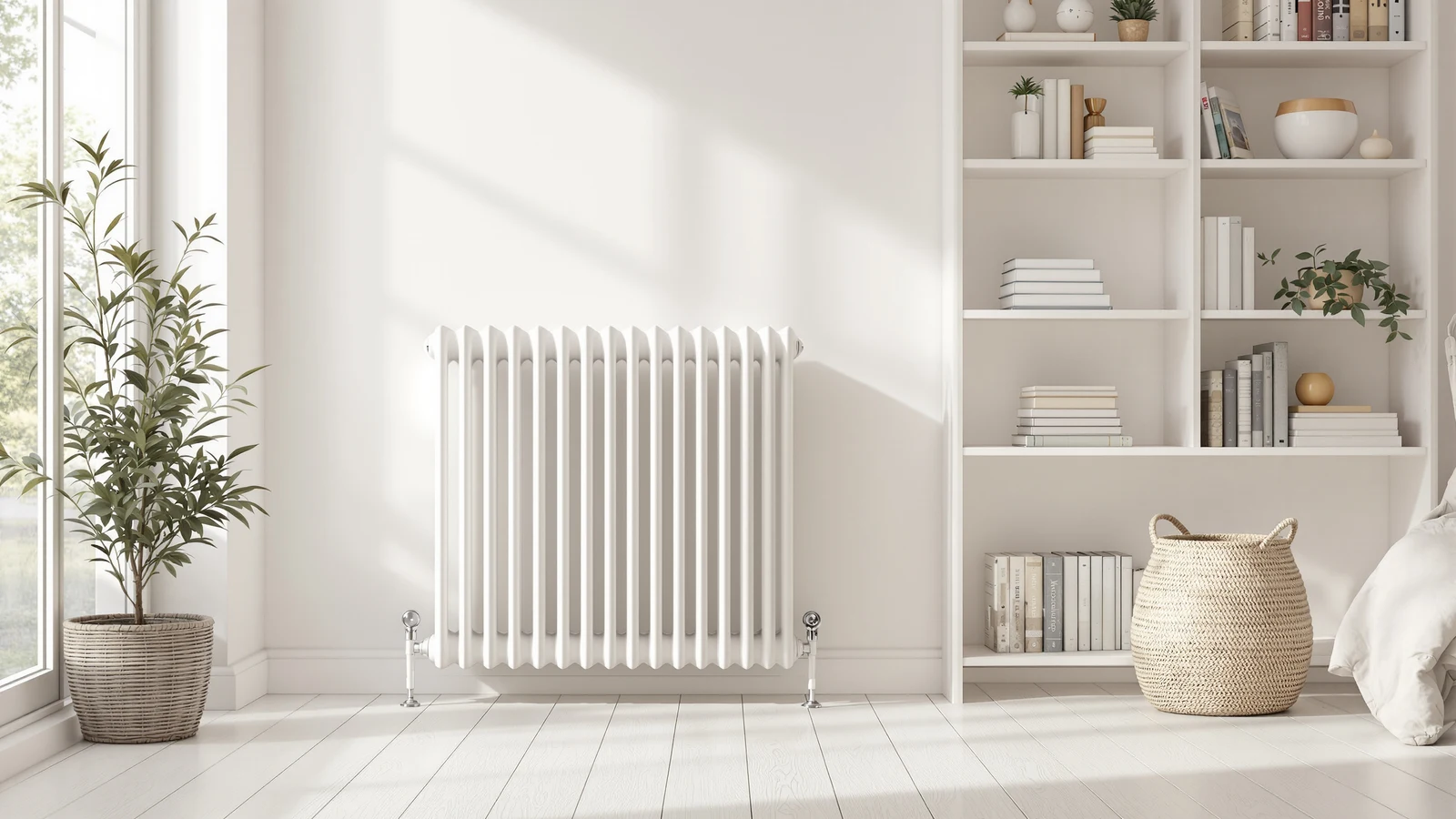
An oil-filled radiator heater works on a different principle entirely. Inside the unit, an electric element heats a reservoir of oil sealed inside steel fins — the Amazon Basics unit lists seven oil-filled steel fins specifically. The oil holds and conducts heat efficiently, warming the metal fins, which then warm the air immediately around them and radiate heat outward the way a car's radiator or a cast-iron home radiator does. There is no fan pushing that warm air anywhere. The air near the fins warms, becomes less dense, and rises on its own — natural convection, not a motor-driven draft.
Both oil-filled radiators in this guide list 1,500 watts, the same practical ceiling almost every plug-in space heater in the US is built to. The De’Longhi EW7707CM states "Energy Saving" and is sized at 5.9 inches deep by 13.78 inches wide by 24.8 inches tall; the Amazon Basics unit is listed at 11 inches deep by 14.8 inches wide by 25.2 inches tall and includes three heat settings, over-heat protection and tip-over protection, with ETL certification. Neither lists a stated noise figure, which is itself the point — there is no fan motor to rate for decibels in the first place.
For a dust-sensitive room, the appeal of that design is straightforward: nothing is actively moving air across the floor, the dresser top or the rug. Whatever dust is in the room stays roughly where it already was, settling at its own pace rather than being pushed into circulation by a motor running for hours. There is also no air filter, intake grille or internal fan blade inside the unit itself to collect dust and need cleaning — the entire heating mechanism is a sealed, oil-filled metal body with nothing drawing air through it.
The trade-off: slower to feel, nothing to clean or replace
The honest cost of going fanless is speed. A fan heater pushes warm air directly at you, so a room with a PTC or ceramic element and a fan can feel noticeably warmer within minutes. An oil-filled radiator has to warm its own metal mass and the oil inside it before it radiates much heat outward, and without a fan to accelerate air movement, that warmth spreads through the room more slowly and more evenly rather than arriving as a draft. If you want a bedroom warm the moment you walk in, an oil radiator is the wrong tool for that specific job.
What you get in exchange is a heater with essentially nothing to maintain. There's no fan blade to collect dust on its blades and throw it back into the room when it spins up. There's no intake grille that needs vacuuming to keep airflow clear. There's no filter — cloth, foam or otherwise — to replace or wash on a schedule. The entire surface you'd ever wipe down is the painted steel fins themselves, the same as dusting any other piece of furniture in the room. For a household managing allergies, that's not a minor convenience; it removes an entire category of the "did I clean the heater this month" maintenance that a fan heater quietly requires.
There's a second, quieter benefit worth naming honestly: an oil-filled radiator keeps radiating heat for a while after it's switched off, because the oil inside stays warm and keeps releasing that heat into the room. That's a feature for someone who wants a bedroom to stay comfortable after the unit cycles down for the night, and it has nothing to do with dust — it's simply what happens when you trade a fast-reacting fan for a slow-reacting thermal mass.
When you need speed: a fan heater built to reduce turbulence
Not every room can wait on an oil radiator's slower warm-up, and not every household is managing dust severe enough that a fan heater is off the table entirely. If you need heat faster — a home office you walk into cold at 7 a.m., or a single occupied room rather than a space you're in for hours — the honest answer is a fan heater, with the caveat that not all fans move air the same way.
The DREO Atom One is a 1,500-watt PTC ceramic heater built around a 70-degree oscillating head and, per its own listing, a brushless DC motor. A brushless motor with shaped blades is specifically engineered to reduce the turbulence a conventional AC fan motor produces — smoother, more directed airflow rather than a chaotic draft bouncing dust off every nearby surface. It's listed with a digital thermostat, a 12-hour timer and quiet operation, and it's ETL-listed with the safety features this category expects. None of that makes it fanless, and none of it means zero air movement in the room — it means the air movement it does produce is engineered to be less disruptive than the cheapest fan heater on the market, which is the realistic target for anyone who needs a fan heater and also needs to think about dust.
The honest framing: a fan heater built to reduce turbulence is still a fan heater. If a dust-sensitive household can tolerate a fan at all, the DREO Atom One is a reasonable middle ground. If the answer is "no fan, full stop," the two oil-filled radiators above remain the more defensible choice regardless of how refined any particular fan design is.
Filters, grilles and how often each type actually needs dusting
Maintenance differs sharply between the two heating approaches, and it's worth being specific rather than hand-wavy about it.
The DREO Atom One, like any PTC ceramic fan heater, draws room air in through an intake grille, across the heating element, and back out through an outlet grille toward the room. Dust in the room settles on that intake grille over time the same way it settles on a box fan or an air purifier's pre-filter, and a grille coated in dust restricts airflow and can recirculate what's trapped on it back into the room once the fan is running. The practical habit: wipe down the intake grille with a dry cloth or a vacuum's brush attachment every few weeks during the heating season, more often in a room with pets or near a carpeted floor, and always with the unit unplugged and cool.
Neither oil-filled radiator in this guide has an intake grille or a filter in the conventional sense, because neither draws air through the unit at all. The only cleaning either needs is the same light dusting you'd give any painted metal furniture — wiping down the fins occasionally to keep dust from building up on the surface, not because dust on the fins gets blown anywhere. That's the maintenance difference in one sentence: a fan heater has an airflow path that needs periodic attention, and an oil radiator doesn't have an airflow path at all.
The picks
Two fanless radiators and one fan heater built to minimize turbulence — which one is right depends on whether a dusty room can tolerate any air movement, or needs to avoid it entirely.
01Best overall for dust-sensitive rooms
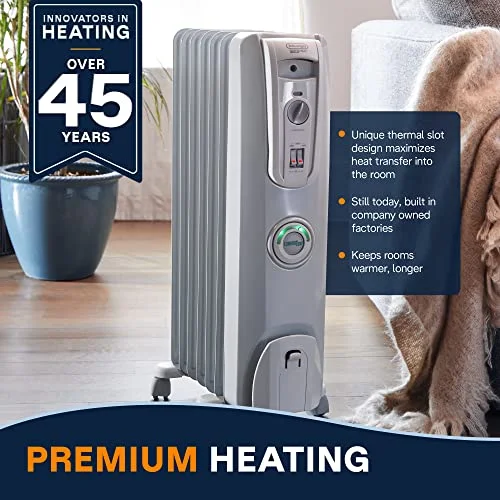
De’Longhi EW7707CM Oil-Filled Radiator
The fanless pick: nothing moving air, nothing to clean inside the unit
Oil-filled·1,500 Watt·Energy Saving·5.9 × 13.78 × 24.8 in
No fan, no intake grille, no filter — the oil-filled design heats by radiating warmth from steel fins into the room rather than pushing air across it, which means it does not disturb dust that's already settled on the floor or furniture. De’Longhi's listing describes an energy-saving design intended for full rooms like an office or bedroom, and the only maintenance the unit asks for is an occasional wipe of the fins, the same as any other metal furniture in the room. It is slower to warm a room than a fan heater, and it keeps radiating heat for a while after it's switched off.
The pick if dust and allergies are the deciding factor and you're willing to trade speed for a heater with nothing inside it to maintain.
02Best value fanless option
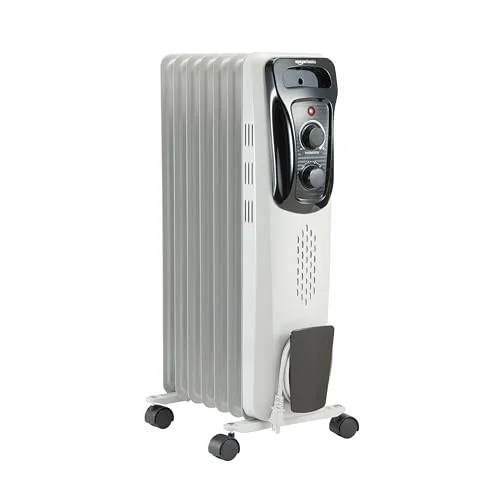
Amazon Basics Portable Oil Radiator Heater
The budget fanless pick: the same no-airflow approach for less
7 oil-filled steel fins·1,500 Watt·3 heat settings·ETL-certified
Seven oil-filled steel fins, three heat settings, tip-over protection and over-heat protection, ETL-certified — the same fanless mechanism as the De’Longhi above, built into an 11-inch deep, 14.8-inch wide, 25.2-inch tall white cabinet. There's no airflow path through this unit either, so the same dust-related argument applies: nothing inside it to filter or vacuum, and nothing pushing settled dust back into the air. The honest trade is the same one every oil radiator makes — it's a slower heater than anything with a fan, and the three heat settings are a coarser way to manage room temperature than a full digital thermostat.
If the De’Longhi's price is the obstacle, this is the same fanless approach at a lower cost.
03Best if you need faster heat
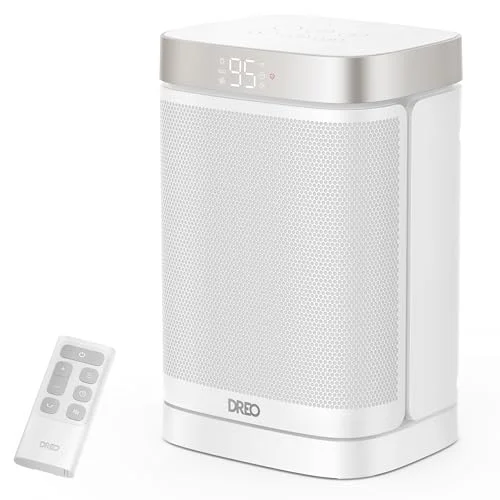
DREO Atom One Space Heater
The fan pick: built to reduce turbulence, not eliminate airflow
PTC ceramic·70° oscillating·Brushless DC motor·12-hour timer
A 1,500-watt PTC ceramic heater with a brushless DC motor and shaped blades, specifically engineered to cut the turbulence a conventional fan produces rather than eliminate airflow altogether. It's listed with a digital thermostat, a 12-hour timer and quiet operation, and it's the heater to reach for when an oil radiator's slower warm-up genuinely doesn't fit the room — a cold home office at 7 a.m., not a bedroom you're heating for hours. It still has an intake grille that will collect dust over the heating season and needs periodic wiping, the one maintenance step neither oil radiator above requires.
The one fan heater worth it here, for a dust-sensitive household that still needs speed over silence and stillness.
General information on allergies and indoor air
None of the above is medical advice, and none of it is a substitute for guidance from an allergist or a physician if dust sensitivity is a diagnosed condition in your household. What follows is general information about indoor air and heating appliances, offered for context, not as a treatment recommendation.
Indoor dust is a mix of things — skin cells, textile fibers, pet dander, pollen tracked in from outside and whatever settles out of the air over time — and it accumulates fastest on carpeted floors, upholstery and anywhere air doesn't circulate much. A space heater is one small part of a room's overall air movement, alongside a central HVAC system, open windows, ceiling fans and foot traffic. Reducing one source of air disturbance, such as a space heater's fan, is unlikely to be a complete solution on its own if carpets, bedding and HVAC filters aren't also part of a regular cleaning routine. Reasonable complements to a fanless heater, for a household managing allergies, include vacuuming with a sealed, HEPA-filtered vacuum, washing bedding regularly in hot water, and keeping central HVAC filters on a replacement schedule rather than letting them run past their rated life. None of that is specific to the products in this guide; it's the general household context a fanless heater fits into, not a replacement for it.
How we picked
We started from this site's own catalogue of space heaters and looked specifically for the two mechanisms that bear directly on dust and airflow: oil-filled radiators, which have no fan at all, and a fan heater whose own listing specifically addresses reduced turbulence rather than just oscillation or wattage. That filter is why this guide covers three products rather than a longer list — most fan heaters in the broader catalogue don't make a specific airflow-design claim worth repeating here, and we're not going to credit a generic ceramic tower with a dust-reduction benefit its listing doesn't claim.
How we compared
We compared the three heaters on their published titles, listed specifications and current Amazon prices. Where a product lists a specific mechanical detail — the Amazon Basics unit's seven oil-filled steel fins, the De’Longhi's energy-saving design and finished dimensions, the DREO's brushless DC motor and 70-degree oscillation — it comes directly from that product's own listing. Neither oil radiator lists a noise figure, and we treat that as a predictable consequence of having no fan rather than a gap in the data.
We do not run a testing lab. We have not placed any of these three heaters in a room and measured dust movement ourselves, and you will not find an invented particulate reading or an allergy-relief score anywhere on this page. We also don't show star ratings, review counts or paraphrased owner sentiment for these specific listings, because we don't have manufacturer-published figures for them — a limitation of the data available to us, not a judgment on the heaters themselves. Every claim above about dust and airflow is drawn from how each type of heater is mechanically built to move air, not from a review, a lab reading or a guess.
Frequently asked questions
Do space heaters make allergies worse?
A space heater doesn't create dust or allergens on its own. A fan heater can stir up dust that's already settled in a room and put more of it into the air you're breathing near the unit, for as long as the fan runs. An oil-filled radiator, which has no fan, doesn't do this — it heats by radiating warmth from oil-filled fins rather than moving air through the room.
Are oil-filled radiators actually better for dust-sensitive rooms?
Mechanically, yes: both the Amazon Basics Portable Oil Radiator Heater and the De’Longhi EW7707CM have no fan, no intake grille and no filter, so there's no mechanism inside either unit for moving or recirculating dust. The trade-off is speed — both warm a room more slowly than a fan heater, since there's no fan accelerating how fast the heat reaches you.
How often do I need to clean a fan heater's grille?
There's no universal schedule, but a reasonable habit is wiping down the intake grille with a dry cloth or a vacuum's brush attachment every few weeks during the heating season, more often in a home with pets or wall-to-wall carpet, always with the unit unplugged and cool. Oil-filled radiators like the two picks in this guide skip this step entirely, since neither has an airflow path to keep clear.
Is the DREO Atom One actually better for dust than a regular fan heater?
DREO's own listing describes a brushless DC motor with shaped blades built to reduce turbulence compared with a conventional fan motor, which should mean smoother, less disruptive airflow. It is still a fan heater, with an intake grille that will collect dust over a heating season, so it's a middle-ground choice — better than a generic fan heater for a dust-sensitive room, not equivalent to the fanless radiators above.
This page offers general information about indoor air and heating appliances. It is not medical advice. If dust sensitivity or allergies are a diagnosed condition in your household, talk to an allergist or physician about what's actually appropriate for your situation.
Related reading on circuits and rooms
If you're pairing a fanless radiator with a second heater elsewhere in the house, see one big heater or several small ones for the circuit math behind running more than one at once.
The same fanless logic applies in rooms with other moisture or air-quality concerns. If you're weighing a heater for a damp, enclosed space, is it safe to use a space heater in a bathroom? covers the GFCI rule and placement that matter there. And if the room in question is below grade, the best space heaters for a basement looks at the heaters rated to actually move air across a larger, damper space — useful context even though this guide's own picks are deliberately fanless. Either way, spending more than the basics doesn't automatically solve a dust problem; what the extra money over $100 actually buys is a useful reality check before assuming price alone fixes air quality.
Written by Ilane Tall. Research-based comparisons of published specifications, current prices and public product data — we do not physically test these units and we do not publish invented scores.