By Ilane Tall · Updated November 10, 2026 · Research-based.
Reader-supported: we may earn a commission when you buy through the links on this page, at no additional cost to you. It never changes which product we recommend. Prices quoted below were correct at the time of writing and move often.
Quick answer
Out of the three heaters covered here, only the DREO Smart Wall Heater ($110.49) actually answers to a phone app or a voice command — it supports Alexa and Google Home and lets you set a weekly schedule from your phone. The DREO Space Heater with Thermostat ($42.49) has a digital thermostat with a visible temperature setpoint, which is a real upgrade over a dial but is not the same thing as an app: there's nothing to install, pair or sign into. The DREO Space Heater with Remote ($39.99) is the baseline — a remote control and nothing more.
The honest framing: app control and Alexa support earn their price difference if you actually want scheduling — heat the bedroom before you wake up, without a timer countdown you have to reset by hand. If you just want to turn a heater on, set a number, and walk away, a digital thermostat already solved that problem for $85 less.
What “smart” means on a space heater, and what it doesn’t
The word "smart" gets attached to almost anything with a circuit board these days, and on space heaters specifically it's worth pinning down before spending more money on it. A smart space heater, in the narrow and accurate sense, is one you can control from somewhere other than the unit itself — a phone app over Wi-Fi, or a voice command through a connected speaker like Amazon Alexa or Google Home. That's the whole definition. It says nothing about how hot the heater gets, how it distributes that heat, or how safe it is to leave running.
What "smart" doesn't mean, on this page or anywhere in this category, is a heater that thinks for itself. None of these units learn your schedule, adjust automatically to outside temperature, or do anything an owner hasn't explicitly told them to do through a dial, a remote or an app. A digital thermostat that holds a number is not smart in this sense, even though it's a meaningful upgrade over a mechanical dial — it's still a control you set in the room, not one you set from your phone. A remote is not smart either; it's just a thermostat you can operate from the sofa instead of walking over to the unit.
That distinction matters because it's easy to assume a heater with a digital display and a sleek plastic housing has app control simply because it looks modern. On this page, exactly one of the three heaters does: the DREO Smart Wall Heater. The other two have real, useful controls — a remote, a digital thermostat — but neither one connects to Wi-Fi, and neither has an app to open. Checking the listing for the words "app," "Alexa," "Google Home" or "Wi-Fi" is the fastest way to find out which category a given heater actually belongs to, because "digital" and "programmable" get used loosely enough in this category to blur the line on their own.
The $130 wall heater: scheduling, app control, and Alexa or Google Home
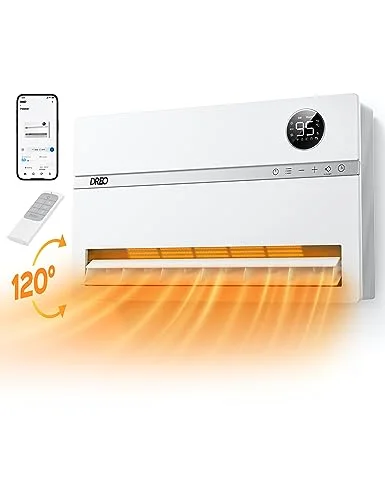
The DREO Smart Wall Heater is the one heater in this comparison that is actually smart by the definition above. It's a 1500-watt wall-mounted unit, built in white, and the listing states support for Alexa and Google Home alongside its own companion app. That combination buys three things a remote cannot: control from outside the room, voice control without touching anything, and a schedule that runs without you.
Control from outside the room is the most literal benefit. A remote only works if you're within line of sight of the receiver and have the remote in hand; an app over Wi-Fi works from the kitchen, the car in the driveway, or the office, which matters most on the specific day you leave the house and realize the heat is still running, or isn't running and you wanted it to be before you got home. Voice control through Alexa or Google Home removes the remote and the phone from the equation entirely — useful at the exact moment you're already in bed and don't want to get up or fumble for a device in the dark.
Scheduling is the feature that does the most actual work. Set a weekly schedule once — on at 6:00 a.m. before you're awake, off at 9:00 p.m. when you're not in the room — and the heater runs that pattern without a nightly reset. That's a materially different experience from a shut-off timer, which counts down and stops, full stop, regardless of what time it is or what day of the week. A schedule repeats; a timer doesn't.
Being wall-mounted changes the calculation too, separate from the smart features. A unit bolted to a wall at 1500 watts, in white, built for a bedroom, isn't something you unplug and move between rooms the way you would a tower or a remote-controlled portable — it's installed once, in the room where scheduling and voice control are actually going to get used daily. That's a reasonable pairing: the app and Alexa support matter most on a heater that lives in one place long enough for a weekly schedule to be worth setting up in the first place.
Installation is the part the listing doesn't spell out for you in the same way it does on a plug-in portable: a wall-mounted heater typically wants mounting hardware secured to a wall, not simply plugged in and set on the floor. Check the listing's own installation instructions and a stud before buying, since that's a different kind of setup than unboxing a tower heater and pressing a button — and if you're renting, putting a hole in a wall may not be an option at all; see our guide to the best space heaters for a rental apartment for portable picks that need no installation.
A digital thermostat is not an app: what the $50 model actually offers
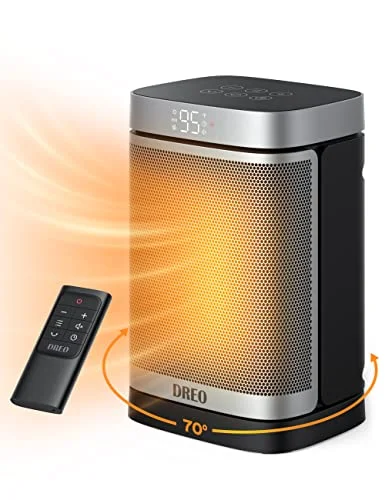
The DREO Space Heater with Thermostat, at $42.49, is the middle step in this lineup, and it's worth being precise about what that middle step is. "Thermostat" in this product's name refers to a built-in control that lets you set and hold a target temperature from the unit itself — a meaningful step up from a heater with only high/low heat settings, because it cycles the heating element to maintain a number instead of running flat out until you turn it off by hand. That's a real feature, and it's the reason this model costs about five dollars more than the remote-only version below it.
What it is not is an app. There's no Wi-Fi connection on this listing, no companion software to install, no Alexa or Google Home integration stated anywhere in the product data. You set the temperature at the unit, the same way you'd set a thermostat on a wall in any room that has one, and the heater holds that number until you change it or unplug it. That's the whole interaction. If what you actually want is to change the setting without walking to the heater, this model doesn't offer that — it's a thermostat heater, not a remote heater and not a smart heater.
The point worth making plainly: a digital display and a specific target temperature are often enough to make a heater feel modern, and they're genuinely useful for consistency — holding 68 degrees instead of oscillating between "too hot" and "off" is a real quality-of-life improvement over a basic dial. But a thermostat answering to a button on its own housing and an app answering to a phone from another room are two different products solving two different problems, and conflating them is how people end up disappointed that their "smart-looking" heater can't be turned off from bed.
A remote without an app: the $36 baseline
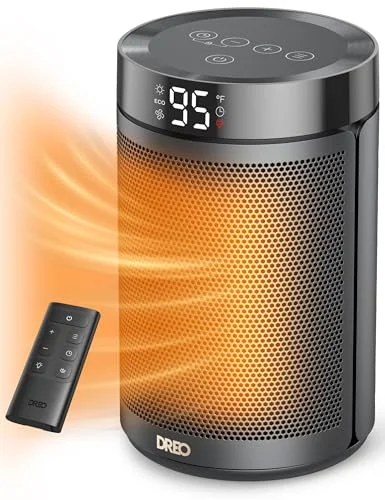
The DREO Space Heater with Remote, at $39.99, is the simplest of the three and the cheapest. The defining feature is in its own name: a remote control, and the standard features that go with a DREO portable heater at this price point, with no stated thermostat display, no app, and no voice assistant support.
A remote solves one specific inconvenience — not having to get up to change the setting — and solves it completely for the price. If the heater sits across a bedroom and you want to switch it off from under the covers without an app, a Wi-Fi connection, or a smart speaker in the room, a remote already does that job for less than a third of the wall heater's price. It does not solve the two things the wall heater solves: control from outside the room, and a repeating weekly schedule. Those require either an app, a voice assistant, or both, and this model has neither.
There's no shame in this being the right answer for a lot of households. A heater in a home office you're sitting in front of all day doesn't need to be scheduled or voice-controlled — you're right there. The remote removes the only real friction point that model has, which is walking across the room, and it does it for $90 less than the wall heater.
Where app control earns its price, and where it's a solved problem already
Put the three side by side and the pattern is less about which heater is "better" and more about which problem you actually have. Three different problems, three different price points, and the smart features only earn their premium when the problem they solve is one you'd otherwise be stuck with.
| Your situation | What actually helps |
|---|
| Want heat on before you wake up, every day, without resetting a timer | App scheduling — only the wall heater does this |
| Want to turn the heater off from another room or while you're out | App or Alexa/Google Home — only the wall heater |
| Want a steady, held temperature instead of on/off cycling by feel | A digital thermostat already does this, no app needed |
| Want to change the setting without walking across the room you're in | A remote already does this, no app needed |
App control and Alexa support earn their price specifically when the control problem is about distance or timing — being somewhere other than the room, or wanting the heater to act at a time you won't be around to trigger it. That's a genuinely unsolved problem for a remote-only or thermostat-only heater: a remote has a limited range and needs line of sight, and neither a remote nor a built-in thermostat can start a heater running before you've woken up to press anything.
Where it's a solved problem already: holding a steady temperature, and adjusting that temperature without crossing the room. Both of those are handled, respectively, by the $42.49 thermostat model and the $39.99 remote model, at a combined price still below the wall heater alone. If your actual complaint about space heaters is "I don't want to keep getting up to adjust it," you don't need Wi-Fi or Alexa to fix that — you need the $39.99 model you can buy today.
It's also worth being honest about diminishing returns here. A scheduling feature you set once and forget is worth $90 over a remote. A scheduling feature you never actually configure, because setting up an app and a weekly pattern is itself a chore, is worth nothing — you'd be paying for a feature sitting unused next to one you'd have used for a third of the price. Buy the smart tier because you'll use the schedule, not because the word "smart" sounds like the safer purchase. At $110.49 the wall heater also sits among the small group of heaters on this site that cross into three figures; our guide to space heaters over $100 covers the others and what each one's extra cost actually buys.
None of this touches footprint or reach, which is a separate axis worth checking before buying any of these three. A wall-mounted unit and a compact portable occupy a room very differently, independent of how smart either one is — see our comparison of tower versus compact space heaters if floor space or where the heat actually reaches matters as much to you as how you control it.
The picks
Three heaters, three control philosophies — not a ranked list, because the right one depends entirely on whether your problem is distance and timing, or just not wanting to get off the couch.
01Best for scheduling and voice control
DREO Smart Wall Heater
The only heater here with an app, Alexa and Google Home support
1500W·Wall-mounted·App + Alexa/Google Home·White, Standard
The only heater in this comparison that answers to a phone app or a voice command. It supports Alexa and Google Home, runs a weekly schedule set from the app, and can be checked on or switched off from outside the room entirely — three things no remote or built-in thermostat can do. Being wall-mounted suits that: it's installed once in the room you'll actually want scheduled, typically a bedroom, rather than carried between rooms. The honest caveat is the setup itself — wall mounting hardware and a Wi-Fi pairing step, against a portable you simply plug in.
The pick if you actually want the heat running before you wake up, without resetting anything by hand.
02Best for a steady, held temperature
DREO Space Heater with Thermostat
A real thermostat, no app — set a number at the unit and it holds it
Portable·Digital thermostat·No app / no Wi-Fi·Standard
A built-in digital thermostat that cycles the heater to hold a target temperature, instead of running at a fixed output until someone switches it off. That's a genuine upgrade over a basic high/low dial, and it's the reason to pick this over the $39.99 remote model if consistency matters more to you than remote range. What it doesn't have is anywhere in the listing: no stated Wi-Fi, no app, no Alexa or Google Home integration. You set it at the unit, not from your phone.
The pick if you want the room held at a number, and you're fine setting that number by hand.
03Best baseline, no app needed
DREO Space Heater with Remote
The cheapest control upgrade over walking to the unit
Portable·Remote included·No app / no thermostat display stated·10 inch
The baseline of this lineup: a remote, and nothing beyond it in the listing data — no stated thermostat display, no app, no voice assistant support. It solves exactly one problem, not having to get up to change a setting, and solves it completely for under forty dollars. If your room is small enough that you're always near the heater anyway, even the remote is a convenience rather than a necessity.
The pick if "smart" is solving a problem you don't have, and all you actually wanted was not to get off the couch.
How we picked
We looked specifically for heaters in our database marketed around their control method — app, Alexa/Google Home, digital thermostat or remote — rather than picking three heaters that differ mainly in wattage or cabinet style. All three happen to be from DREO, which made for a cleaner comparison of control tiers at similar build quality rather than a comparison muddied by brand differences; see our DREO model comparison if you want the fuller picture of how this brand's lineup differs beyond control method.
How we compared
We compared the three listings on their stated control features, published specifications and current Amazon prices. The DREO Smart Wall Heater's app, Alexa and Google Home support come directly from its own listing; neither of the other two states any app, Wi-Fi or voice-assistant feature, and we treat that absence as the listing's own answer rather than a gap we're guessing at. Price and wattage figures are pulled from the product database at the dates shown; prices move, so check the current Amazon price before buying.
We do not run a testing lab. We have not installed or operated any of these three heaters ourselves, so you will not find a claim here about how responsive the app actually feels or how reliably the Wi-Fi connection holds — neither is something a spec sheet tells you, and neither is something we're going to invent. We also don't show star ratings, review counts or paraphrased owner sentiment on this page, because we don't have manufacturer-published figures for these specific listings.
Frequently asked questions
Is a "smart" space heater actually worth the extra money?
It depends entirely on whether you need control from outside the room or a repeating schedule. If you do — heat on before you wake up, off while you're at work — the app and Alexa support on a model like the DREO Smart Wall Heater solve a problem a remote or a built-in thermostat genuinely cannot. If your only complaint is not wanting to get up to change a setting, a $39.99 remote-only heater already solves that for far less.
What's the difference between a digital thermostat and an app?
A digital thermostat is a control built into the heater itself: you set a target temperature at the unit, and it cycles to hold that number. An app is a separate piece of software on your phone that connects to the heater over Wi-Fi, letting you change settings from anywhere, including outside the room or the house. A heater can have one without the other — the DREO Space Heater with Thermostat has a thermostat and no app.
Do I need Alexa or Google Home for the smart wall heater to work?
No. The DREO Smart Wall Heater's app control works on its own over Wi-Fi without any smart speaker in the house. Alexa and Google Home support is an additional option for voice control, on top of the app, not a requirement for the heater's scheduling or remote features to function.
Can a remote-only heater be upgraded to app control later?
No. App and voice-assistant support depend on Wi-Fi hardware built into the heater itself; a remote-only model like the DREO Space Heater with Remote has no such hardware and can't gain that feature after purchase. If app control matters to you, it has to be a feature of the unit you buy, not something added afterward.
Written by Ilane Tall. Research-based comparisons of published specifications, current prices and public product data — we do not physically test these units and we do not publish invented scores.