By Ilane Tall · Updated November 14, 2026 · Research-based.
Reader-supported: we may earn a commission when you buy through the links on this page, at no additional cost to you. It never changes which product we recommend. Prices quoted below were correct at the time of writing and move often.
Quick answer
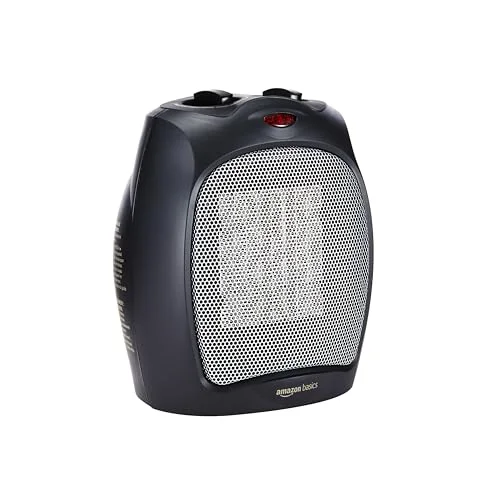
Before you buy anything, check your own housing policy — some campuses ban portable heaters entirely, with no exception for any product. Where heaters are allowed, the policy almost always comes down to three checks: an enclosed heating element (no visible glowing coil), a UL or ETL safety mark on the label, and a wattage at or under the campus cap, which is sometimes 1,500 watts and sometimes lower. The Amazon Basics Ceramic Space Heater ($20.69) clears all three at the smallest footprint of the three picks here, which also makes it the easiest to tuck under a desk during a room inspection.
If you want oscillation to spread the heat around a shared room, the JIBUFI 17-Inch ($37.98) and the DREO 10-Inch ($39.99) are both enclosed ceramic heaters at the same 1,500-watt draw. None of the three fixes the rule that actually gets heaters confiscated: you still can't plug one into an extension cord or a power strip, no matter how compliant the heater itself is.
Why many campuses ban space heaters outright, and what gets an exception
Space heaters show up near the top of US campus fire-safety statistics for a specific reason: a dorm room is a small space, often carpeted, usually cluttered with bedding, curtains and paper, with one person who may fall asleep with the heater running. The National Fire Protection Association has repeatedly flagged portable heating equipment as a leading cause of dormitory and residential fires, and most university housing offices write their rules with that history in mind rather than guessing at what's dangerous.
That's why the baseline policy at a large share of US colleges is a flat ban: no portable electric space heater of any kind, certified or not, in a residence hall room. If your school's housing agreement says this, it is not a technicality to work around — a compliant-looking heater is still a banned heater, and it will still be confiscated or fined the same as an uncertified one.
Where campuses do grant an exception, it is usually narrow and specific rather than "any UL-listed heater is fine." Common conditions include a documented medical need filed with disability services, a wattage cap well under the 1,500-watt consumer standard, a requirement that the unit have no exposed heating element, and a blanket ban on running it unattended or overnight regardless of the heater's own automatic shut-off. Some schools allow heaters only in specific building types — apartment-style suites with their own kitchens and smoke detectors, for instance, but not traditional hall-style dorms with a shared corridor and one building-wide fire alarm system.
The honest starting point, before any product recommendation on this page matters at all, is your own school's current housing or residence-life policy document, not a general assumption about what's reasonable. Policies change by year and sometimes by building.
Exposed coil versus enclosed element: the distinction a housing policy actually checks
Read enough campus fire-safety pages and one phrase recurs: "no exposed heating element" or "no visible coil." This is the single clearest technical line a resident advisor can check at a glance, which is exactly why it shows up in so many policies — it doesn't require reading a spec sheet, just looking at the heater.
An exposed-coil heater is the classic cheap space heater: a metal wire coil that glows orange when running, visible through a wire guard. It heats up fast and heats the air right around it efficiently, but that glowing coil can ignite anything that touches or falls against it — a sock drying nearby, a curtain blown by a fan, a stack of papers knocked off a desk. It's also the style of heater most associated with house and dorm fires in safety-office literature, which is why so many policies single it out by name rather than banning "heaters" generically.
An enclosed-element heater puts the heating mechanism — ceramic plates, a PTC element, or a sealed quartz tube — behind a solid housing or a fine mesh grille that a finger, a sock or a piece of paper genuinely cannot reach. The heater still gets hot and the housing can get warm to the touch, but there's no glowing wire exposed to the room. All three heaters on this page are built this way: the Amazon Basics Ceramic Space Heater, the JIBUFI 17-Inch, and the DREO 10-Inch are each enclosed ceramic-element designs, with no exposed coil visible anywhere on the unit based on their listed design.
If your school's policy specifically names "no exposed coils" or "ceramic/PTC only," an enclosed-element heater is the category you're shopping in regardless of which specific model you choose. If the policy is a flat ban on all space heaters, no heater design clears that bar.
UL and ETL marks: what an RA is looking for on the label
The second thing almost every campus policy that permits heaters at all will specify is a safety certification — usually written as "must be UL listed" or "UL or ETL certified," sometimes both named, sometimes just "a recognized safety certification mark." These are two separate independent testing organizations (Underwriters Laboratories and Intertek, which issues the ETL mark) that test electrical products against established safety standards and allow a physical mark to be printed on the unit and its packaging once it passes. Either mark, on its own, generally satisfies a policy that asks for "a safety certification" without naming one specifically — but check your exact policy wording, since a handful of schools name UL by itself.
What the mark actually tests is narrower than people assume. It verifies the unit as built and sold meets a baseline standard for things like fire resistance of internal components, protection against electric shock, and the presence of safety features like tip-over and overheat shut-off. It does not test how the heater performs in your specific room, how long the thermostat holds its setting accurately, or how it behaves after two years of being knocked around a dorm room. It's a baseline, not a guarantee the heater can't ever cause a problem — which is also why "UL listed" doesn't override a flat no-heaters policy.
Practically, an RA doing a room check is looking for the printed mark on the heater's label or base, not asking you to produce documentation. All three products in our picks below are sold as UL- or ETL-recognized through standard US retail channels for this product category; confirm the specific certification marking on the listing and the physical unit before you buy, since marks can vary by specific model revision and a housing office checking your room will be looking at the sticker on the heater itself, not the product page you bought it from.
Wattage caps, and why 1,500 watts is sometimes already too much
Nearly every portable electric space heater sold for a standard US wall outlet, dorm or otherwise, runs at roughly 1,500 watts — that's close to the practical ceiling of what a standard 120-volt, 15-amp residential circuit can deliver continuously. All three products on this page, the Amazon Basics Ceramic, the JIBUFI 17-Inch and the DREO 10-Inch, are built to this same 1,500-watt standard.
The wrinkle specific to dorms: some campus policies cap permitted heaters well below that 1,500-watt consumer default, sometimes at 1,000 watts or lower, specifically because dorm wiring and circuits are older, shared across more rooms per circuit than a typical house, and harder for a single resident to know the condition of. A heater that is perfectly safe and standard for home use can still exceed what a specific dorm building's electrical system, and therefore its housing policy, is rated to tolerate.
This is also where "the heater passed the UL test" and "the heater is allowed in your room" can diverge. A UL or ETL mark says the unit itself is built safely at its rated wattage. It says nothing about whether 1,500 watts is an acceptable load for the specific circuit your dorm room shares with four other rooms down the hall. If your policy states a wattage cap below 1,500, none of the three heaters here — or any standard off-the-shelf space heater we're aware of — will fall under it, and the honest answer in that situation is a different category of product entirely, such as a heated blanket or a small personal hand/foot warmer that draws a fraction of the current.
Read your policy's wattage number, if it states one, before assuming "UL listed and enclosed" is the whole checklist. It frequently is not.
No extension cords, no power strips: the rule that trips people up
This is the rule that catches people who did everything else right. A huge share of campus fire-safety policies, whether or not they ban heaters outright, explicitly prohibit plugging a space heater into an extension cord, a power strip, or a surge protector — it must go directly into a wall outlet. This isn't an arbitrary restriction stacked on top of the wattage and certification rules; it's addressing the same circuit-overload risk from a different angle, because an extension cord or power strip rated for a lamp and a phone charger is frequently not rated for the roughly 12.5 amps a 1,500-watt heater draws continuously, and a cord that overheats under that load is a fire risk independent of how safe the heater plugged into it is.
The reason this specific rule "trips people up," as much as any other dorm-heater rule, is that it's invisible at the point of purchase. Nothing on a space heater's product listing or packaging tells you not to use an extension cord — that instruction usually lives in the heater's printed manual in small print, and separately, explicitly, in your school's housing policy. A student can buy a fully compliant, UL-listed, enclosed-element heater, plug it into the power strip already running their desk setup because that's the only outlet within reach, and fail inspection for that reason alone, with a heater that would otherwise have passed.
The practical fix is almost always about room layout rather than the heater: identify a wall outlet near where you'd place the heater before you buy one, and plan to run it there directly. If no wall outlet is within reach of a safe heater placement — away from bedding, curtains, and foot traffic — that's a sign the room's layout doesn't support a space heater at all, independent of which model you were considering.
The picks
Three enclosed-element, 1,500-watt ceramic heaters, each UL- or ETL-recognized through standard US retail channels for this category — the differences between them come down to size, controls and whether you want the heat spread around the room or aimed in one direction. None of them overrides a flat no-heaters policy or a wattage cap below 1,500; check your own housing agreement first.
01Smallest footprint
Amazon Basics Ceramic Space Heater
The one to tuck under a desk during a room check
Ceramic, enclosed·1,500 Watt·Non-oscillating·7.52"D x 6.34"W x 9.45"H
At 7.52 by 6.34 by 9.45 inches, this is the smallest of the three picks by a wide margin — small enough to sit on a desk corner or the floor beside a nightstand without eating into the limited floor space a shared dorm room allows. It's a ceramic design with an enclosed element, a thermostat, and Amazon's own stated overheat and tip-over protection, non-oscillating, which means it heats whatever's directly in front of it rather than spreading warmth across a shared room. That directional, personal-heater character is the tradeoff for the smallest size and lowest price on this page.
The pick if floor space is the constraint and you mainly need to warm the desk or the bed, not the whole room.
02Best for a shared room
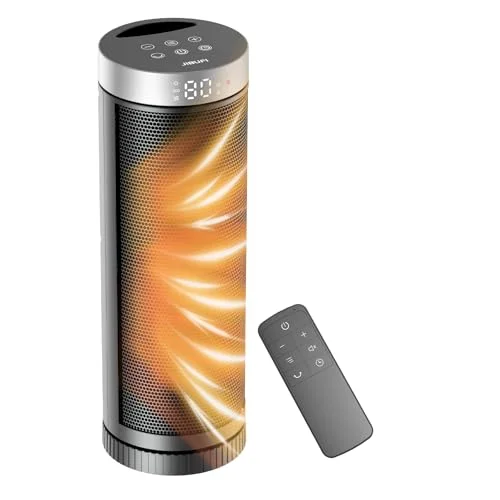
JIBUFI 17-Inch Space Heater
Oscillation spreads the heat if you have a roommate
Ceramic, enclosed·1,500 Watt·70° Oscillation·16.4-inch
At 16.4 inches with 70-degree oscillation, this is built to move warm air across more of a room than a non-oscillating personal heater can, which matters more in a dorm than in a studio apartment — most dorm rooms have two beds and two desks, and a heater that only warms one corner leaves a roommate out in the cold. It's the same 1,500-watt ceramic, enclosed-element design as the other two picks, just in a taller cabinet built around the oscillating mechanism. The taller footprint is the tradeoff for that wider reach; it takes up more visible floor or desk space than the Amazon Basics model during an inspection.
Buy it if the room has two occupants and one heater needs to do double duty.
03Best with a remote
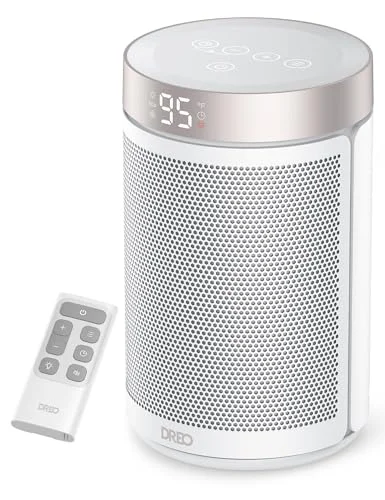
DREO Space Heater, 10-Inch, with Remote
Control it from bed without getting up on a cold floor
Ceramic, enclosed·1,500 Watt·Remote included·10-inch
A 10-inch portable ceramic heater that ships with a remote, which is a genuinely useful dorm-specific detail: adjusting or shutting the heater off from a bed across a small room, rather than crossing a cold floor to reach a unit tucked under a desk. It's the same 1,500-watt, enclosed-ceramic-element category as the other two picks here, sized between the compact Amazon Basics model and the taller oscillating JIBUFI. DREO doesn't state oscillation for this specific model in the listing data we have, so treat it as a fixed-direction heater unless the current listing says otherwise.
The pick if you want the heater running or off without leaving bed on a cold morning.
Reading your specific housing policy before you buy anything
Everything above describes the checks that recur most often across US campus housing policies — enclosed element, UL or ETL mark, a wattage figure, no extension cords or power strips — because those are the specific, checkable items a resident advisor or housing inspector can verify in thirty seconds standing in your doorway. None of it substitutes for reading your own school's current policy document, because the details genuinely vary by institution and sometimes by residence hall within the same campus.
Where to find the actual policy
Your school's housing or residence-life website, usually under a "community standards," "fire safety" or "prohibited items" page. The written agreement you signed when you moved in is the authoritative document, not a roommate's memory of last year's rule or a general internet search result about "college dorm heater rules."
What to check before buying
Whether heaters are permitted at all; whether a specific wattage cap is named; whether a specific certification mark is required by name; and whether there's a building-type exception (apartment-style versus traditional hall-style) that applies to your specific assignment.
If the policy is silent on heaters entirely — which does happen, especially at smaller schools without a detailed published fire-safety page — that's worth a direct email to your residence-life or housing office rather than an assumption either way. A heater that would be entirely reasonable in an apartment can still get confiscated, or worse, trigger a fire-code violation on your record, in a dorm where the answer turns out to be "we don't allow those, we just never wrote it down for this building."
And once a heater is permitted and sitting in your room: keep it on bare floor rather than a rug, away from bedding and curtains, running directly into a wall outlet, and off whenever you leave the room or go to sleep if your policy doesn't explicitly say overnight unattended use is fine. The certification mark and the enclosed element reduce risk; they don't eliminate the reasons dorm fire-safety policies exist in the first place.
How we picked
We looked specifically for enclosed-element ceramic heaters marketed for compact, personal-room use rather than large-room towers or cabinet-style units, since those are the form factor that fits both a dorm room's limited floor space and the "no exposed coil" language that shows up across campus policies. The three products here differ mainly in size and controls — compact and non-oscillating, taller with oscillation, and remote-controlled — while sharing the same enclosed-element, 1,500-watt design.
How we compared
We compared the three heaters on their published titles, available specifications and current Amazon prices. Where a spec isn't stated in the listing data we worked from — such as a specific oscillation angle for the DREO 10-Inch — we say so plainly rather than estimate one to fill a gap. Every size and price figure above comes directly from the product's own listing.
We do not run a testing lab. We do not own these three heaters and have not run them in a dorm room ourselves, so you will not find an invented decibel reading or a score out of ten anywhere on this page. We also don't show star ratings, review counts or paraphrased owner sentiment, because we don't have manufacturer-published figures for these specific listings — a limitation of the data available to us, not a judgment on the heaters themselves.
Frequently asked questions
Does a UL or ETL mark mean my college will allow the heater?
Not by itself. A UL or ETL mark verifies the unit meets a baseline electrical safety standard, and it's one of the most common requirements in campus policies that permit heaters at all — but it doesn't override a wattage cap, a flat no-heaters policy, or the rule against plugging into an extension cord or power strip. Check your specific housing agreement for every requirement it names, not just the certification.
Why do campuses specifically mention "exposed coils" or "exposed heating elements"?
Because a glowing exposed coil can ignite anything that touches or falls against it — a sock, a curtain, a stack of papers — and that style of heater is strongly associated with residential and dormitory fires in fire-safety office literature. An enclosed ceramic or PTC element gets hot but has no exposed glowing wire, which is why policies that allow any heater at all almost always require this specific design.
Can I run my space heater on a power strip if the heater itself is UL listed?
Almost certainly not under most campus policies, and it's a bad idea even where it's not explicitly banned. A 1,500-watt heater draws roughly 12.5 amps continuously, more than most power strips and extension cords rated for everyday electronics are built to carry, independent of how safe the heater itself is. Plug it directly into a wall outlet.
What if my dorm's wattage cap is lower than 1,500 watts?
Then none of the standard off-the-shelf space heaters on this page, or any typical consumer space heater we're aware of, will meet that cap — nearly the entire category is built around the same roughly 1,500-watt ceiling. In that situation, the honest answer is a different category of product, such as a low-wattage heated blanket or a small personal hand/foot warmer, rather than searching for a space heater that technically fits a number this category generally doesn't go below.
Written by Ilane Tall. Research-based comparisons of published specifications, current prices and public product data — we do not physically test these units and we do not publish invented scores.