By Ilane Tall · Updated November 17, 2026 · Research-based.
Reader-supported: we may earn a commission when you buy through the links on this page, at no additional cost to you. It never changes which product we recommend. Prices quoted below were correct at the time of writing and move often.
Quick answer
All three heaters here use infrared quartz elements, run at the same 1,500 watts, and warm surfaces directly rather than heating the air with a fan first — they differ almost entirely in how many features are built around that core element. The BLACK+DECKER BHTI06 ($53.99) is the entry point: an infrared radiant quartz tower with an adjustable thermostat and 2 settings, nothing more. The WEWARM ($56.09) is the mid-tier pick, with 6 quartz elements, an ECO mode, a child lock, a 12-hour timer and a remote — and it's actually the cheaper of the two, which is worth noting before you assume price tracks features in this category.
The outlier is the DR. INFRARED HEATER DR-998 ($145.55), which pairs its infrared quartz element with a second heating element and adds a built-in humidifier, oscillation and wheels. It's the one to read about clearance and glow before buying, and the one that makes the case for when a fan heater still beats infrared.
What infrared quartz actually warms — and what it leaves cold
A quartz infrared heater works by running an electric current through a quartz tube wrapped around (or containing) a resistive element, which glows and radiates heat the way a toaster element or a bar heater does, just at lower intensity and spread across multiple tubes. That radiant energy travels in a straight line and is absorbed directly by whatever it hits first — your skin, a sofa cushion, a rug, a cat — and starts warming it on contact. It doesn't need to raise the temperature of the air in the room first, which is why infrared heaters have a reputation for feeling warm almost the instant they switch on: the sensation of heat and the heater turning on happen close together, because the mechanism skips a step a convection heater can't skip.
That same mechanism is also the honest limit of the category. Radiant heat only warms what's in its line of sight. Step behind a chair, sit at an angle to the unit, or occupy the far side of a room from where the heater is aimed, and the air around you hasn't been meaningfully changed — you're simply outside the beam. A ceramic or PTC fan heater is slower to feel but eventually raises the air temperature of the whole room it's in, including the parts nobody is facing. Infrared trades that slow, room-wide coverage for speed in one direction.
This also means a stated thermostat range doesn't quite measure the thing you feel. The WEWARM lists a 50–90°F thermostat, reading ambient air temperature, even though the heat you notice is radiant and hits you before the air near the sensor has caught up. Treat the thermostat as a way to stop the unit from running unattended at an extreme, not as a description of how warm you'll feel in front of it — that comes down to distance and angle, not degrees on a dial.
Entry-level: one or two elements and a simple thermostat
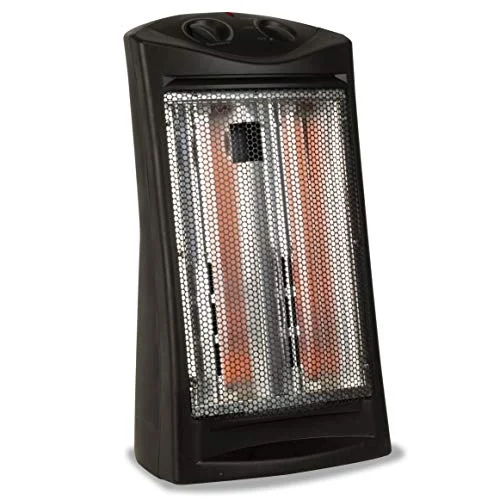
The BLACK+DECKER Infrared Radiant Quartz Tower Heater (BHTI06) is the plainest heater of the three, and it doesn't pretend otherwise. The listing states an adjustable thermostat and 2 settings, full stop — no timer, no remote, no child lock, no oscillation. It's built and marketed as a personal space heater for home and office, which fits the feature list: this is a heater you place near one chair or one desk, adjust once between its two settings, and leave alone.
What it does include is safety overheat protection, which every heater on this page states in some form, and that matters more for a unit this simple than a longer feature list would. A heater with two settings and a thermostat has fewer things to go wrong, and fewer things to forget to check before you leave it running. The tradeoff is also plain: without a timer, it keeps running until someone switches it off, and without a remote, that someone has to get up and do it by hand.
At $53.99, it's priced in the middle of this group despite having the shortest feature list — a reminder that "entry-level" here describes the control panel, not necessarily the receipt. If a simple tower with one thermostat dial is genuinely all you want, the BHTI06 doesn't ask you to pay for anything beyond that; if you'd use a timer or a remote even occasionally, it's worth comparing against the next heater before you commit.
Mid-tier: more elements, an ECO mode and a child lock
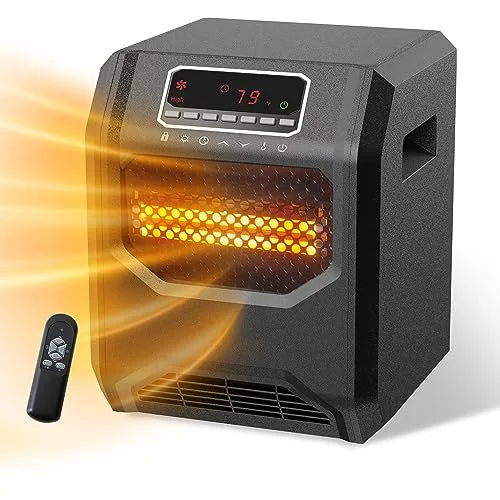
The WEWARM Infrared Space Heater sits a clear step up in stated features: 6 quartz elements against the BLACK+DECKER's unstated count, a 50–90°F thermostat, a 12-hour timer, a handheld remote rather than app or voice control, overheat and tip-over protection, and a child lock on top of an ECO mode. That's a meaningfully longer list for $56.09 — cheaper than the simpler tower above it, which is the kind of mismatch between price and feature count that's worth flagging rather than assuming away. Tier, in this category, tracks what a listing states, not what it costs.
ECO mode on a resistive heater like this typically means the unit cycles its output to hold a target temperature rather than running at full draw continuously — trading a little of that instant-on immediacy for lower running cost over a long session. It's a reasonable mode to leave on for a heater that's going to run for hours in an occupied room, and one to turn off if you want the fastest possible warm-up in a cold room you just walked into.
The child lock is a control-panel feature, not a heat-output feature: it disables the buttons so a setting can't be bumped by accident, which matters more in a household with kids or pets than it does to the heat itself. Paired with tip-over and overheat protection, it's the kind of spec that shows up on a mid-tier unit specifically because the brand is trying to cover more households with one SKU, including ones a bare two-setting tower wasn't designed for. The listing notes a "Middle" size variant; if the physical footprint matters to your space, check the current listing for the exact dimensions of that variant rather than assuming it matches either of the other two heaters here.
The outlier: dual heating plus a built-in humidifier
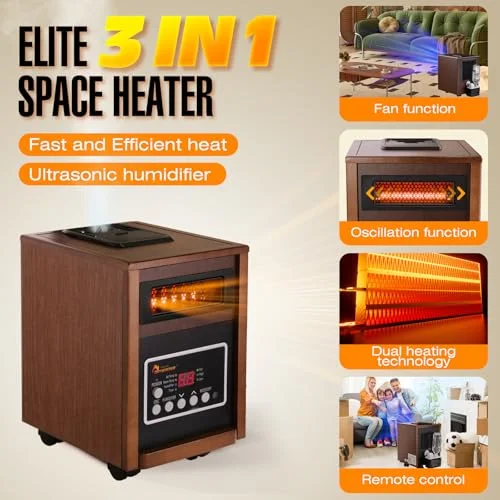
The DR. INFRARED HEATER DR-998 is a different kind of product rather than simply a higher tier of the same one. It pairs its infrared quartz element with a second heating element — the listing calls it "dual heating" without specifying the second element's technology, so that's as far as we'll describe it — and adds oscillation, a remote, a thermostat, wheels for moving it around a floor, and a built-in humidifier. At $145.55 it's priced well above the other two, and the feature list explains most of that gap.
The humidifier is the feature that sets it apart from almost everything else in this category. Any heating appliance that runs for hours in a closed room tends to lower the relative humidity of that room's air, simply because warmer air holds more moisture at the same absolute water content, which reads as drier to your skin and sinuses even though nothing was physically removed from the air. Building a humidifier into the cabinet is a direct answer to that specific side effect, rather than a feature bolted on for the spec sheet. It's worth noting as a convenience rather than a health claim: we're describing what a humidifier does generally, not making a promise about your specific room or symptoms.
Oscillation on this unit does real work that the other two heaters here can't do: it sweeps the quartz element's radiant beam across an arc instead of holding it fixed, which partially answers the directional limit described above by spreading "in the beam" across more of the room over time, even though any single moment still only warms whatever the heater happens to be facing. The wheels make sense once you account for the rest of the cabinet — a second heating element, a humidifier tank and an oscillation motor add real weight, and a unit this equipped is meant to be rolled between rooms rather than carried. "Energy efficient" appears in the title; we can't verify that claim beyond the stated 1,500-watt draw, so take it as marketing language rather than a tested figure. The "With Humidifier" variant is what's priced here — check the current listing if you're comparing it against a version without one.
The picks
Three heaters, three tiers of the same underlying technology — not a ranked list, since which one is "best" depends entirely on how many features around the quartz element you actually want to pay for.
01Best entry-level
BLACK+DECKER Infrared Radiant Quartz Tower Heater
The simplest pick: a thermostat, 2 settings, nothing else
Infrared radiant quartz·1,500 Watt·Adjustable thermostat·2 settings · overheat protection
A personal-sized quartz tower built around an adjustable thermostat and two settings, with safety overheat protection and nothing to configure beyond that. There's no timer and no remote, so it's a heater you set once near one chair or desk and switch off by hand when you're done. For anyone who finds timers and app controls more fiddly than useful, that's a feature, not a gap.
The pick if you want quartz heat at one desk or one chair and don't want a control panel to learn.
02Best mid-tier
WEWARM Infrared Space Heater
Six quartz elements, an ECO mode and a child lock — for less than the simpler tower
6 quartz elements·ECO mode·Child lock·12H timer · remote · 50–90°F thermostat
Six stated quartz elements, a 12-hour timer, a remote, overheat and tip-over protection, a child lock and an ECO mode for cycling output on longer sessions — a long feature list for a heater priced below the simpler tower above it. The child lock and tip-over protection are the two specs that matter most if the heater is going to run in a room with kids or pets around it. The listing's "Middle" size variant is the one priced here; confirm the current dimensions if your space is tight.
The pick if you want the control features — timer, remote, child lock — without paying the outlier's price for a second heating element.
03The outlier
DR. INFRARED HEATER DR-998
Dual heating, oscillation and a built-in humidifier, on wheels
Dual heating infrared·Built-in humidifier·Oscillation·Remote · thermostat · wheels
A second heating element alongside the infrared quartz tube, a built-in humidifier to counter the air-drying effect of hours of continuous heating, oscillation to spread the radiant beam across an arc instead of holding it fixed, and wheels to move the whole cabinet between rooms. It's the priciest heater here by a wide margin, and the feature list is the reason — this is a heater built to be the only one running in a room for a long session, not a quick supplementary boost.
The pick if you want one heater to handle warmth, air-drying and room coverage at once — and you're buying the "with humidifier" variant on purpose.
Clearance and glow: what sits in front matters more than with a ceramic heater
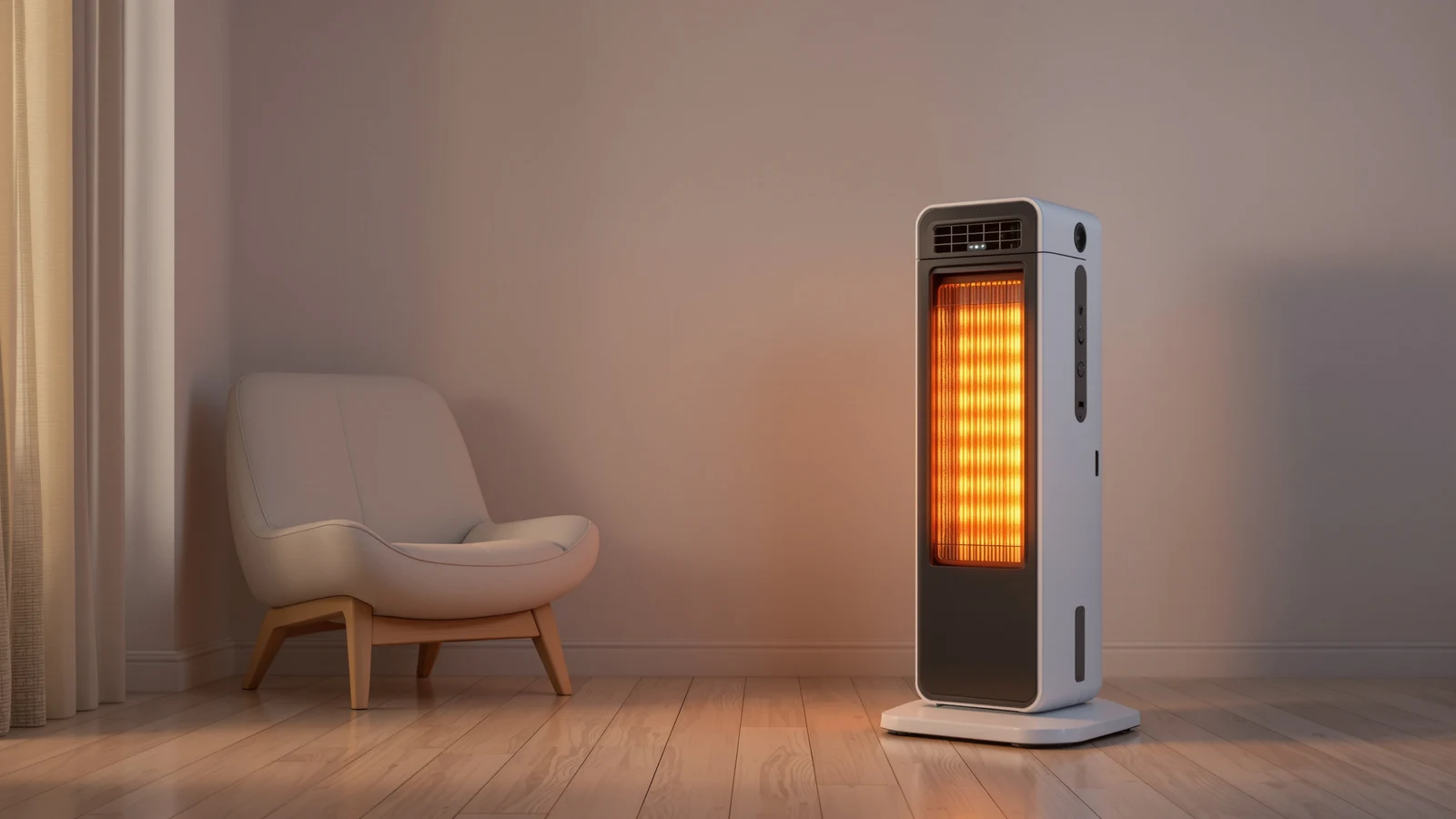
Quartz infrared elements typically glow visibly while running — a warm orange line behind the safety guard, visible across a dark room — in a way a ceramic or PTC element usually doesn't. That glow isn't just cosmetic; it's a direct sign of where the radiant energy is actually being aimed, which makes clearance a slightly different question than it is for a fan heater. With a convection heater, clearance is mostly about not blocking the air intake and exhaust. With a quartz heater, it's also about not pointing a sustained beam of radiant heat at anything that shouldn't be warmed directly — a nearby curtain, a pet bed placed too close, upholstery pushed right up against the grille.
All three heaters here state overheat protection, and the WEWARM and DR-998 add tip-over protection on top of that, which matters because these shut-offs are a backstop for a fault condition, not a substitute for sensible placement. None of that protection changes where the glowing element is pointed while the unit is running normally. The basic rule holds across all three: give the heater the clearance stated in its own manual, keep it on a stable, level surface, and don't place anything — furniture, bedding, a pet, a person who's fallen asleep — directly in the beam at close range for an extended period.
The glow is also worth a thought for overnight placement. A quartz heater running in a bedroom puts out a steady orange light a ceramic tower doesn't, which some people find useful as a low night light and others find distracting enough to angle the unit away from the bed. That's a comfort preference, not a safety spec, but it's a real difference from the ceramic and oil-filled heaters elsewhere in this category.
Where infrared loses to a fan heater: an empty corner of the same room
Take the directional limit from earlier and push it to its edge case: a corner of the room nobody is sitting in. A fan-driven ceramic or PTC heater, left running long enough, eventually raises the air temperature throughout the space it's in, including a corner no one occupies — because it's heating the air itself, and air moves and mixes on its own. A quartz infrared heater, even the DR-998 with oscillation sweeping its beam across an arc, is still only warming what the beam currently touches. Point any of the three heaters here away from a corner, or simply don't aim the sweep that far, and that corner stays close to ambient temperature no matter how long the unit runs.
This isn't a flaw in these three heaters specifically — it's the fundamental tradeoff of the category versus a fan heater, and it's worth deciding on before you buy rather than after. If the goal is bringing an entire room's air up to a comfortable temperature, including parts of it you're not currently sitting in, a convection or fan-assisted heater does that job more completely, just more slowly. If the goal is feeling warm fast at one chair, one desk, or one side of a bed, quartz infrared is built specifically for that and a fan heater will feel comparatively slow to get there. Two different jobs; neither heater type does both equally well, which is also the logic behind pairing heaters instead of upgrading to one bigger unit if a single room genuinely needs both kinds of coverage.
How we picked
We started from our own database of space heaters listed for sale in the US and filtered specifically for units built around an infrared quartz element, rather than ceramic or PTC heaters that simply use "infrared" as a marketing word. The three products here were chosen to represent three distinct feature tiers around that same core element — a bare two-setting tower, a mid-range unit with a longer control feature list, and a higher-end cabinet that adds a second heating element and a humidifier — rather than three near-identical towers that differ only in color.
How we compared
We compared the three heaters on their published titles, stated specifications and current Amazon prices. Every spec cited above — the WEWARM's 6 quartz elements, 12-hour timer and thermostat range; the BLACK+DECKER's 2 settings; the DR-998's dual heating, humidifier, oscillation and wheels — comes directly from the product's own listing. Where a listing didn't state a figure, such as the BLACK+DECKER's quartz element count, we said so rather than estimate one to fill the page.
We do not run a testing lab. We do not own these three heaters and have not run them ourselves, so you won't find an invented decibel reading or a score out of ten anywhere on this page. We also don't show star ratings, review counts or paraphrased owner sentiment, because as with the rest of this catalogue, we don't have manufacturer-published figures for these listings.
Frequently asked questions
Does an infrared quartz heater warm the room, or just me?
Mostly you, or whatever else sits directly in front of it. A quartz element radiates heat in a straight line and warms whatever that beam hits first — skin, furniture, a rug — without needing to heat the surrounding air the way a fan-driven ceramic heater does. That's why it feels warm almost immediately, and also why anything outside the beam, including an empty corner of the same room, stays close to ambient temperature no matter how long the heater runs.
What's actually different between the entry-level and mid-tier heaters here?
Mostly the control panel, not the core heat. The BLACK+DECKER BHTI06 offers an adjustable thermostat and 2 settings and nothing more. The WEWARM adds a stated 6 quartz elements, a 12-hour timer, a remote, a child lock and an ECO mode for the same underlying infrared quartz technology — and it's priced lower than the simpler tower, so a longer feature list here doesn't necessarily mean a higher price.
Why does the DR-998 include a humidifier?
Running any heater for hours in a closed room tends to lower the room's relative humidity, since warmer air can hold more moisture at the same absolute water content, which reads as drier even though nothing has been removed from the air. A built-in humidifier is a direct answer to that specific effect rather than an unrelated bonus feature, which is why it's paired with the DR-998's longer runtime profile rather than the simpler, shorter-session heaters above it.
Is the visible glow from a quartz heater a safety concern?
The glow itself is normal operation, not a fault — it's a direct sign of where the element is radiating heat. It does mean clearance is a slightly different question than with a ceramic heater: keep curtains, bedding, pets and furniture out of the direct beam at close range, follow the clearance distance in the unit's manual, and treat the overheat and tip-over protection every heater here states as a backstop for a fault condition, not a reason to skip sensible placement.
Written by Ilane Tall. Research-based comparisons of published specifications, current prices and public product data — we do not physically test these units and we do not publish invented scores.