By Ilane Tall · Updated November 2, 2026 · Research-based.
Reader-supported: we may earn a commission when you buy through the links on this page, at no additional cost to you. It never changes which product we recommend. Prices quoted below were correct at the time of writing and move often.
Quick answer
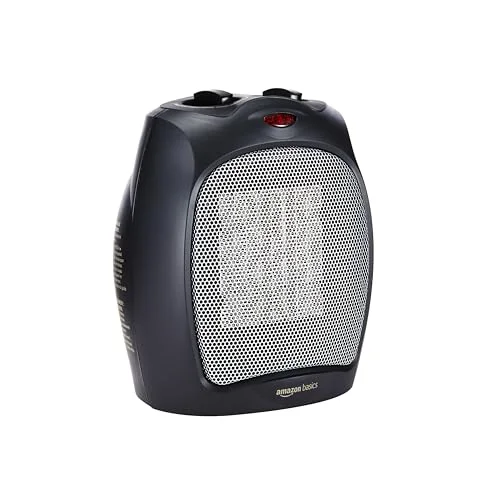
A tower and a compact cube can draw the same power and still solve different problems. A tower, like the Lasko 751320 ($59.49) or the PELONIS 23” ($59.49), stands tall on a narrow base and sweeps heat across a room — the right shape when more than one seat needs to feel the difference. A compact cube, like the Amazon Basics 1,500W Ceramic ($20.69), sits under a desk or beside a chair and warms whatever is in front of it — the right shape when there's one spot to heat and not much floor to give up.
Choosing on floor space alone, the cube wins by a wide margin: its footprint is smaller than a hardback book. Choosing on room coverage, the tower wins just as clearly. The tip-over question is where the two shapes trade places unexpectedly, and it's worth reading before buying either one.
Same wattage, two different shapes
Start with the number that doesn't actually separate these heaters, because it's tempting to assume a taller unit must be more powerful. The Amazon Basics Ceramic Space Heater states 1,500 watts directly in its listing — the practical ceiling for a plug-in heater on a standard US wall outlet, running 120 volts at 15 amps. At 1,500 watts, that's roughly 12.5 amps, close enough to the circuit's rated limit that it wants an outlet of its own rather than one shared with a microwave or hair dryer.
Neither the Lasko 751320 nor the PELONIS 23” states a wattage figure in the listing data we worked from, and we're not going to invent one to fill the gap. Both are indoor, plug-in tower heaters built for the same US wall outlets as the Amazon Basics cube, and nothing in either listing suggests an exception to how this category is built. Treat 1,500 watts as the reasonable working assumption for any full-size plug-in tower unless its listing states otherwise, and treat the absent figure as a gap in the data, not a claim either way.
The practical point: if all three heaters draw roughly the same wattage, the cube isn't weaker and the towers aren't stronger. They're the same fixed amount of heat, delivered through two different shapes. Everything below is about what each shape does with the watts it's given, not which one has more of them.
A tower's reach versus a cube's focus
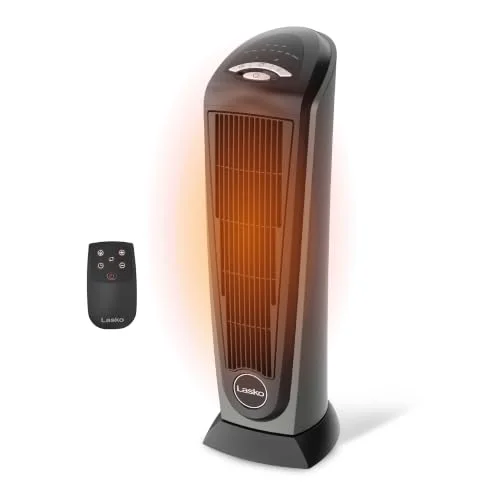
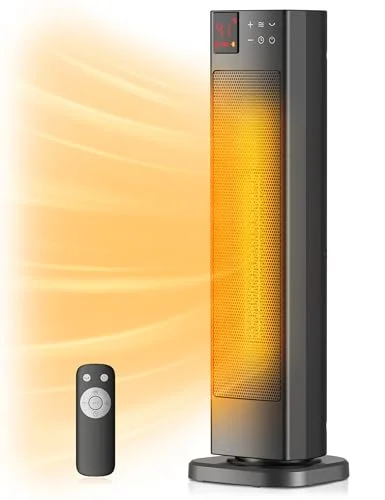
A tower's entire design exists to move air. The Lasko 751320 is built around a self-regulating ceramic heating element inside a tall, narrow cabinet with a fan that pulls air in and pushes it back out across the room, and it oscillates, sweeping that output side to side rather than holding it in one direction. The PELONIS 23” follows the same basic layout — a ceramic tower with an oscillating base — bundled with a timer and remote so the sweep, and the shut-off, can be set without getting up. Height is the point: a tower's outlet sits well above a coffee table or an ottoman, so the warm air it pushes clears furniture that would block a low unit sitting on the floor.
The Amazon Basics cube does the opposite on purpose. It's non-oscillating, built with a thermostat so it cycles on and off to hold a set temperature rather than running flat out, with no sweep motor because it isn't designed to reach across a room. Aimed at a chair or the space under a desk, it keeps heat exactly where you pointed it instead of spreading it thinner across a wider arc. A tower spreads a fixed 1,500 watts over more air, so less of it reaches any single point; a cube concentrates the same wattage on one spot, so it does nothing for anywhere else in the room.
Neither approach is more efficient — they're solving different problems with an identical energy budget. A tower suits a room with more than one occupied seat, where an even temperature matters more than a fast result in any one spot. A cube suits exactly one spot that needs to feel warmer, with the rest of the room beside the point. Our guide to space heaters with a real thermostat covers why the cube's cycling, rather than running at full output continuously, is what holds a set temperature instead of overshooting it.
Floor space: what each one actually occupies
This is the spec that rarely makes it into a buying decision until the heater is already home and the room turns out smaller than expected. The Amazon Basics cube measures 7.52 inches deep by 6.34 inches wide by 9.45 inches tall — a footprint that fits on a corner of a desk, tucked beside a monitor stand, or under a chair without touching anyone's feet. It is, by a wide margin, the smaller object of the three, and it's the one you can genuinely forget is there until it switches on.
The Lasko 751320's own listed size is 22.5 inches, and the PELONIS 23” lists its size as a 23-inch, Premium variant — both towers standing just under two feet tall. What that height buys is a narrow base: a tower occupies less floor-level square inches than its height suggests, because nearly all of its bulk is stacked vertically rather than spread across the carpet. That's the trade a tower makes for its reach — more vertical presence, less actual floor contact than its height makes it look like it needs.
Where the two shapes genuinely differ is clearance, not contact patch. A cube needs almost no clearance beyond basic airflow, because nothing about it moves or extends. A tower needs open floor around its base that nobody's foot catches walking past, plus vertical clearance so curtains or shelving aren't within its airflow path. In a tight RV galley or a studio apartment where every square foot is assigned, that clearance is worth measuring before a 23-inch tower arrives — our guide to space heaters for RVs and small spaces covers which shape tends to win in rooms that size.
Tip-over risk and footprint are related
It's reasonable to assume the taller object is the more precarious one, and in absolute terms a 23-inch tower has more height to fall from than a 9.45-inch cube. But tip-over risk isn't really about height on its own — it's about the relationship between height and the width of the base holding it up, and that relationship doesn't favor either shape automatically.
A tower's narrow footprint is exactly what makes a wide, low base necessary, and both the Lasko and the PELONIS are built on bases proportioned for the height above them, standard practice across this product category rather than a feature specific to either model. Neither listing states a tip-over protection feature explicitly, so we won't claim one that isn't confirmed — check the current listing if that safeguard matters to your household.
The Amazon Basics cube takes the opposite path to the same goal: it states overheat and tip-over protection directly in its listing, and its low center of gravity means less distance to fall even if something knocks it over. A short, squat object close to the floor is mechanically harder to topple, and easier to right again if it does go over.
A tower's risk is about contact, not height
A tall, narrow base standing in a walkway or beside a curtain is more likely to get bumped, caught on a cord, or clipped by a pet running past than a low object tucked against a wall — the floor space it occupies determines how often it's in the way, not just how far it could fall.
A cube's risk is about reach, not stability
A compact unit sitting close to the floor is hard to tip, but it's also easy to leave within reach of small hands or a curious pet precisely because it looks unthreatening and sits at floor level — the footprint that makes it stable is the same footprint that puts it within easy reach.
Footprint changes the kind of incident each shape is prone to, not which one is categorically safer. A household with pets that dart between rooms has more to think about with a tower standing in a walkway than a low cube tucked under a desk; our guide to space heaters for homes with pets covers the placement habits that matter more than the shape. A toddler who can reach anything at floor level is the opposite concern — a cube at hand height isn't automatically safer just because it's smaller.
Which shape suits which room
Put the wattage, the reach and the footprint together, and the decision mostly comes down to how many people are in the room and how much floor you're willing to give up.
Choose a tower when
More than one seat needs to feel warmer, the room is open enough that a sweep clears furniture, and there's a strip of floor near a wall or corner not doing anything else — a living room, a shared bedroom, or any space you walk through rather than sit in.
Choose a compact cube when
There's exactly one spot that needs heat — a desk chair, a reading chair, the side of a bed — floor space is already spoken for, or the room is small enough that a tower's sweep would just heat a wall. A desk, a dorm room or a workbench are the obvious cases.
There's a middle case worth naming: a home office that's a genuine small room rather than a desk nook. There, the cube's thermostat lets it cycle and hold a temperature across a space bigger than one chair, without a tower's footprint or sweep motor. A garage or workshop runs the opposite way — open floor plans and drafts a cube's focused output can't cross, closer to tower territory; our guide to space heaters for a garage or workshop covers that case. If the question is really budget rather than shape, both towers here sit in the same $50–$100 bracket covered by our guide to heaters between $50 and $100.
The picks
One cube, two towers — not a ranked list, since the better pick depends entirely on which problem you're solving, not on which heater is objectively stronger.
01Best compact cube
Amazon Basics Ceramic Space Heater
The focus pick: small footprint, one spot heated well
1,500W·Thermostat·Non-oscillating·7.52"D × 6.34"W × 9.45"H
A squat ceramic cube that states its 1,500 watts directly in the listing, with a thermostat that cycles the unit on and off to hold a temperature rather than running flat out. Non-oscillating means the heat stays exactly where you aim it — built to warm the person in front of it, not the room around them. Overheat and tip-over protection are both stated features, and the footprint is small enough to sit under a desk or beside a chair without stealing floor space you need for something else.
The pick if you have one chair to heat and not much floor to spare doing it.
02Best tower overall
Lasko 751320 23-inch Ceramic Tower
The reach pick: a narrow base built to sweep across a room
Ceramic, oscillating·Remote included·22.5" tower·Self-regulating element
A self-regulating ceramic tower, listed at 22.5 inches, that oscillates to spread its output across a room rather than holding it in one direction. The remote covers controls you'd otherwise walk over and adjust by hand, which matters more for a tower usually placed farther from where you're sitting. Its narrow stance means it occupies a small patch of floor relative to its height — the trade this shape makes for reaching further than a cube ever could.
The sensible default if you want a tower and don't want to compare oscillation specs any further.
03Best tower with a timer
PELONIS 23” Oscillating Ceramic Tower
The set-and-forget pick: the same reach, with a shut-off built in
Ceramic, oscillating·Timer & remote·23-inch, Premium variant·Tower
The same basic tower layout as the Lasko — a ceramic element in a 23-inch oscillating cabinet — with a built-in timer bundled alongside the remote. That timer separates it from a tower you have to remember to switch off yourself: set it once and the unit shuts down on its own. Our guide to space heaters with a remote control covers whether that convenience is worth the price difference over a model without one.
The pick if you want a tower's reach but don't want to be the one responsible for switching it off.
One more note before any of these three: the shape question only matters once the room is sized correctly for a 1,500-watt heater in the first place. A cube and a tower both struggle the same way in a room too large for either one's wattage — a separate problem from footprint. Our guide to how many watts your room actually needs covers that arithmetic before the shape decision.
How we picked
We started from our own database of space heaters listed for sale in the US and looked for products that represent the two dominant plug-in shapes in this category — a tall oscillating tower and a compact, low-profile cube — rather than three near-identical units differing mainly in color. We included two towers rather than one because the gap between them, a built-in timer versus none, is a real purchase decision within the shape itself, not just between shapes.
How we compared
We compared these three on their published titles, listed specifications and current Amazon prices. Where a figure is specific — the cube's 1,500 watts and dimensions, the Lasko's 22.5-inch listed size, the PELONIS's 23-inch Premium variant and bundled timer — it comes directly from the product's own listing. Neither tower states a wattage or tip-over protection figure in the data we worked from, and we say so above rather than estimate one to fill the gap.
We do not run a testing lab. We have not stood these three heaters side by side and measured how far their heat travels, so you won't find an invented reach figure or a score out of ten here. We also don't show star ratings, review counts or paraphrased owner sentiment, because we don't have manufacturer-published figures for these listings — a limitation of the data, not a judgment on the heaters.
Frequently asked questions
Does a tower heater actually warm a room faster than a compact cube?
Not necessarily faster — differently. Both shapes typically draw the same roughly 1,500 watts, so neither produces more raw heat. A tower spreads that output across more air through oscillation, taking longer to raise temperature anywhere specific but eventually reaching more of the space. A cube concentrates the identical wattage on one spot, so the chair or desk in front of it warms up sooner, while the rest of the room doesn't change at all.
Is a tower or a compact heater more likely to tip over?
Neither shape is automatically safer. A tower's height is offset by a wide, proportioned base built for it, standard across this product category. A compact cube sits lower to the ground, making it mechanically harder to tip, but its low profile also puts it within easy reach of pets and small children. The real risk factor is where either one is placed and what's likely to bump into it, not the shape alone.
How much floor space does each shape actually need?
A compact cube like the Amazon Basics model needs almost no clearance beyond basic airflow around a footprint of roughly 7.5 by 6.3 inches. A 23-inch tower occupies less floor-level contact than its height suggests, since most of its bulk is stacked vertically on a narrow base, but it needs open space around that base plus head-height clearance so its airflow isn't blocked.
Can a compact heater work as well as a tower in a small room?
Often, yes, and sometimes better. In a small enough room — a dorm room, a desk nook, a tight RV galley — a tower's wide sweep may simply be heating a wall or empty floor a cube wouldn't bother with. A compact cube's thermostat lets it cycle and hold a temperature across a genuinely small space without the footprint or sweep motor a tower brings along for a room that doesn't need one.
Written by Ilane Tall. Research-based comparisons of published specifications, current prices and public product data — we do not physically test these units and we do not publish invented scores.