By Ilane Tall · Updated October 28, 2026 · Research-based.
Reader-supported: we may earn a commission when you buy through the links on this page, at no additional cost to you. It never changes which product we recommend. Prices quoted below were correct at the time of writing and move often.
Quick answer
A garage or workshop is almost always uninsulated or under-insulated, which means a 1,500-watt plug-in heater is warming a space that's losing heat faster than most rooms in the house. Treat it as personal or task heating near the workbench, not whole-room heating. For a dusty or sawdust-heavy shop, the De’Longhi EW7707CM oil-filled radiator ($129.95) is the pick worth starting with: it has no fan at all, so there's nothing pulling fine dust across a heating element.
For a quick blast of warmth before a short visit, the small AUBKN heater ($23.74) with its remote is cheap enough to leave in the garage without a second thought. If you're at the bench for hours and want a thermostat holding a set temperature across a bigger two-car bay, the DREO 25-Inch tower ($79.93) is built for that. None of the three will make an uninsulated garage feel like the rest of the house — see why insulation is usually the better dollar before you buy a second heater.
Why a garage is the hardest room in the house to heat
Every other room covered on this site at least starts from the same baseline: drywall, batt insulation in the walls, a finished ceiling, and a door that seals reasonably well. A garage usually has none of that. Framing is frequently left bare or only partially insulated, the ceiling above an attached garage often borders an unheated attic space rather than a conditioned room, and the floor is an uninsulated concrete slab sitting directly on cold ground — which pulls heat out of the air above it and out of anyone standing on it, continuously, regardless of what a heater is doing.
Then there's the door. A standard sectional garage door is, square foot for square foot, the single largest opening in most homes' exterior envelope, and a large share of them are thin steel or aluminum with minimal or no insulation layer. Even a well-sealed one has more joints and panels than a solid exterior wall, which means more paths for outside air to get in. Add that the door gets opened — sometimes for seconds, sometimes for the twenty minutes it takes to back out a car and clear snow off the windshield — and a garage exchanges its air with the outside on a schedule no bedroom ever has to deal with.
None of this means a heater is pointless in a garage. It means the job is different. In an insulated living room, a 1,500-watt heater raises the room's overall temperature because the room is reasonably good at holding onto what it adds. In a garage, that same heater is fighting a much larger, much leakier box, so the realistic goal shifts from "warm the room" to "warm the person and the task in front of the heater." That distinction decides almost everything else in this guide, including which of the three heaters below actually suits your garage.
Dust, sawdust and a fan: the one spec sheet detail that matters here
A living room produces dust the normal, slow way furniture and carpets always do. A workshop produces it on purpose and in volume: sawdust from a miter saw or sander, fine drywall dust from patching a wall, metal filings from a grinder, and whatever gets tracked in on a car's undercarriage. That changes which spec on a heater's listing actually matters, and it isn't wattage or price — it's whether the heater has a fan.
A ceramic or PTC fan heater, and most towers in this category, work by pulling room air in through an intake grille, passing it across a heated element, and pushing it back out. In a clean bedroom that's a non-issue. In a shop with sawdust on the floor, that same fan is actively drawing fine particulate across a hot element and back out into the air you're breathing, continuously, for as long as the unit runs. Manufacturers of fan-based heaters routinely warn against operating near dust-generating equipment for this reason — it's a maintenance and clogging concern as much as anything else, and worth taking seriously.
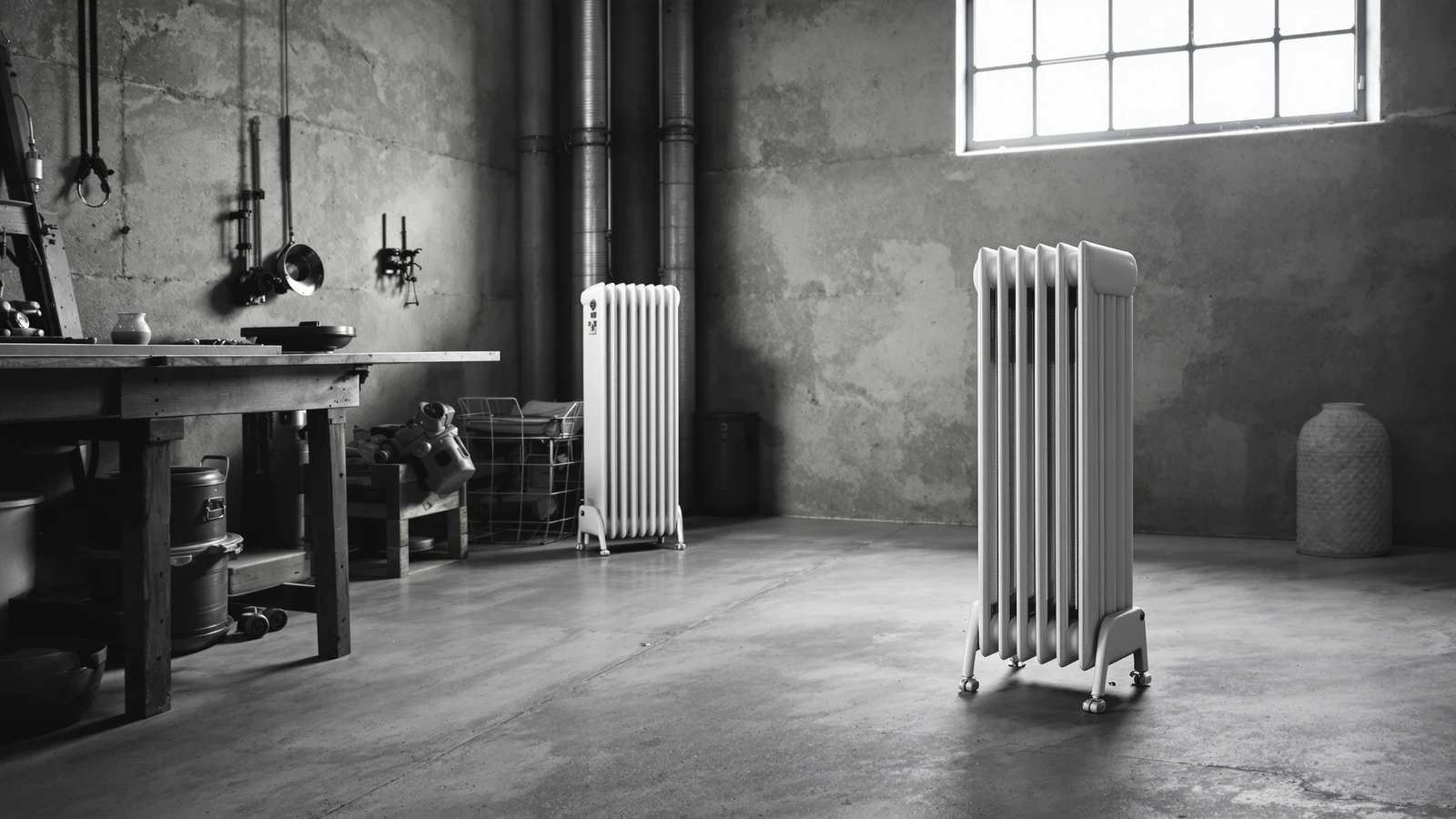
An oil-filled radiator sidesteps the problem entirely because it has no fan and no air intake at all. The De’Longhi EW7707CM heats a sealed column of oil inside its finned housing, and that housing radiates warmth into the room by convection and direct radiant heat, not by moving air across a heating coil. There's nothing drawing sawdust in, and nothing for sawdust to clog. That single difference is why, of the three heaters covered here, the oil-filled radiator is the one we'd put closest to an actual workbench where cutting or sanding happens.
That doesn't disqualify the AUBKN or the DREO from a garage entirely — it just changes where they belong. Both are reasonable choices for a garage used mainly for parking, storage, or light hobby work where the floor stays swept and dust isn't actively being generated while the heater runs. Keep the intake grille clear of sawdust and debris either way, and if you're running a table saw or a belt sander for any length of time, switch the fan-based heater off or move it to another part of the space until the dust settles.
Continuous heat for a workbench versus a quick blast before you start
A garage gets used two very different ways, and they call for two different heating strategies. Sometimes you're in and out in five minutes — grabbing a tool, loading the car, checking on a project — and what you want is warmth aimed at you immediately, not a slow climb in room temperature that finishes about the time you're leaving. Other times you're genuinely working: at a bench for an hour or three, and what you want is a heater that holds a temperature near where you're standing without needing to be babysat or restarted.
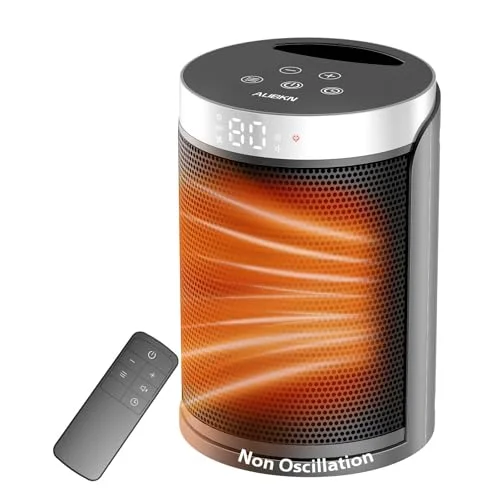
The small AUBKN heater, at $23.74 and controllable from a remote, fits the first case well. It's inexpensive enough to treat as a convenience object rather than an investment, easy to point at a chair or a bench corner, and the remote means you can switch it on from the doorway before you've even stepped onto a cold slab floor. It is not the heater to run unattended for a full afternoon in a two-car bay; it's the heater for the five-minute visit and the quick blast of warmth that makes the task bearable.
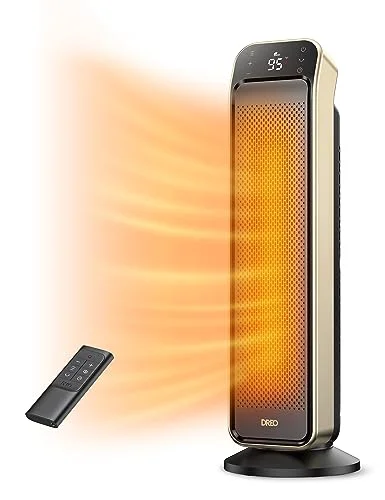
The DREO 25-Inch, built with a thermostat and marketed for larger rooms, is the better fit for the second case. A thermostat means it cycles on and off to hold roughly the temperature you set rather than running at full output the entire time, which matters if you're going to be standing near it for hours — both for comfort and for not needing to think about it. In a bigger, draftier garage, it's also the one of the three built to push warm air across more floor space rather than concentrating it in one spot.
The De’Longhi oil-filled radiator sits in its own category here: genuinely continuous, and genuinely slow. Oil-filled radiators take longer to reach their working temperature than a fan heater does, but once the oil is warm it keeps radiating heat into the room well after the element switches off, which is useful if you're moving around a shop rather than sitting still in front of it. De’Longhi's ComfortTemp setting is built to hold a moderate temperature automatically rather than cycle at full output, which is the same idea as the DREO's thermostat, delivered through a completely different, fan-free mechanism. If the plan is to leave a heater running quietly in a corner of the workshop for the whole afternoon, this is the build suited to that job.
What 1,500 watts does and does not do in an uninsulated space
Nearly every plug-in space heater sold for a standard US wall outlet, including all three covered here, runs at roughly 1,500 watts — the practical ceiling of a 15-amp residential circuit. That figure translates to about 5,100 BTU per hour of heat output. In a small, reasonably sealed bedroom, that's genuinely enough to raise and hold a comfortable temperature. In an uninsulated or partially insulated garage, it is a different proposition entirely, and it's worth being precise about where the line sits.
What 1,500 watts does do: it will noticeably warm the air and surfaces in a radius of a few feet around the heater, usually within minutes for a radiant or hybrid unit and somewhat longer for a convection tower or an oil-filled radiator working up to temperature. Stand or sit close to it, point it at a bench, and you will feel a real, useful difference. That's the entire premise behind treating a garage heater as task or personal heating rather than whole-room heating.
What it does not do: raise the ambient temperature of an entire one- or two-car garage to anything most people would call comfortable, especially with an 8–10-foot ceiling, bare framing, and a large uninsulated door. Heating contractors sizing a dedicated garage heater commonly land on 30,000 to 60,000 BTU per hour for a typical uninsulated two-car garage in a cold climate — six to twelve times what one 1,500-watt plug-in unit provides. Running two or three of the heaters covered here at once narrows that gap, but it doesn't close it, and stacking heaters on one circuit raises the breaker risk covered in our guide to space heaters and breakers before it solves the insulation problem.
The practical takeaway: set the expectation before you plug anything in. A space heater in a garage is there to make the spot you're standing in, or the bench you're working at, tolerable for the time you're actually there — not to turn the whole garage into a warm room you'd want to sit in without a jacket.
The picks
Three heaters, three different garage jobs — not a ranked list, since the right pick depends on whether you're ducking in for five minutes, settling in at a bench, or working around active dust.
01Best for a dusty workshop
De’Longhi EW7707CM Oil-Filled Radiator
No fan, no intake — nothing to pull sawdust across a hot element
Oil-filled·No fan, no noise·ComfortTemp·5.9 × 13.78 × 24.8 in
The only one of the three with no fan and no air intake at all, which is the entire reason it leads this list for a workshop. A fan-based heater continuously draws room air, and whatever fine dust is in it, across a hot element; an oil-filled radiator has nothing to draw air through, so sawdust, drywall dust and metal filings simply aren't a factor the way they are for the other two picks. De’Longhi's ComfortTemp setting holds a moderate temperature automatically rather than running flat out, and it radiates heat into the room well after the element switches off. It's slower to warm up than either fan-based pick here, which is the honest trade-off for running silent and fan-free next to a bench.
The pick if you're sanding, sawing or sweeping anywhere near where the heater runs.
02Best for a quick blast
AUBKN Space Heater
Small, cheap, and switchable from the doorway with a remote
Portable, small·Remote control·Indoor use·$23.74
At $23.74, this is the heater to treat as disposable convenience rather than an investment — the right posture for a garage you're only in for a few minutes at a time. Its remote means you can switch it on from the doorway before stepping onto a cold slab floor, so the warmth is already building by the time you reach the bench. Its small size is also its honest limitation: it's built for warming a person in one spot, not a two-car bay, and it isn't the heater to leave running unattended for a long afternoon session.
The one to keep by the door for the five-minute trip, not the three-hour project.
03Best for long sessions at the bench
DREO 25 Inch Electric Space Heater
A thermostat, built for a bigger bay you're working in for hours
25-inch tower·Thermostat·Large, size variant·Remote included
Built with a thermostat so it cycles to hold a set temperature rather than running at full output the entire time — the feature that matters most if you're genuinely spending hours at a workbench rather than passing through. Marketed for large-room use, which in a garage translates to pushing warm air further across a two-car bay than a small personal heater can manage. It has a fan, the trade-off covered above, so it's the better fit for a garage used for projects that don't involve active sawdust or fine particulate while it's running — woodworking finish work, electronics, bike repair — rather than a table saw station.
The pick for a bigger garage and a session measured in hours, not minutes.
When the answer is insulation, not another heater
There's a specific signal worth watching for: if a heater has run for an hour or more and the garage still feels barely different a few feet away, that's not a sign you bought the wrong heater. It's a sign the room is losing heat roughly as fast as the heater adds it, and no plug-in unit sold for a standard outlet wins that race. At that point, the better use of the next dollar is usually the garage door, not a second heater.
A standard steel or aluminum sectional garage door is, as covered earlier, the largest single opening in most homes' exterior envelope, and a meaningful share have little or no insulation layer. A foam insulation kit is inexpensive relative to a space heater and addresses the biggest heat-loss surface directly, rather than trying to out-produce the loss with more wattage. Weatherstripping the door's edges and bottom seal, and checking that a side door actually seats properly, closes the smaller gaps a heater can't compensate for.
A heater is still the right call when
You need warmth at one spot — a workbench, a chair, the few minutes it takes to grab tools — and the garage is otherwise used the way garages are used: briefly, for storage or parking, or for projects that don't require sitting still in the cold for hours.
Insulation is the better dollar when
You're running a heater for hours at a time, every session, and the room still feels close to outdoor temperature a short distance away — especially if the garage door is bare steel with no insulation layer and no weatherstripping to speak of.
None of this argues against owning a heater. It argues for sequencing the spending: seal the door first, then let a heater handle the last few degrees around the spot you work.
How we picked
We looked specifically for heaters that map onto the three real patterns of garage and workshop use — a brief task-focused visit, a long session at a fixed workbench, and active work that generates dust — rather than pulling three similar towers that differ mainly in price. The oil-filled radiator, the small remote-controlled unit, and the thermostat-equipped tower each represent a genuinely different mechanism and a genuinely different use case, which is why all three earned a place here instead of three variations on one idea.
How we compared
We compared the three heaters on their published titles, available specifications and current Amazon prices. The AUBKN and DREO listings we worked from do not include a stated noise figure, and we say so plainly rather than estimate one. Where we cite a specific detail — the De’Longhi's finished dimensions, the DREO's thermostat and large-room sizing, the AUBKN's remote control and price — it comes directly from the product's own listing data.
We do not run a testing lab. We have not run these three heaters in a real garage ourselves, so you will not find an invented decibel reading, a square-footage claim we can't verify, or a score out of ten anywhere on this page. We also don't show star ratings, review counts or paraphrased owner sentiment for these specific listings, because we don't have manufacturer-published figures for them — a limitation of the available data, not a judgment on the heaters themselves.
Frequently asked questions
Will a space heater actually warm an uninsulated garage?
Not the whole room, no. A 1,500-watt plug-in heater puts out roughly 5,100 BTU per hour, while a typical uninsulated two-car garage in a cold climate can need 30,000 to 60,000 BTU per hour to meaningfully raise the ambient temperature. Treat a space heater as warmth for the spot you're standing in or working at, not a replacement for insulating the room.
Is it safe to run a space heater in a workshop with sawdust?
It depends on the heater's design more than its wattage. Fan-based heaters draw room air, and any fine dust suspended in it, across a heated element, which manufacturers generally warn against doing near dust-generating work. An oil-filled radiator like the De’Longhi EW7707CM has no fan and no air intake, so it doesn't share that specific concern. Either way, keep sawdust swept away from the unit and its cord.
Should I leave the heater running continuously or just use it in quick bursts?
Match the heater to the visit. A thermostat-equipped unit like the DREO 25-Inch, or a slow-radiating oil-filled radiator like the De’Longhi, suits a multi-hour session at a bench because both are built to hold a temperature rather than run flat out unattended. A small, inexpensive unit like the AUBKN, switched on by remote right before you walk in, suits a five-minute visit better than leaving a bigger heater running for a task that's over before the room has really warmed.
What's a cheaper fix than buying a bigger heater?
Insulating and weatherstripping the garage door. It's typically the largest uninsulated surface in the room, and a foam insulation kit costs a fraction of what a second or third space heater does while addressing the actual source of the heat loss rather than trying to out-produce it with more wattage.
Written by Ilane Tall. Research-based comparisons of published specifications, current prices and public product data — we do not physically test these units and we do not publish invented scores.