By Ilane Tall · Updated October 25, 2026 · Research-based.
Reader-supported: we may earn a commission when you buy through the links on this page, at no additional cost to you. It never changes which product we recommend. Prices quoted below were correct at the time of writing and move often.
Quick answer
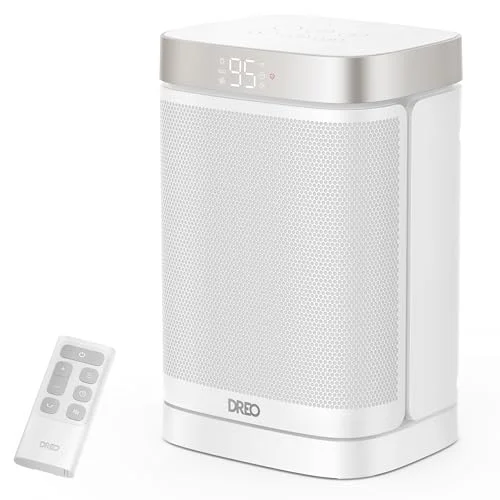
A power-level switch tells a space heater how hard to run. A thermostat tells it what temperature to hold, and leaves the "how hard" decision to the heater itself — which is the entire difference between a unit that overshoots a warm room and bakes it, and one that settles in and goes quiet. If you want a heater that manages itself through a long evening or a full night, the DREO Atom One ($60.49) pairs a digital thermostat with a 12-hour timer and 70-degree oscillation in a compact cabinet built for a desk or a small bedroom.
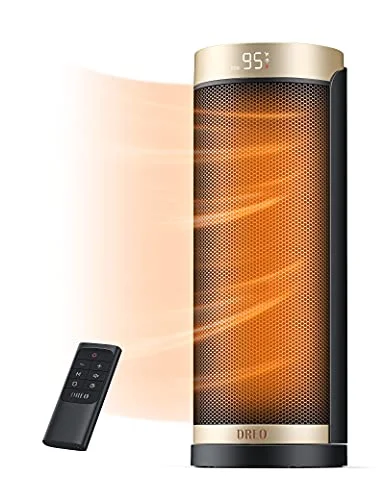
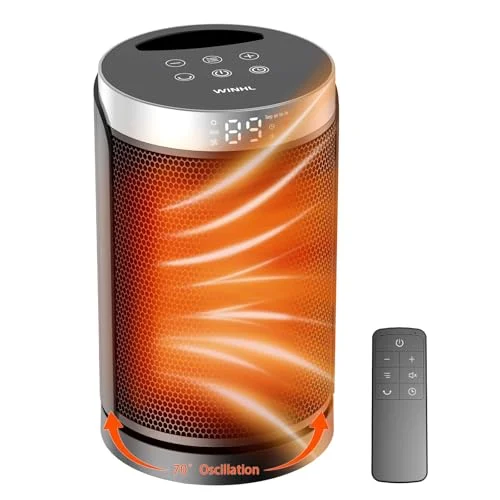
If the room is bigger or you'd rather not share a footprint, the DREO 16-Inch with Thermostat ($63.74) is the same control idea in a taller 1,500-watt tower. And if you genuinely just need to take the chill off a small space for an hour at a time, the WINHL Oscillating Heater ($28.46) is a reasonable case for skipping the thermostat altogether — covered honestly below.
Power settings versus a temperature target
A power-level control is simple by design: you pick low, medium or high, and the heating element draws roughly that share of its rated wattage for as long as the switch stays there. Nothing in the heater is checking the room. If you set it to high and leave for the afternoon, it runs on high for the afternoon, whether the room reached a comfortable temperature twenty minutes in or never gets there at all. You are the thermostat, and you only check in when you remember to.
A thermostat control flips that arrangement. You set a target temperature, not a power level, and a sensor inside the unit compares the room against that number continuously. When the room is below target, the heating element runs at its rated output. When the room reaches target, the element shuts off, and the fan either stops or switches to a lower, non-heating mode. The DREO Atom One and the DREO 16-Inch in this guide both advertise a thermostat rather than a stepped dial, and both are rated at 1,500 watts — the same ceiling nearly every plug-in heater in this category runs against, covered in more depth in our comparison of space heater and central heating costs. The wattage ceiling doesn't change with a thermostat. What changes is how much of the time the heater actually spends drawing it.
This is the part that is easy to miss on a spec sheet: a thermostat is not a stronger heater, and it will not warm a room faster than the same wattage on a fixed high setting. What it buys is restraint. Once the room is at the number you asked for, the heater stops working to exceed it. A heater with only power levels has no equivalent instruction — "high" doesn't mean "work until it's 70 degrees in here," it means "run at this output indefinitely," and the only thermostat in that arrangement is whoever is in the room, turning the dial down when it starts to feel too warm.
What cycling does to consumption
A heater with a thermostat doesn't run continuously the way a fixed-power heater does; it cycles — on while the room is below target, off while it coasts back down, on again once it drifts below target a second time. That on-off rhythm is the mechanism behind most of the savings people associate with "smart" or thermostat-controlled heaters, and it's worth being precise about why it works, because the heater itself isn't using less power while it runs. A 1,500-watt heating element draws roughly 1,500 watts whether a dial or a thermostat is telling it to run. The difference is how many of the sixty minutes in an hour it actually spends drawing that power.
Picture a small bedroom that reaches its target temperature after fifteen minutes of full output, then takes forty-five minutes to drift back down far enough to need another fifteen-minute burst. Across that hour, a thermostat-controlled heater has run at full output for roughly thirty minutes, not sixty — call it half the energy a fixed-high setting would have drawn to sit in the same room for the same hour, heat loss through walls and windows being equal. A heater without a thermostat, left on high for that same hour in the same room, keeps running at full output the entire time, overshooting the target the first heater was aiming for and then holding the room warmer than anyone asked it to be.
None of this is a fixed percentage you can apply to every room; the real cycling ratio depends on insulation, outdoor temperature and where the target is set. A drafty room calls for heat more often than a sealed one, and the thermostat simply cycles more frequently to keep up. What stays constant is the principle: a thermostat trades continuous output for output matched to the moment, and a fixed power level has no such feedback loop. Our guide to space heater timers covers the related difference between a thermostat that cycles indefinitely and a timer that cuts power after a fixed number of hours regardless of room temperature.
Digital readouts and what they are actually measuring
Both DREO units in this guide pair their thermostat with a digital display, and it's worth being clear about what that number on the screen is reporting, because it is easy to assume it's measuring something more precise than it actually is. The display reads the temperature at the heater's own internal sensor — typically mounted near the air intake, close to floor level in most portable heaters — not the temperature at head height across the room, and not an average of the whole space. A heater sitting in a corner is reading the corner.
That distinction matters because rooms are not uniform in temperature. Heat rises, so the air near the ceiling runs warmer than the air at floor level where most heaters sit, sometimes by several degrees in a room with a tall ceiling or poor air circulation. A heater reading 70 degrees at its own intake, close to the floor, may sit in a room that feels distinctly cooler at the height of a chair or a bed a few feet away, simply because the air hasn't finished circulating. The readout is accurate to what the sensor can see; it isn't a claim about comfort everywhere in the room.
The practical habit worth building: treat the digital number as a consistent reference point for that one heater in that one spot, not as an absolute room temperature. If a target of 70 on the display isn't matching how the room feels where you actually sit or sleep, adjust the target to match your own experience rather than trusting the number to be universally correct.
Why a thermostat matters most overnight
During the day, a fixed-power heater's main cost is wasted energy and an overheated room — annoying, but you're there to notice and adjust it. Overnight, nobody is awake to turn the dial down at 3 a.m. when the room has already reached a comfortable temperature, which is precisely the scenario a thermostat is built to handle without supervision. A heater cycling itself off once the room hits target, then back on once it drifts, is doing through the night exactly what you would have done by hand if you'd stayed awake to manage it.
The alternative, a heater left on a fixed high setting for eight hours of sleep, has no equivalent safeguard against overshoot. The room keeps climbing past comfortable, which at minimum means waking up too warm. Automatic shut-off and tip-over protection, which every heater worth buying should have regardless of thermostat, cover the safety side of that equation; a thermostat covers the comfort and consumption side, which a fixed-power heater simply has no mechanism for. For the safety side specifically, our guide on leaving a space heater on overnight goes through what to check before you do.
This is also where the DREO Atom One's 12-hour timer complements rather than duplicates its thermostat. The thermostat decides whether the heating element runs or idles, minute to minute, based on room temperature; the timer is a hard backstop that shuts the entire unit off after twelve hours regardless of what the thermostat wants, in case you oversleep or simply forget it's on. The two features are solving different problems, and a bedroom heater benefits from carrying both rather than either alone.
The picks
Three heaters, three different answers to how much control you actually need over the temperature in the room — not a strict ranking, since the honest answer depends on the room and how long the heater runs unattended.
01Best overall
DREO Atom One Space Heater with Remote
Digital thermostat, 12-hour timer, 70° oscillation
Digital Thermostat·1,500W PTC Ceramic·12h Timer·70° Oscillating
This is the heater on this page with the fullest set of stated controls: a digital thermostat, a 1,500-watt PTC ceramic element, a 12-hour timer, 70-degree oscillation and a remote, marketed specifically for a home office. The PTC ceramic element is the same self-regulating technology used across most modern compact heaters, and pairing it with a thermostat rather than a stepped dial means it's the unit here best equipped to run unsupervised for a stretch — the timer catching anything the thermostat alone wouldn't. Oscillation spreads that output across more of a small room than a fixed, forward-facing heater would, which suits a desk or a compact bedroom better than a single corner.
The pick if you want one control panel to handle the target temperature, the oscillation and the cutoff, and you'd rather set it once than check on it.
02Best 16-inch tower
DREO Space Heater with Thermostat, 16 Inch
The same thermostat control in a taller, 1,500W tower
With Thermostat·1,500W·16-inch size
A taller tower built around the same core idea as the Atom One — a thermostat rather than a stepped dial, at the same 1,500-watt ceiling — in a 16-inch cabinet rather than the Atom One's compact footprint. The listing doesn't state a timer interval or an oscillation angle for this model, so we're not going to attribute either to it; what it does confirm is the thermostat and the wattage, which is the control distinction this whole guide is about. If floor space for a taller, more conventional tower shape suits your room better than a compact desk unit, this is the thermostat-equipped option built that way.
Buy this one for the shape rather than for extra features over the Atom One — the thermostat is the headline either way.
03Best if you don't need one
WINHL Portable Electric Heater, 70° Oscillation
The honest budget case for skipping the thermostat
70° Oscillation·9.9-inch size
The listing for this heater doesn't advertise a digital thermostat or a numeric temperature target — control here comes from power level rather than a sensor deciding when to cycle, typical of heaters at this price. At $28.46, it's the least expensive of the three, and the 70-degree oscillation still spreads heat across a small room rather than pointing it at one spot. What you give up against the two DREO units is the self-regulating part: nobody is watching the room temperature for you, so it needs a person to switch it off once the space feels right. Whether that trade is worth it depends entirely on how you plan to use it.
A sensible choice for short, supervised bursts of heat. A worse choice for a room you plan to leave unattended.
When three power settings are genuinely enough
A thermostat is a feature, not a moral obligation, and there are real situations where a simple power-level heater like the WINHL is the more sensible purchase rather than a compromise. The common thread across all of them is supervision: a heater without a thermostat works fine as long as a person is the one deciding when it has done its job, which is a reasonable division of labor for some uses and a poor one for others.
A thermostat matters when
The heater runs for hours at a stretch, overnight or while you're elsewhere in the house, in a room where nobody is checking in to switch it off once it's warm enough.
Power settings are enough when
You're in the room the whole time, running it for a short, specific stretch — getting dressed, warming up a bathroom before a shower — and switching it off yourself the moment it's done.
Price is part of the honest calculation too. The WINHL at $28.46 costs roughly half of either DREO thermostat model, and if the heater's job is a twenty-minute burst while you're standing right next to it, a thermostat's main benefit — running unattended without overshooting — never really comes into play. You are the feedback loop in that scenario. Readers weighing price above all else may also want our roundup of space heaters under $50. And if oscillation itself is the feature you care about rather than the thermostat, both the WINHL and the Atom One spread heat across a wider arc than a fixed heater, a category covered in our guide to oscillating space heaters.
Where the calculation changes is duration and attention. The moment a heater is meant to run for an hour or more without you standing next to it — a nursery during a nap, a bedroom overnight, a home office while you're on a call elsewhere in the house — the lack of a thermostat stops being a minor omission and starts being the entire risk: an unsupervised heater simply keeps running at whatever power level was last set, for as long as the timer or your own memory allows.
How we picked
We looked specifically for heaters whose listings make a clear, checkable claim about the control method — a stated thermostat, a specific wattage, a timer interval, an oscillation angle — rather than vague marketing language about "custom comfort." The three products here represent two clearly thermostat-equipped units at a similar price and a third, lower-priced heater built around power levels instead, so the comparison is genuine rather than three near-identical units.
How we compared
We compared the three heaters on their published titles, stated specifications and current Amazon prices. Where a listing states a number — the Atom One's 1,500 watts, 12-hour timer and 70-degree oscillation, the 16-inch model's 1,500 watts, the WINHL's 70-degree oscillation and 9.9-inch size — it comes directly from that product's own listing. Where a listing omits a figure, such as a timer interval for the 16-inch DREO or a wattage figure for the WINHL, we say so rather than estimate one to fill a gap.
We do not run a testing lab. We have not run these three heaters in a room ourselves and are not publishing an invented decibel reading or a score out of ten here. We also don't show star ratings, review counts or paraphrased owner sentiment, because we don't have manufacturer-published figures for these specific listings — a limitation of the data available to us, not a judgment on the heaters themselves.
Frequently asked questions
Is a thermostat the same thing as an automatic shut-off timer?
No, and the two are worth telling apart. A thermostat decides whether the heating element runs or idles based on the room's current temperature against a target you set, continuously, for as long as the heater is on. A timer is a fixed countdown that shuts the whole unit off after a set number of hours regardless of room temperature. The DREO Atom One in this guide carries both: the thermostat manages minute-to-minute cycling, and the 12-hour timer is a hard backstop in case you forget about it entirely. Our guide to space heater timers covers the timer side on its own.
Does a thermostat actually lower what a heater costs to run?
Indirectly, yes, through cycling rather than through using less power while it runs. A 1,500-watt heating element draws the same wattage whether a thermostat or a dial is controlling it; what a thermostat changes is how much of each hour the element actually spends at that output once the room has reached your target temperature. A fixed power-level heater left on high has no equivalent off-switch built in, so it keeps drawing full output even after the room is already comfortable.
What is the digital readout on a thermostat heater actually measuring?
The temperature at the heater's own internal sensor, usually mounted near the air intake close to floor level, not an average of the whole room and not the temperature at head height across the space. Because warm air rises, a room can read one number at the heater and feel noticeably different a few feet away at chair or bed height. Treat the display as a consistent reference for that heater in that spot, and adjust the target to match how the room actually feels rather than trusting the number as an absolute room temperature.
Do I need a thermostat if I only run the heater for a few minutes at a time?
Probably not. A thermostat's main advantage is managing a room over hours without supervision, which doesn't come into play if you're standing in the room the whole time and switching the heater off yourself once it's warm enough. For short, supervised bursts, a simpler power-level heater like the WINHL in this guide is a reasonable way to spend less. The trade-off flips once the heater is meant to run unattended for an hour or more, such as overnight or in a room you've stepped away from.
Written by Ilane Tall. Research-based comparisons of published specifications, current prices and public product data — we do not physically test these units and we do not publish invented scores.