By Ilane Tall · Updated October 31, 2026 · Research-based.
Reader-supported: we may earn a commission when you buy through the links on this page, at no additional cost to you. It never changes which product we recommend. Prices quoted below were correct at the time of writing and move often.
Quick answer
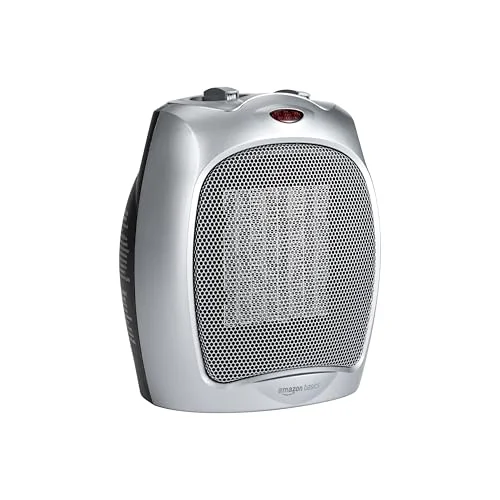
None of the three heaters here were designed specifically "for pets" — that's not a real product category, and any listing claiming otherwise is marketing, not engineering. What you can buy is a heater with a tip-over switch, an overheat sensor and a fully enclosed heating element, then pair it with placement habits a spec sheet can't enforce. The Amazon Basics Ceramic Space Heater ($17.59) is our starting point: it states overheat and tip-over protection directly in its listing, stays planted because it doesn't oscillate, and costs little enough that losing it to a curious paw isn't a disaster.
If you want to run the heater from across the room rather than crouching near it while a pet is nearby, the JIBUFI ($26.56) adds a remote and 70° oscillation. For a bit more floor coverage in a room a dog actually uses, the OLIXIS 23-inch ($39.93) oscillates the same 70° with four operating modes. The habit that matters more than any of the three: where you put it, not which one you buy.
What a tip-over sensor catches — and what it doesn't
A tip-over switch is a mechanical or gravity-based cutoff built into the base of a heater: past a certain angle, usually somewhere around 45 degrees, a switch disengages and the heating element loses power. The Amazon Basics Ceramic Space Heater states this feature directly in its own listing, alongside overheat protection, which is a separate sensor that shuts the unit down if the internal temperature climbs past a safe threshold regardless of the heater's position. These are the two protections a listing can state as a fact, and they're genuinely the two that matter most in a home with no pets at all.
Here's what a tip-over switch does not catch, and it's worth being specific rather than vague about it. A cat that jumps onto a heater and knocks it from upright to resting-against-the-wall at a shallow angle may not trip the switch at all, because the angle threshold is tuned to catch a full fall, not a partial lean. A dog that noses a heater a few inches across a hardwood floor, without ever tipping it, keeps it fully powered and pointed exactly where it was before — which might now be a curtain, a dog bed or a stack of newspaper that wasn't there when you set it up. The switch protects against the heater falling over; it does nothing about the heater staying upright in the wrong place.
Neither the JIBUFI nor the OLIXIS listing we're working from states a tip-over protection feature in its title or available specs, which is a gap in the data we have, not a claim that the feature is absent. If a confirmed tip-over switch is a requirement for you specifically because of a jumpy cat or a heeler puppy that likes to investigate everything new, the Amazon Basics heater is the one of these three that states it outright — for the other two, check the current listing's safety-feature bullet points before you buy, rather than assuming the feature is there because most heaters in this price range tend to have it.
A grille a paw cannot reach through
Ceramic PTC heaters, the Amazon Basics unit's category, are built around a flat ceramic element that sits behind a perforated metal or plastic grille rather than an exposed glowing coil. That's a meaningful design difference for a home with pets: a paw or nose pressed against the front of the unit meets the grille, not the element generating the heat. The grille doesn't make the front of the unit cold — a heater working as intended will have a warm-to-hot exterior near the vents — but it removes direct contact with the part actually producing the heat.
The 70°-oscillating towers from JIBUFI and OLIXIS are built the same general way towers in this category usually are: the heating element sits inside a tall, mostly sealed cabinet, with air pulled in low and pushed out through vents rather than one large exposed opening. Neither listing gives us a grille-opening measurement or a surface-temperature figure, and we're not going to estimate either to fill a gap — if a determined cat is a real concern, check the product photos on the current listing yourself before buying.
What no grille design solves is a pet lying directly against the vent to warm up, which is a separate and more common problem than reaching inside one. A sealed cabinet keeps a paw away from the heating element; it does not keep a dog from curling up two inches from the air outlet where the exhaust is hottest. That's a placement issue, covered below, not a feature any of these three heaters can engineer around.
The cord: the part no heater protects
Every safety feature discussed so far is built into the unit itself. None of them touches the one component most likely to actually injure a pet: the power cord. A cord carrying 120 volts to a running heater is not chew-resistant and not insulated against a determined puppy's teeth. A dog or cat that bites through a live cord risks a serious electrical burn or worse, and no tip-over switch or overheat sensor does anything to prevent it, because the fault happens at the cord, not inside the heater.
None of the three listings here state anything about cord length, material or chew-resistance — this simply isn't a spec space heaters are sold on. The realistic fix lives on the owner's side, not the product's: run the cord along a wall rather than across open floor, behind furniture where a pet can't easily reach it, or through a cord cover rated for the purpose. Several of the heaters we've covered for nurseries face the identical cord problem with toddlers instead of teeth, and the fix is the same — routing and supervision, not something you can shop your way out of.
Fur, dust and the air intake
A ceramic or PTC heater works by pulling room air across a heated element and pushing it back out, which means anything suspended in that air — pet fur, dander, dust the fur kicks up — gets pulled toward the intake vents continuously while the unit runs. Over weeks in a home with a shedding dog or cat, fur accumulates on or inside the intake grille. A partially blocked intake makes the heater work harder to pull the same volume of air through a smaller opening, which raises the internal operating temperature above what the unit was designed to run at continuously.
This is exactly where the Amazon Basics heater's stated overheat protection earns its place on this list: a sensor that cuts power if the internal temperature climbs too high is a meaningful backstop against a fur-clogged intake specifically. We don't have a stated overheat-protection feature for the JIBUFI or OLIXIS listings, which is a gap in the data rather than a claim it's missing — either way, the fix is the same regardless of which heater you own: wipe down the intake grille every week or two in a home with a shedding pet, unplugged and cool. The same buildup problem shows up with sawdust in a workshop — different debris, same mechanism, same fix.
The picks
Three heaters, three slightly different answers to the same brief: stay planted, keep the element enclosed, and cost little enough that a worst-case loss isn't a crisis. None of these is marketed by its manufacturer as pet-specific, because that isn't a real certification — these are the three general-purpose picks that come closest to what a pet owner should actually be looking for.
01Best starting point
Amazon Basics Ceramic Space Heater
Stays put, stated tip-over and overheat protection, 1500W
Ceramic, PTC·Non-Oscillating·Thermostat·7.52"D x 6.34"W x 9.45"H
This is the only one of the three whose listing states overheat and tip-over protection directly, and it's non-oscillating, which matters more than it sounds: a stationary heater can't rock itself into a new position the way an oscillating one gently does over hours of running. It's small — 7.52 inches deep, 6.34 wide, 9.45 tall — so it sits low and compact rather than top-heavy, and at $17.59 it's the heater to start with if you're not yet sure how your specific pet will react to having one in the house. It has a built-in thermostat, so it cycles rather than running flat out continuously.
The pick if you want the two safety features that matter most stated outright, in the smallest, cheapest footprint of the three.
02Best for hands-off control
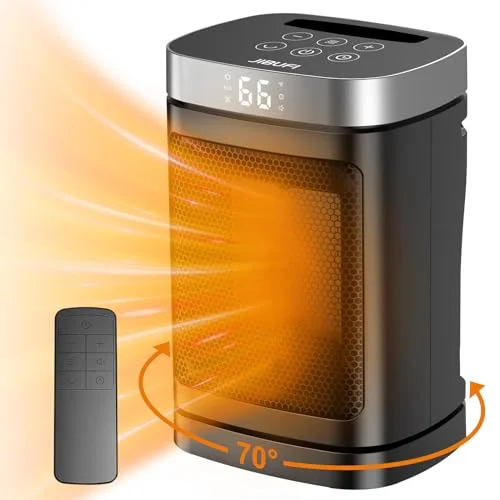
JIBUFI Portable Space Heater
70° oscillation plus a remote, so you don't have to approach it
70° Oscillation·Remote included·9.96"
The remote is the detail that matters most here for a pet-aware setup: you can turn this heater off or adjust it from across the room, rather than walking over to a unit a pet may be curled up near. The 70-degree oscillation spreads the same output across more of the room instead of concentrating it on one spot a pet might be drawn to for warmth. The listing we're working from doesn't state a wattage figure or a tip-over feature, which is a gap in the data rather than a claim either way — check the current listing if either matters to your decision. At $26.56, it's a modest step up from the Amazon Basics unit for the convenience of the remote alone.
Buy this if being able to shut a heater off without walking up to it is worth more to you than the lowest price on this page.
03Best for a room a dog actually uses
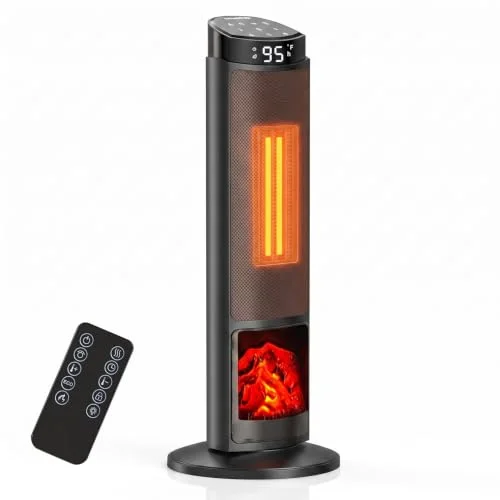
OLIXIS 23" Space Heater
The tallest, widest-coverage pick, with four operating modes
23" Tower·70° Oscillation·4 Modes·9.09"x7.87"x23.62"
At 23.62 inches tall, this is the biggest footprint of the three, built as a slim tower rather than a compact box, which keeps the air intake and vents higher off the floor than the other two picks — a small but real advantage in a home with a dog that likes to lie flat against anything warm. The four operating modes give you more ways to dial down output in a room a pet spends real time in, rather than running one fixed setting. We don't have a stated weight or a tip-over feature for this listing, so if stability against a bigger dog bumping it is a specific concern, check the current listing's photos and any customer Q&A before buying. At $39.93, it's the most expensive of the three and the one best suited to a room where a pet spends hours, not minutes.
The pick if the room has real floor space and a pet that's going to be in it for the long haul, not just passing through.
The one placement rule that matters most with pets
Every section above is about what a heater's design can and can't do. This one is about the single habit that does more for pet safety than any spec on any of the three units above: put the heater somewhere a pet cannot get behind, under or directly against it, full stop — not just somewhere that looks clear when you set it up.
In practice that means a few concrete things. Give the unit a minimum of three feet of clearance on every side, including behind it — a cat can squeeze behind a heater pushed near a wall just as easily as it can walk in front of one. Place it on a hard, flat, non-flammable surface rather than a rug or a dog bed's edge, since a heater nudged a few inches on carpet can end up partly on fabric it wasn't on a minute earlier. Keep it out of main pet traffic paths — the route from a windowsill to the food bowl, or the path a dog takes at a run when the doorbell rings. And never run a heater with an unsupervised pet behind a closed door; a tip-over switch and an overheat sensor are backstops, not a reason to stop checking.
A heater is reasonably placed when
It sits on a hard surface with clearance on all four sides, including behind it, away from bedding, curtains and any path a pet runs through regularly, and the cord is routed where teeth can't reach it.
Move it — or rethink the room — when
A pet's favorite resting spot is within arm's reach of the vents, the cord crosses open floor, or the heater is wedged into a corner a cat could get behind without you noticing.
None of this is a reason to avoid a space heater in a home with pets. A heater that holds a steady temperature with a thermostat rather than running at full output continuously is already a safer default than an old-style heater without one, and all three picks above include at least one meaningful protection. The placement habit is simply the piece that no amount of shopping replaces — it's free, it takes thirty seconds to check each time, and it closes the exact gaps a tip-over switch and a grille were never designed to close.
How we picked
We started from our own database of space heaters currently listed for sale in the US and looked specifically for units whose listings state the protections that matter most around an animal — tip-over protection, overheat protection, a fully enclosed element — rather than pulling three heaters at random and writing pet-safety copy around them after the fact. We also deliberately kept the price low: a heater a pet might damage or knock around shouldn't be a significant financial loss if the worst happens.
How we compared
We compared these three on their published titles, available specifications and current Amazon prices. Where a listing states a feature directly — the Amazon Basics heater's tip-over and overheat protection, its 1500W rating, the oscillation angle and remote on the JIBUFI, the four modes on the OLIXIS — we report it as stated. Where a listing is silent on a feature, including tip-over protection for two of the three units, we say so plainly rather than assume it exists because it's common in the category.
We do not run a testing lab. We do not own these heaters and have not run them in a home with a pet. We also don't show star ratings, review counts or paraphrased owner sentiment, because we don't have manufacturer-published figures for these specific listings — a limitation of the data available to us, not a judgment on the heaters themselves.
Frequently asked questions
Does a tip-over switch mean a space heater is safe around pets?
It means the heater will cut power if it falls past a certain angle, which is a real and useful protection — but it doesn't catch a heater nudged a few inches without tipping, or a heater that stays upright while a pet lies directly against the warm vents. Treat a tip-over switch as one layer of protection, not a substitute for where you place the unit.
Can a cat or dog get burned on a space heater's grille?
A ceramic heater's perforated grille keeps a paw or nose from reaching the heating element directly, but the grille and the air coming out of the vents will still be warm to hot while the unit runs — that's how the heater works. None of the three listings here give a surface-temperature figure, so treat any running heater's exterior as something a pet shouldn't press against for long, not as cool-to-the-touch.
Will my dog or cat chew through a heater's cord?
It's possible, and it's the one failure mode no heater's internal safety features address, since the fault happens at the cord rather than inside the unit. Route the cord along a wall or behind furniture, out of a pet's usual path, or use a cord cover — this is a placement and supervision fix, not a spec to shop for.
Where should I place a space heater in a home with pets?
Give it clearance on all sides, including behind it, on a hard non-flammable surface, away from bedding and any path a pet runs through regularly — and don't run it in a closed room with an unsupervised pet. This single habit matters more than which of these three heaters you buy.
Written by Ilane Tall. Research-based comparisons of published specifications, current prices and public product data — we do not physically test these units and we do not publish invented scores.