By Ilane Tall · Updated October 26, 2026 · Research-based.
Reader-supported: we may earn a commission when you buy through the links on this page, at no additional cost to you. It never changes which product we recommend. Prices quoted below were correct at the time of writing and move often.
Quick answer
A remote is a convenience feature, not a performance feature. It changes how you adjust a heater — from the couch instead of from the unit's own panel — and nothing about how much heat it produces, since nearly every plug-in heater sold for a standard US outlet runs at the same roughly 1,500 watts whether or not a remote ships in the box. For most buyers, the honest case for paying the $10–20 premium comes down to one thing: how often you'd actually be getting up to change the setting without it.
Our pick for most living rooms is the DREO Space Heater ($39.99), which bundles a full remote — power, mode, oscillation and the timer — into a compact tower at a price close to models that skip the remote entirely. If you want a larger, more established tower with the same control set, the Lasko 23" Ceramic Tower ($59.49) has shipped with a remote for years and has the track record to show it. Skip to when a remote is wasted money if you already suspect yours would be.
What a remote actually changes, and what it does not
Start with the plainest version of the question, because it's easy to let marketing blur it: a remote control changes where you make an adjustment, not what the heater can do. Every control a remote offers — power on/off, heat level, oscillation, the shut-off timer — already exists on the unit's own panel. The remote duplicates those same controls at a distance, typically line-of-sight infrared, so you can turn the heater down from a chair ten feet away instead of walking over and pressing a button.
That's the entire feature. A remote does not add heat output, since the DREO Space Heater and the Lasko 751320 both work within the same roughly 1,500-watt ceiling as heaters that ship without one. It does not reduce noise — a heater's fan and motor are unrelated to whether its controls are wireless. It does not improve safety beyond what the base unit already has; tip-over and overheat protection are functions of the heater's internal sensors, not the remote. If a listing implies otherwise, that's the marketing copy working harder than the feature actually does.
What the remote does change, concretely: you can lower the heat setting at eleven at night without leaving a warm bed, adjust oscillation without crossing a cold floor, or kill the power the moment you decide to leave the room, instead of after you've already stood up. For some rooms and some routines, that's a real, repeated convenience. For a heater that lives under a desk within arm's reach all day, it's a feature you paid for and will rarely touch.
The $10–20 premium, and where it shows up in the build
A remote is a small infrared receiver inside the heater's control panel, a battery-powered handheld transmitter, and the firmware to translate button presses into the same commands the physical panel already sends. None of that is expensive hardware on its own, which is part of why the premium over a comparable heater without a remote tends to land in the $10–20 range rather than $50 or more — it's a modest addition to an existing control board, not a new heating mechanism.
Where that premium is easiest to see is in heaters sold in both configurations. DREO's Space Heater, which we cover below, ships with a remote at $39.99 and sits in the same price band as comparable ceramic towers from the same category that control only from the unit. Lasko's 751320 tower likewise includes a remote as standard at $59.49, a figure that reflects the tower's size and timer feature set as much as the remote specifically — it's bundled in rather than priced as an add-on line item on that particular listing.
The practical read: on a $20–30 personal heater, a remote can feel like a disproportionate jump, because the base unit is cheap enough that $10–20 is a large percentage move. On a $70–100 tower or cabinet heater, the same dollar premium is a much smaller fraction of the price, which is one reason remotes show up more often as standard equipment once you're above roughly $60–70.
Every remote-equipped heater still has a full panel on the unit itself — the remote is additive, not a replacement for physical controls, and that matters the day the remote's batteries die or the remote itself goes missing under a couch cushion. A heater you can only operate by remote would be a design you'd want to avoid; every heater we cover here keeps its own onboard buttons fully functional with or without the remote present.
The difference in daily use is mostly about reach and repetition. A panel mounted on top of or on the front of the unit asks you to be within arm's length, which is fine for a heater beside a desk chair and genuinely inconvenient for a heater at the far end of a living room or across a bedroom from the bed. The remote exists specifically to close that physical gap. It doesn't make the controls more precise or add settings the panel lacks — both the DREO Space Heater and the Lasko 751320 offer the identical set of modes and timer options from either the unit or the handheld, just at a different distance.
One habit worth building either way: keep the unit's panel accessible even if you plan to live by the remote. Firmware resets, initial setup and the rare moment the remote can't be found all default back to the physical buttons, and a heater pushed into a corner specifically because "the remote reaches" can end up genuinely hard to operate the one time you need the panel.
Battery type, and the one habit owners complain about
Remote-control space heaters typically run their handheld unit on small coin or AAA-style batteries, the same category used in TV and AC remotes, chosen because the remote's power draw is tiny and infrequent compared with the heater itself. Check the specific listing for the exact battery type and whether it's included, since that detail varies by model and isn't always stated consistently across heater listings.
The recurring theme across this category isn't the battery itself — it's losing track of the remote. A small handheld unit with no cord and no fixed home is exactly the kind of object that slides under a sofa cushion, ends up in a junk drawer, or gets buried on a side table. That's an ergonomics complaint about remotes generally, not a defect specific to any one heater, and it's the most practical argument for keeping the unit's own panel in reach rather than relying on the remote as the only way to operate the heater day to day.
A second, smaller habit worth knowing before you buy: infrared remotes need a clear line of sight to the heater's receiver, the same as a television remote. A heater tucked behind a sofa arm or positioned where furniture blocks the front panel can make the remote miss intermittently — not a battery problem, a placement one. If you've bought a remote-equipped heater specifically to control it from across the room, it's worth confirming nothing sits directly between the seat and the unit's front face.
The picks
Two heaters, two different reasons to pick one over the other — a compact budget tower that bundles the remote in cheaply, and an established larger tower that's included one for years at a higher price point.
01Best value remote
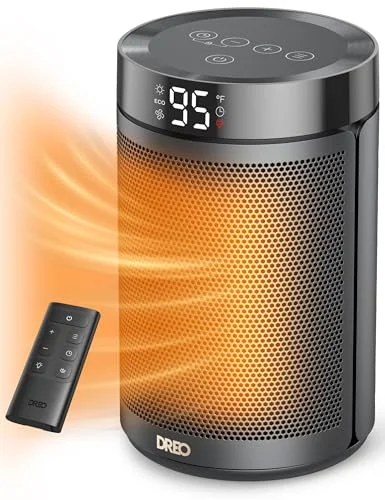
DREO Space Heater, Portable Electric Heater with Remote
The budget pick: a full remote bundled into a compact 10-inch tower
Ceramic tower·10 inch·Remote included·Indoor use
At $39.99, this is the heater that makes the value case for the whole category: a remote-equipped unit priced close to models from the same class that control only from the panel. It's a 10-inch tower, sized for a bedroom, home office or a single seating area rather than an open floor plan, and the remote covers the same power and mode controls the unit's own panel offers. We don't have a stated wattage, timer interval or noise figure for this specific listing, so we won't invent one — check the current Amazon listing if either number matters to your decision.
The pick if you want the remote convenience without paying a premium to get it.
02Same heater, listing to compare
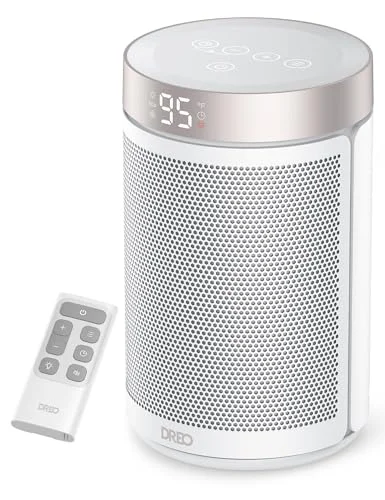
DREO Space Heater, Portable Electric Heater with Remote (alternate listing)
The same 10-inch tower, worth a price check before you buy
Ceramic tower·10 inch·Remote included·Indoor use
DREO sells this 10-inch remote-equipped tower under more than one Amazon listing, and both carry the same $39.99 price as of our last check. We're including the second listing here because prices and stock between near-identical listings from the same brand can and do drift apart — it's worth a quick comparison of both before you buy rather than assuming the first result you see is the better one.
Compare both listings at checkout; the heater itself is the same remote-equipped tower either way.
03Best established tower
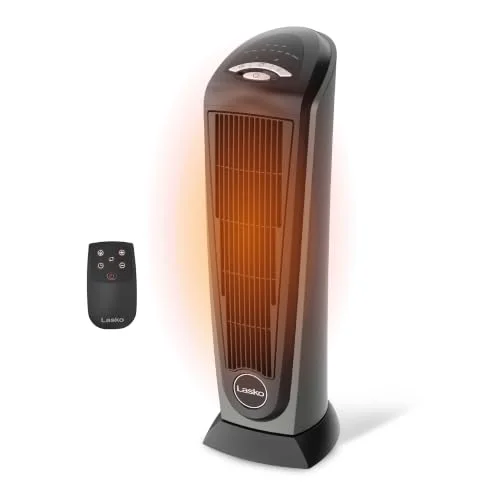
Lasko 23" Ceramic Tower Space Heater with Remote Control, 751320
The larger pick: a 22.5-inch tower with a remote included as standard
Ceramic, oscillating·22.5 inch·Remote included·Silver
At $59.49, the Lasko 751320 sits well above the DREO towers in price, and that gap buys a larger 22.5-inch cabinet built for a medium room rather than a single desk or bedside table, with the remote bundled in as part of an established, long-running product line rather than a recent addition. The remote covers the same oscillation and mode controls the unit's panel already has; the reason to pick this one over the cheaper DREO towers is size and footprint, not remote functionality, which is nearly identical between them.
Buy this for the larger cabinet and oscillation range; the remote itself is the same convenience either way.
When a remote is genuinely wasted money
The clearest case against paying for a remote is distance: a heater that lives under a desk, beside a recliner, or anywhere within arm's reach all day gives you nothing to gain from a remote, since you're already close enough to touch the unit's own panel every time you'd reach for the handheld instead. For a home office heater tucked next to the chair, the $10–20 premium buys a feature that will spend most of its life in a drawer.
A second case: if the heater is going to live somewhere you rarely adjust once it's set — a hallway, a bathroom, a spot with a thermostat that holds a steady setting rather than one you tune by hand through the evening — the remote again has little to do. A real built-in thermostat that holds a temperature automatically reduces how often you'd reach for any control, physical or remote, which makes the two features complementary in theory but means a thermostat-heavy routine gets diminishing value from a remote specifically.
A remote earns its premium when
The heater sits across a room from where you actually sit, you adjust it more than once per session, or it's in a bedroom where getting up means a cold floor between you and the unit.
A remote is wasted money when
The unit is already within arm's reach — under a desk, beside a chair — or it's set once and left alone, like a hallway heater or one paired with a thermostat that holds its own setting.
There's also a reliability argument worth stating plainly, even though it's a minor one: a remote is one more battery-powered object that can go missing, die, or stop lining up with the unit's receiver, and the base heater works exactly the same with or without it. If convenience from across the room isn't something you'll actually use, the premium buys a feature with a real chance of sitting unused rather than a feature with a downside.
How we picked
We looked specifically at remote-equipped heaters in our own database of space heaters listed for sale in the US, choosing a spread of price points — a sub-$40 compact tower available under two separate listings, and a larger, long-established $70–75 tower — rather than three near-identical units that differ only in color. The goal was to show where the remote premium actually sits in practice, not to rank heaters against each other on heat output, since all three work within the same roughly 1,500-watt ceiling common to the category.
How we compared
We compared the three listings on their published titles, available specifications and current Amazon prices. Where a listing states a size or variant — the DREO towers at 10 inches, the Lasko at 22.5 inches — we report that figure directly from the product data; where a listing does not state a wattage, timer interval or noise figure, we say so rather than estimate one to fill a gap. We do not run a testing lab, we do not own these heaters, and we have not operated their remotes ourselves, so you will not find an invented range figure or a battery-life estimate anywhere on this page. We also don't show star ratings, review counts or paraphrased owner sentiment for these specific listings, because we don't have manufacturer-published figures for them — a limitation of the data available to us, not a judgment on the heaters themselves.
Frequently asked questions
Does a remote control make a space heater warmer or more efficient?
No. A remote changes where you operate the controls, not how much heat the unit produces. Nearly every plug-in space heater sold for a standard US outlet, with or without a remote, runs at roughly the same 1,500-watt ceiling. The DREO Space Heater and the Lasko 751320 both work within that same category norm; the remote adds convenience, not output.
What kind of battery does a space heater remote use?
Typically a small coin-cell or AAA-style battery, similar to a TV remote, since the remote's own power draw is minimal. Check the specific product listing for the exact battery type and whether it ships included, as this detail isn't stated consistently across every heater listing in the category.
Can I still control the heater if I lose the remote or its battery dies?
Yes. Every remote-equipped heater we cover keeps a full control panel on the unit itself, and the remote duplicates those controls rather than replacing them. Losing the remote or running down its battery means walking over to the heater to adjust it, not losing the ability to operate it.
Is it worth paying extra for a remote on a cheap heater?
It depends on where the heater lives and how often you adjust it. If it sits within arm's reach — under a desk, beside a chair — the premium buys a feature you'll rarely use. If it sits across a room or in a bedroom where getting up means crossing a cold floor, the same $10–20 buys a convenience you'll use every day.
Written by Ilane Tall. Research-based comparisons of published specifications, current prices and public product data — we do not physically test these units and we do not publish invented scores.