By Ilane Tall · Updated November 1, 2026 · Research-based.
Reader-supported: we may earn a commission when you buy through the links on this page, at no additional cost to you. It never changes which product we recommend. Prices quoted below were correct at the time of writing and move often.
Quick answer
Wattage and square-footage ratings answer two different questions, and the box usually only gives you one of them clearly. As a working rule, a room with an 8-foot ceiling and average insulation needs roughly 10 watts per square foot to feel warm — a 150-square-foot bedroom lands close to 1,500 watts, which is why that figure is everywhere. A 500-watt heater like the Amazon Basics Mini ($18.39) is built for a desk, not a room. A 1,500-watt heater is the practical ceiling almost the entire market shares. And a model rated for a specific square footage, like the duraflame stove ($258.99) at 1,000 sq ft, is describing a best-case room — worth a second look before you buy on that number alone.
If your room is larger than one heater can honestly cover, the fix usually isn't a bigger heater — there mostly isn't one to buy. It's two smaller heaters in two zones.
Watts are not the square-footage rating printed on the box
Shoppers reach for one number when they size a space heater — "rated for 1,000 square feet," "good for a small bedroom," "heats up to 150 sq ft" — and treat it as the spec that matters. It isn't, not directly. Wattage measures electrical power: how much energy the heater converts into heat per second. Square footage is the manufacturer's own estimate of how far that heat will carry, under conditions the manufacturer chose. One is physics; the other is marketing copy wrapped around physics, and the two numbers only line up when your room matches the assumptions behind the estimate.
Nobody measured your living room before duraflame decided its freestanding stove is "for 1,000 Sq. Ft. Room." They measured a test room, under conditions favorable to the heater, and published the result. Wattage, by contrast, is a hard electrical fact: a 500-watt heater and a 1,500-watt heater draw measurably different current, full stop, regardless of which room either one ends up in.
The practical move is to flip the order most people shop in. Start from wattage, since it's the number you can trust without a lab. Then treat the square-footage claim as a hypothesis about your specific room, checked against the ceiling height, insulation and layout covered later in this guide — not accepted as a guarantee because it's printed in bold on a listing.
500 watts: a desk, not a room
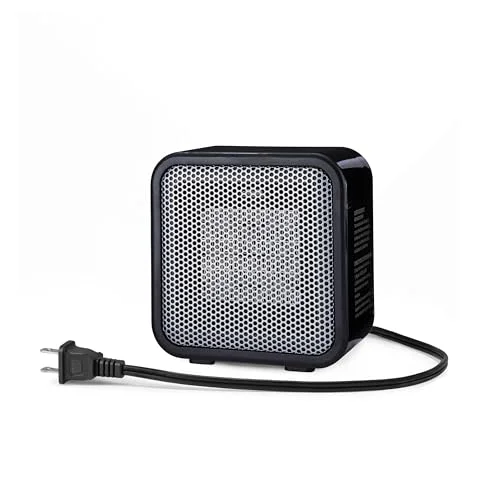
Five hundred watts is the wattage of a category built around a different question than "how do I heat this room." The Amazon Basics Ceramic Portable Mini Space Heater states its output plainly in the title — 500 watts — in a unit measuring roughly 5.87 inches deep by 3.15 inches wide by 5.95 inches tall and weighing 1.4 pounds. That's not a room heater shrunk down. It's a personal heater, sized to sit on a desk and warm the air within arm's reach, the way a mug of coffee warms your palms without doing anything for the rest of the kitchen.
Run the arithmetic from the rule of thumb in the next section and 500 watts covers, at best, somewhere in the neighborhood of 50 square feet under favorable conditions — smaller than most home offices, let alone a bedroom. That's not a flaw in the product; it's a 500-watt heater doing exactly what a 500-watt heater can do. At $18.39, the Amazon Basics Mini is priced like what it is: a cheap, light, low-draw accessory for one person's immediate space, not a heating appliance for a room anyone else is sitting in. Buy one expecting it to take the chill off a 12-by-14 bedroom, and the disappointment is arithmetic, not a product defect.
1,500 watts: the ceiling almost everything on the market shares
Look past the desk-heater tier and nearly every plug-in space heater sold for a standard US household outlet converges on the same number: roughly 1,500 watts. That's not a round number manufacturers picked because it sounds substantial. A standard US residential circuit runs 120 volts at 15 amps — about 1,800 watts in theory — and the long-standing practical guidance for a continuously-running device is to stay comfortably under that circuit's rated capacity rather than push it to the edge. 1,500 watts, drawing roughly 12.5 amps, is close to the practical limit of what a single wall outlet can deliver to a plug-in appliance, continuously, without an electrician getting involved.
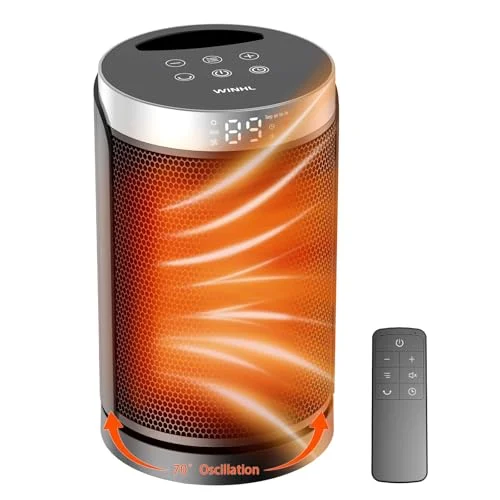
That ceiling is why a $30 oscillating tower and a $250 heater with a glass-front flame display can draw the same power. The WINHL Portable Electric Heater, built with a 9.9-inch body and 70-degree oscillation for general indoor use, doesn't state a wattage figure in its own listing — and we're not going to invent one to fill a gap. What we can say honestly is that it's a plug-in indoor heater built for the same US wall outlets as everything else in this category, and nothing about its oscillating-tower design suggests an exception. Treat 1,500 watts as the safe working assumption for any mid-size plug-in space heater unless its own listing states a different number.
What this means for shopping: once you're past the 500-watt desk tier, wattage mostly stops being the differentiator. Almost everything at $25, $75 or $150 is moving the same roughly 1,500 watts into a room; what actually changes between those price points is how that fixed amount of heat reaches you — oscillation angle, fan noise, a thermostat that cycles the unit instead of running it flat out, a remote, a timer, the cabinet it's built into.
The arithmetic that matches wattage to a room
The widely used contractor rule of thumb for electric resistance heating is approximately 10 watts per square foot of floor area, assuming a standard 8-foot ceiling, reasonably sealed windows and typical home insulation. It's a starting estimate, not a code requirement, adjusted up for anything that makes a room harder to heat. Used that way, it turns "how big a heater do I need" from a guess into a calculation you can do with a tape measure.
- Measure the room's floor area. Multiply length by width in feet. A 10-by-12 bedroom is 120 square feet; a 15-by-20 living room is 300.
- Multiply by roughly 10 watts per square foot. The 120-square-foot bedroom lands near 1,200 watts; the 300-square-foot living room lands near 3,000 — already past what a single plug-in heater can provide, the first sign you're looking at a two-heater room.
- Adjust upward for anything that isn't a standard 8-foot, well-insulated box. A vaulted ceiling, a drafty older window, a room over an unheated garage or a poorly insulated wall all raise the real requirement above the base-case number.
- Compare the result to what's actually sold. Under about 750 watts is the desk-heater tier. Near 1,200 to 1,500 is the tier almost the entire market occupies. Comfortably past 1,500, no single plug-in heater covers the room honestly — see the section below.
- Decide between one zone and two. A heater warms the air and the people near it fastest; the far corner of an oversized room is always the last part to feel different, regardless of the wattage on the box.
Worked example: a 12-by-14 home office is 168 square feet. At 10 watts per square foot, that's roughly 1,680 watts — already above the 1,500-watt ceiling a single plug-in heater can deliver. It will still make the room noticeably warmer; it just won't hit the full theoretical number.
What a square-footage rating assumes about your ceiling and insulation
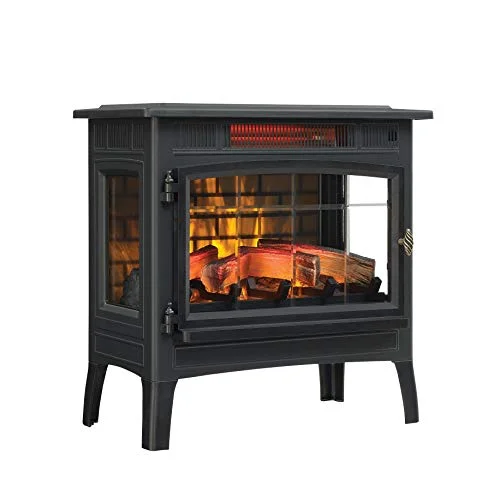
The duraflame stove's own product title states a number with real confidence: "for 1,000 Sq. Ft. Room." It's worth asking what that figure is actually measuring before it decides a $258.99 purchase.
Square-footage ratings on space heaters aren't audited the way an appliance's federal energy label is. They come from the manufacturer, under conditions chosen to be favorable: a closed, single-story room, a standard 8-foot ceiling, reasonable insulation, no major draft sources, and no significant heat loss through oversized windows or an open stairwell. A 1,000-square-foot rating describes that room. It doesn't describe yours, and the gap between the two is where a heater that looked right on paper disappoints in practice.
Three things about a real room routinely break those assumptions. A vaulted or unusually tall ceiling adds volume the rating doesn't account for, since there's more air above head height to bring up to temperature. An open floor plan connecting a living room to a kitchen and a hallway isn't a sealed 1,000 square feet the way a test room is — it's 1,000 square feet with extra doorways bleeding warmth into hallways nobody is trying to heat. And a room over an unheated basement, or one with a single-pane window and an exterior door, loses heat the test room never had to fight.
None of this makes a rating like the duraflame's false. It makes it a best-case ceiling rather than a guarantee, the same way a car's EPA mileage figure describes a test track rather than your commute. Before buying on the strength of a square-footage number, weigh ceiling height, how open the floor plan is, and how well the room is insulated against the outside — and discount the rating accordingly before the box arrives, not after.
The picks, one per tier
Three heaters, three different answers to "how much room does this actually need to cover" — not a ranked list, since the right one depends entirely on which tier your own arithmetic landed in above.
01Under 750 watts
Amazon Basics Ceramic Portable Mini Space Heater
The desk tier: built for arm's reach, not a room
500 Watts·1.4 lbs·5.87"D x 3.15"W x 5.95"H·Tip-over protection
The listing states its wattage outright, which makes this the easiest tier to size correctly: 500 watts, built into a body small enough to sit next to a keyboard. By the 10-watts-per-square-foot rule, that covers a space closer to a cubicle than a bedroom — precisely the job it's priced and built for. It includes tip-over protection, worth checking on anything this light and this close to a desk edge.
Buy it to stop your hands from being cold at a desk. Don't expect it to change the temperature of the room around you.
02The 1,500-watt tier
WINHL Portable Electric Space Heater
The mid-room tier: the wattage class almost everything shares
9.9" body·70° Oscillation·Indoor use·Oscillating tower design
WINHL's own listing doesn't print a wattage figure, so we won't assign one — but a 9.9-inch oscillating tower built for general indoor use is squarely the category that runs at the roughly 1,500-watt ceiling covered earlier, and nothing about its design suggests an exception. The 70-degree oscillation is the feature that matters at this tier: it spreads a fixed amount of heat across more of a room's width instead of pointing it at one spot.
The safe default for a bedroom or home office sized heater once a 500-watt desk unit is clearly too small.
03The rated-square-footage tier
duraflame Freestanding Electric Fireplace Stove
The whole-room tier: rated to 1,000 sq ft, read that rating first
3D Flame Effect·Rated for 1,000 Sq. Ft.·13.07"D x 24"W x 23.4"H·Freestanding cabinet
The only pick here that leads with a square-footage claim rather than a wattage figure, which is why the earlier section on what that number assumes applies most directly to it. Read the 1,000-square-foot rating as a best case measured in a closed, well-insulated room — then discount it for a vaulted ceiling or an open floor plan. At 13.07 inches deep by 24 inches wide by 23.4 inches tall, it's also the largest footprint of the three picks, worth checking against your floor space before it arrives.
The pick for a single room you want to look warm as much as be warm, with the rating treated as a ceiling, not a promise.
When two smaller heaters beat one big one
Here's the piece of this arithmetic most buyers don't run into until the heater is already plugged in: once your room's calculated wattage comfortably clears 1,500, there usually isn't a bigger plug-in heater to buy. Unlike a furnace, where a larger space genuinely gets a larger unit, a portable electric heater built for a standard US outlet tops out around 1,500 watts almost without exception, for the circuit reasons covered above. "Just buy the bigger one" isn't a real upgrade path here.
A single heater also has an effective range shorter than its rating implies. It warms the air and the people nearest it first; the far side of an open-plan room, or anything outside a radiant heater's direct line of sight, stays close to ambient temperature no matter how long the unit runs. Put one heater at one end of a 300-square-foot great room and seating at the other, and the arithmetic from earlier already told you this — one heater can't honestly do both ends of that math.
One heater is enough when
Square footage times 10 watts lands at or under about 1,500, the space is a single enclosed room, and the seating you want warm sits within 10–12 feet of the heater.
Two heaters beat one bigger heater when
The math clears 1,500 watts, the floor plan is open or split across two seating zones, or the room is too long for a single unit's output to reach both ends.
The honest answer for a room that outgrows one heater's math is to split the job rather than keep shopping for one unit that doesn't exist at this wattage ceiling. A WINHL-tier oscillating heater covering the zone people actually sit in, paired with a second small unit — even a 500-watt desk heater near a drafty window or a cold corner — distributes heat across a room's full footprint the way one unit, however it's marketed, cannot manage alone. Two 1,500-watt-class heaters running together is roughly 3,000 watts genuinely spread across the space instead of concentrated at one end.
The catch runs the same math in the other direction: two 1,500-watt heaters draw roughly 25 amps combined, well past what a single 15-amp residential circuit is rated to carry. Plugging both into outlets that share a breaker, or into the same power strip, is how breakers trip. Before setting up a two-zone arrangement, check which outlets actually share a circuit on your home's panel — that's the authority here, not a guess based on which wall each outlet happens to be on.
How we picked
We pulled three heaters that sit at genuinely different points on the wattage scale rather than three near-identical models that differ mainly in color, to make the arithmetic in this guide concrete: a stated 500-watt desk unit, a mid-tier oscillating heater built for the wattage class almost the whole market shares, and a heater that leads with a square-footage claim instead of a wattage figure. The goal was a heater for each tier this guide's math can produce, not a ranked "best overall."
How we compared
We compared these three heaters on their published titles, available specifications and current Amazon prices. Where a listing states a hard number — the Amazon Basics Mini's 500 watts, the duraflame stove's 1,000-square-foot rating and dimensions — we cite it directly. Where a listing doesn't, as with WINHL's wattage, we say so rather than estimate a figure. We do not run a testing lab or own these units, so you will not find an invented decibel reading, a score out of ten, or a paraphrased review quote anywhere on this page.
Frequently asked questions
How many watts do I need for a small bedroom or home office?
Using the roughly 10-watts-per-square-foot rule of thumb, a 120-square-foot bedroom needs about 1,200 watts, and a 150-square-foot room lands close to 1,500 — the exact ceiling most plug-in heaters are built to. That's why a single mid-tier oscillating heater is usually enough for one bedroom or office, while a 500-watt desk heater is undersized for anything bigger than the desk itself.
Is a higher-wattage heater always better?
No, mostly because there's very little headroom to shop for. Once you're past the 500-watt desk tier, nearly every plug-in heater sold for a standard US outlet runs at roughly the same 1,500-watt ceiling, set by what a 15-amp residential circuit can safely deliver. Above that tier, what actually differs between models is how the heat is delivered — oscillation, a thermostat, a stove-style cabinet — not how much heat a higher price buys.
What does a square-footage rating like "1,000 sq ft" actually assume?
It's typically measured in a closed, single-story test room with a standard 8-foot ceiling, good insulation and no major drafts — favorable conditions, not a guarantee about your home. A vaulted ceiling, an open floor plan, extra doorways or a room over an unheated space will all pull real-world performance below the rated figure. Treat any square-footage claim, including the duraflame stove's 1,000-square-foot rating, as a best-case ceiling rather than a promise.
Should I buy one big heater or two smaller ones for a large room?
Often two, because there usually isn't a bigger single plug-in heater to buy once your room's square footage times 10 watts clears about 1,500 — nearly every unit on the market tops out there regardless of price. Splitting an oversized or open-plan room into two zones, each with its own heater, covers more of the space honestly than searching for one heater rated for the whole thing. Just confirm the two heaters aren't sharing a circuit before running them together.
Written by Ilane Tall. Research-based comparisons of published specifications, current prices and public product data — we do not physically test these units and we do not publish invented scores.