By Ilane Tall · Updated October 30, 2026 · Research-based.
Reader-supported: we may earn a commission when you buy through the links on this page, at no additional cost to you. It never changes which product we recommend. Prices quoted below were correct at the time of writing and move often.
Quick answer
A camper, a van or a tiny room doesn't need a smaller version of a living-room heater — it needs one built around weight and footprint first, heat output second. The Amazon Basics Ceramic Mini Space Heater ($18.39) is the pick if the heater has to disappear into a cabinet between trips: it's 500 watts, a stated 1.4 pounds, and small enough to tuck beside a dinette seat.
If you want a digital thermostat and a remote in that same small footprint, the DREO 10-Inch Space Heater ($33.36) is the step up, and the DREO Standard ($42.49) is the one to add if the "room" is really a small cabin or tiny house rather than a single bunk. None of the three is rated for outdoor or bathroom use, and the amp math on a 15-amp hookup deserves a look before any of them gets plugged in.
Why a tiny room is a different brief than a small room
"Small room" and "tiny room" sound like a difference of degree. On a heater-shopping list they're a difference of kind. A small bedroom in a house still has a wall outlet on a 15- or 20-amp household circuit, a closet to store the heater in during summer, and enough floor or counter space that a 10-inch-wide tower barely registers. A camper van, a truck bed slide-in, a travel trailer bunk or a backyard tiny house has none of those things as a given: the available surface is a single counter that also holds a stove top or a sink, storage is a cabinet already full of cookware, and the outlet may run off a 15-amp shore-power pedestal shared with the refrigerator, the water heater and whatever the neighboring site is running.
That's the actual brief behind this page. We're not comparing three heaters that happen to be small. We're comparing them against a different set of constraints — pack size, weight, and what they do to a circuit with less headroom than a house's — because those are the variables that decide whether a heater earns its spot in a rig with no spare space, not a square-footage number built for a house.
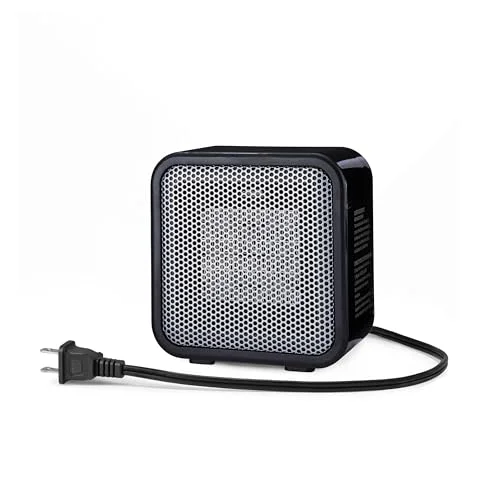
The Amazon Basics Ceramic Mini is the only one of the three with a stated weight in its own listing: 1.4 pounds, with a footprint the database lists at 3.4 by 5.8 by 6 inches. That's small enough to sit on a narrow counter edge, ride in a door pocket while you drive, or get tucked into a cabinet that already holds pots and a cutting board without anything else having to move. At 500 watts, it's also well under the 1,500-watt ceiling most living-room heaters run at — less total heat, but a heater this size was never going to warm an open floor plan; it's built to take the edge off a space you can touch every wall of from the middle of the room.
The two DREO units don't carry a stated weight or exact footprint in our data. What the database does give us is each product's own size label: "10 inch" for the smaller DREO, "Standard" for the larger one. Those are vendor size tiers, not independently measured dimensions, so treat them as a relative ranking rather than an exact number to plan cabinet space around. If precise dimensions decide whether a heater fits a specific shelf, check the current listing's measurements before buying.
The honest trade-off: a heater light and small enough to live in a cabinet between trips is, almost by definition, a heater that can't do what a full-size tower does. None of the three picks here claims a square-footage rating, and we're not going to estimate one. Judge them on whether they'll warm the one room you're actually sitting in.
Shore power and a 15-amp hookup: the same arithmetic, less margin
The arithmetic that governs any plug-in heater doesn't change in an RV: watts divided by volts gives you amps, and a standard 120-volt circuit is commonly rated 15 amps. A 1,500-watt heater draws roughly 12.5 amps on its own — close to that limit even in a house. The Amazon Basics Mini, at a stated 500 watts, draws closer to 4.2 amps, which is the entire point of choosing a lower-wattage unit for a rig: it leaves far more of a shared circuit's capacity for everything else plugged into it.
Neither DREO listing in our data states a wattage figure. Like most plug-in space heaters sold for a standard US outlet, the reasonable working assumption is that they run at or near the common 1,500-watt ceiling unless the listing says otherwise — and we'd rather say that plainly than invent a number to fill the gap. If the exact wattage of a specific heater decides whether it's safe on your setup, confirm it on the current listing before buying, because the difference between a 500-watt mini and a 1,500-watt unit is the difference between four amps and twelve.
What makes a campsite hookup different from a house circuit isn't the physics — it's the margin. A 30-amp RV shore-power connection splits into a single 120-volt leg that, once the air conditioner, the water heater and the refrigerator are already drawing from it, can leave surprisingly little headroom for a 1,500-watt heater. Boondocking on a generator or an inverter shrinks that margin further: a small gas generator rated around 2,000 watts can be entirely consumed by one full-size heater. A 50-amp connection with two separate 120-volt legs has more room, but it's still worth knowing which outlets share a leg before running a heater and the microwave at once.
A smaller heater makes sense when
You're on a 15- or 30-amp hookup, running other appliances off the same circuit, or relying on a generator or inverter with a hard wattage ceiling. The Amazon Basics Mini's roughly 4-amp draw leaves room for almost everything else in the rig.
A full-size unit's assumed 1,500 watts matters when
You're on a dedicated outlet, a 50-amp connection with real headroom, or shore power at a developed site rather than a generator. Confirm the specific heater's wattage on its listing before relying on it.
The practical habit either way: plug a space heater directly into a wall outlet, never a daisy-chained power strip or an extension cord rated for light duty, and check what else is drawing from the same circuit before you leave it running unattended — the same rule that applies in a house, with a lot less slack to absorb a mistake.
What gets left off a travel-sized heater
The product photos are honest about where each of these three heaters spends its budget. The Amazon Basics Mini's listing shows a simple wire-mesh front and a basic control, with no digital display and no remote pictured anywhere in the listing — it's built around tip-over protection and fast heating, full stop. That's not a flaw for the job it's doing: a heater meant to live in a cabinet and come out for an hour at a time doesn't need a seven-day schedule or a phone app, and at $18.39 it isn't priced as if it should.
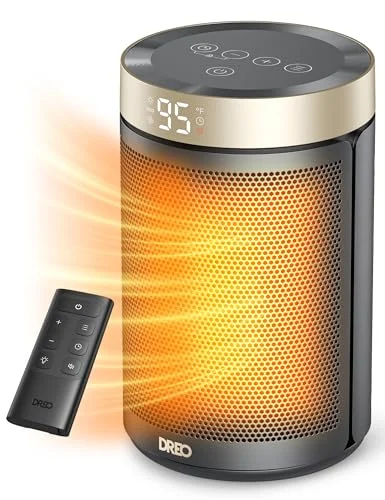
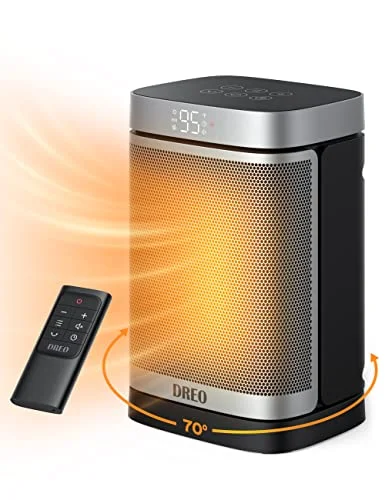
Both DREO units, by contrast, are pictured with a backlit touch control panel, a digital temperature readout and an included physical remote — features that usually show up on full-size living-room heaters, scaled down into a travel-sized cabinet. The Standard-size DREO's product image also marks 70-degree oscillation, spreading heat across a wider arc than a fixed-point heater would; the 10-inch DREO's listing images don't show the same oscillation callout, which is consistent with it being the more compact, likely fixed-direction option in the pair. If oscillation specifically matters to your layout, that's worth confirming on the current listing rather than assuming it carries over between the two sizes.
What none of the three offers, based on what's in our data: a stated noise rating, a square-footage coverage claim, or a multi-day programmable schedule. Those tend to disappear first as a heater gets smaller and more travel-oriented — see our look at what a remote actually buys you for which controls matter and which are convenience add-ons. A heater built for a rig is optimized for pack size and simple operation, not the full feature set of something meant to sit in one house spot for years.
The picks
Three sizes, not a ranked list — the right one depends on how much counter and cabinet space you actually have, and whether you want a thermostat and a remote badly enough to give up the smallest possible footprint.
01Best for the tightest space
Amazon Basics Ceramic Mini Space Heater
The one built to disappear into a cabinet
500 Watt·1.4 lb stated weight·Tip-over protection·3.4 x 5.8 x 6 in
The smallest and lightest option in our catalogue for this use, and the only one of the three with a stated weight: 1.4 pounds, in a 3.4 by 5.8 by 6-inch footprint. At 500 watts it draws roughly 4.2 amps, a fraction of what a full-size heater pulls off the same circuit — useful on a shared shore-power hookup. The trade-off is simplicity: tip-over protection and fast heating, no digital display, no remote pictured in the listing. For a dinette seat, a bunk, or a desk corner in a van, that's the entire job description.
The pick if the heater has to earn its cabinet space every single trip.
02Best with a thermostat and remote
DREO 10-Inch Space Heater
The compact pick that keeps the digital controls
10-inch size tier·Digital thermostat·Remote included·Touch panel
DREO's smaller size tier in this line, labeled "10 inch," pairs a backlit touch panel and digital temperature readout with an included remote — the controls the Amazon Basics Mini skips, in a unit still compact enough for a counter doing other jobs. Our data doesn't give a stated wattage or exact weight, so treat it like most 1,500-watt-class heaters for circuit planning unless the current listing says otherwise. It's the middle ground: more control than the cheapest option, without the larger DREO's size.
Buy this if a thermostat you can actually set matters more than shaving off the last inch of footprint.
03Best for a tiny house or small cabin
DREO Space Heater, Standard
The step up for a room you'd actually call a room
Standard size tier·70° oscillation·Digital thermostat·Remote included
The larger of DREO's two size tiers, marked "Standard," and the only pick whose listing images show 70-degree oscillation — spreading heat across an arc instead of a fixed point, useful once the space is big enough that one direction doesn't cover it. It carries the same digital touch panel and remote as the 10-inch version, and the same lack of a stated wattage figure, so plan your circuit around the typical 1,500-watt assumption. At $42.49 it's priced closer to our picks in the $50-to-$100 bracket, which tracks with it being built for more square footage than a bunk or a dinette.
The pick for a park-model trailer, a tiny house, or any "small room" that's bigger than a single sleeping nook.
Storing it between trips
A heater that lives in a cabinet eight or ten months a year gets treated differently than one that sits in a living room corner year-round, and that changes what's worth checking before it goes back into storage and again before the first cold trip of the season.
- Let it cool fully before packing it away. A ceramic element holds heat for a few minutes after it's switched off; give it time before it goes into a cabinet next to anything flammable, including its own cord.
- Coil the cord loosely, not tightly wound around the body. A cord wound tight around a hot housing, trip after trip, is a common way insulation cracks years before the heating element fails.
- Check the vents for dust before the first use each season. A cabinet that also stores blankets or paper goods tends to leave lint near an intake grille, and a partially blocked vent is a common reason a small heater runs hotter than it should.
- Keep it dry. None of the three heaters on this page is rated for bathroom, outdoor or high-humidity use. A rig with window condensation in cold weather is not a safe storage spot if moisture can reach it directly.
- Test it on household power before the trip, not after you've set up camp. A known-good outlet at home confirms it survived the off-season before you're relying on it with no backup heat source.
How we picked
We started from our own database of space heaters listed for sale in the US and filtered specifically for small physical size and, where stated, lower wattage, rather than pulling three near-identical towers that happen to be marketed at a tiny-space audience. The three products here cover a genuine range: a sub-two-pound mini with no digital controls, and two sizes of a more fully featured compact unit, so the picks reflect an actual trade-off between size and features rather than three versions of the same compromise.
How we compared
We compared the three heaters on their published titles, stated specifications, product photography and current Amazon prices. Where a figure is stated — the Amazon Basics Mini's 500 watts, 1.4-pound weight and 3.4 by 5.8 by 6-inch size — it comes directly from the product's own listing data. Where a figure isn't stated, including wattage and exact dimensions for both DREO units, we say so plainly rather than estimate one, and we worked from product photography only for details visibly present in the images, such as the touch panel, remote and oscillation marking on the DREO units.
We do not run a testing lab. We do not own these three heaters and have not run them in a van, a trailer or a tiny house ourselves, so you will not find an invented decibel reading, a square-footage claim or a score out of ten here. We also don't show star ratings, review counts or paraphrased owner sentiment, because we don't have manufacturer-published figures for these specific listings.
Frequently asked questions
What makes an RV or camper heater different from a regular small-room heater?
Mainly the constraints around it, not the heating itself. A house bedroom has a dedicated closet, a household circuit with normal headroom, and enough floor space that heater size barely matters. An RV or camper has none of those as a given — a single shared counter, a shore-power or generator circuit with much less spare capacity, and storage that has to be packed and unpacked every trip. That's why weight and footprint matter as much as, or more than, heat output when choosing one.
Does a travel heater need to be lighter than a home heater?
Not strictly, but it helps. The Amazon Basics Mini's stated 1.4-pound weight and compact footprint make it easy to store in a cabinet and move around without it feeling like dead weight. A heavier unit isn't unsafe to travel with, but it takes up a fixed spot rather than tucking into whatever gap is available, which matters more in a rig with limited storage than in a house.
Will a space heater work on a 15-amp campsite hookup?
Often, but with less margin than at home. A 1,500-watt heater draws roughly 12.5 amps on its own, which can leave little headroom once an air conditioner, a water heater or a refrigerator is already pulling from the same circuit. A lower-wattage heater, like a 500-watt mini drawing around 4.2 amps, leaves much more of a 15-amp circuit free for everything else running at the same time — see our full breakdown of breaker math for the household version of the same arithmetic.
How should I store a space heater between trips?
Let it cool fully before packing it away, coil the cord loosely rather than wrapping it tight around the housing, and check the intake vents for dust before the first use of the season. None of the heaters on this page is rated for damp storage, so keep it away from any spot in the rig prone to condensation.
Written by Ilane Tall. Research-based comparisons of published specifications, current prices and public product data — we do not physically test these units and we do not publish invented scores.