By Ilane Tall · Updated October 29, 2026 · Research-based.
Reader-supported: we may earn a commission when you buy through the links on this page, at no additional cost to you. It never changes which product we recommend. Prices quoted below were correct at the time of writing and move often — check the current price before buying.
Quick answer
Every heater in this roundup draws the same 1,500 watts a $25 heater draws, so the $50–$100 bracket is not selling you more heat. It is selling you a more precise way to control that heat and a housing built to take a season of daily use. If you want the most precise control in this bracket, the DREO Space Heater with Thermostat ($63.74) is the one to buy: it is the only one of the three with a stated digital thermostat rather than fixed settings.
If you specifically want the quietest option, the DREO Quiet Space Heater ($69.99) states a 34 dB noise figure and ships with a remote. If coverage and oscillation matter more than either, the DREO 16 Inch for Large Room ($69.99) spreads heat across a 70-degree arc. Past $100, read on before spending more — the next tier adds different heating elements, not more watts.
What changes at the $50 line, and what does not
Start with what never moves: the wattage. A standard US wall outlet is rated 15 amps at 120 volts, and nearly every portable electric heater sold for that outlet — a $23 personal heater or a $75 one — is built to roughly 1,500 watts, the practical ceiling before a continuous plug-in load starts eating into a circuit's safety margin. All three heaters in this bracket state 1,500 watts. None of them heats a room faster than a cheaper heater at the same wattage, and none of them heats a room this bracket's price alone wouldn't suggest. If a listing promises more heat for more money at this wattage, that claim doesn't hold up against the electrical ceiling every plug-in heater shares.
What does change, consistently, once a heater crosses roughly $50: the control mechanism gets more specific, the motor and fan get engineered rather than just installed, and the housing material gets a safety rating called out by name instead of implied. The DREO Space Heater with Thermostat states a 12-hour timer on top of its digital thermostat and a 24-hour automatic power-off as a backstop, plus V-0 flame-retardant housing material — a fire-safety classification meaning the plastic self-extinguishes rather than continuing to burn once removed from a flame. The DREO Quiet Space Heater and the DREO 16 Inch both state the same V-0 rating and the same tip-over and overheat protection, all ETL-listed. A $25 heater often has tip-over protection too; what the higher bracket adds is the combination, stated plainly, along with the engineering behind why it should hold up to months of continuous use rather than one.
The honest version of this section: you are not buying watts in this bracket. You are buying the parts of the heater you interact with every day — the dial, the fan noise, the shutoff logic — built to a standard that a bargain unit usually skips or states less specifically.
Changes above $50
A stated thermostat instead of fixed settings, a stated noise figure instead of silence on the spec sheet, a named flame-retardant housing grade, and auto-off logic layered with a hard 24-hour cutoff rather than one shutoff path alone.
Does not change
The wattage (still ~1,500W), the physical reach of the heat into a room, and the fact that none of this is a substitute for central heating in anything but a single room.
A digital thermostat versus three power settings, again
This is the single biggest functional difference inside the bracket itself, not just against cheaper heaters. The DREO Space Heater with Thermostat is named for the feature: a digital thermostat that reads the room and cycles the heating element to hold a target temperature, rather than running flat out or idle. The DREO Quiet Space Heater and the DREO 16 Inch for Large Room, by contrast, are built around DREO's Hyperamics PTC heating system but their listings describe remote control and oscillation rather than a stated thermostat — which means, on the data available, you are setting a level and leaving it, not telling the unit a number and trusting it to hold there.
The practical difference shows up at 3 a.m. and on the electric bill, not on the showroom floor. A heater with a handful of fixed settings is either too much heat or not quite enough for the room you're in; a thermostat-equipped unit cycles the element on and off to track a target, which in practice draws less than the full 1,500 watts most of the time once the room reaches temperature. We go deeper on why this distinction matters more than wattage in its own guide, but the short version for this bracket: if you're choosing between these three and only one feature should break the tie, make it the thermostat.
That doesn't make the other two heaters worse choices — it makes them different trade-offs. The DREO Quiet Space Heater ships with a remote, which is its own kind of control: you're not adjusting a thermostat number, but you're also not getting up to change the setting, which is worth weighing on its own against the ten-dollar premium a remote typically adds. The DREO 16 Inch leans on a 70-degree oscillation angle instead, trading precise temperature-holding for physically spreading the same fixed output across more of a room.
Quieter motors and better-sealed housings
Noise is one of the few specs in this category that a manufacturer can state honestly and a reader can actually use for comparison, because decibels are measurable rather than marketing language. Two of the three heaters here state a figure: the DREO Quiet Space Heater and the DREO Space Heater with Thermostat both list 34 dB, which the thermostat model's listing frames as roughly 12% quieter than a traditional electric heater fan. For context, that's close to a quiet library — audible in a silent room, not something that competes with a television at normal volume.
Both of those two heaters attribute the figure to specific engineering rather than just a smaller fan: a brushless DC motor paired with a winglet-shaped fan blade on the Quiet model, intended to cut the turbulence a standard fan motor produces, and an angled, "oblique airflow" fan design on the thermostat model aimed at the same problem from a different direction. The DREO 16 Inch for Large Room doesn't state a decibel figure in the data we have, so we won't assign it one — its listing instead emphasizes heating speed and the 70-degree spread, which is a different kind of claim doing a different kind of work.
Housing is the other half of this section, and it's less visible than noise but just as consistent across the bracket: all three heaters state V-0 flame-retardant housing material, ETL certification, and both tip-over and overheat protection. The DREO 16 Inch adds what it calls Shield360° protection and the thermostat model adds a 24-hour automatic power-off as a second shutoff path beyond its 12-hour timer. None of this is unique to expensive heaters, but a $50–$100 heater is the price point where you stop having to take the safety claim on faith and start seeing the specific certification and material grade spelled out in the listing.
The picks
Three heaters, three different answers to what the $50–$100 bracket is actually for — not a strict ranking, since the right one depends on whether silence, coverage or precise temperature control matters most in the room you're heating.
01Best controls
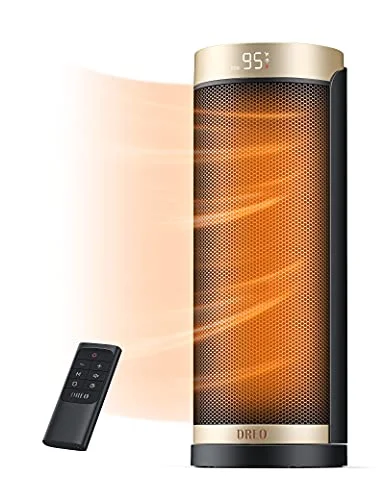
DREO Space Heater with Thermostat
The only one of the three built around a digital thermostat
PTC ceramic·1,500W·Digital thermostat·34 dB stated·16 inch
This is the heater in the bracket built around precision rather than raw output. The thermostat is the headline feature, backed by a 12-hour timer and, separately, a 24-hour automatic power-off that triggers even without you resetting anything. DREO states a 34 dB noise figure here too, attributed to an angled fan design meant to cut wind noise, and a heating coverage figure of 270 square feet — which, like every square-footage claim in this category, is a best-case number from a favorable test room rather than a guarantee about yours. The housing is V-0 flame-retardant and ETL-listed, with the usual tip-over and overheat protection. The one instruction worth repeating from the listing itself: it is not rated for an extension cord, so it wants a direct wall outlet.
The pick if you want the heater to manage the room's temperature on its own rather than you managing it.
02Best for quiet rooms
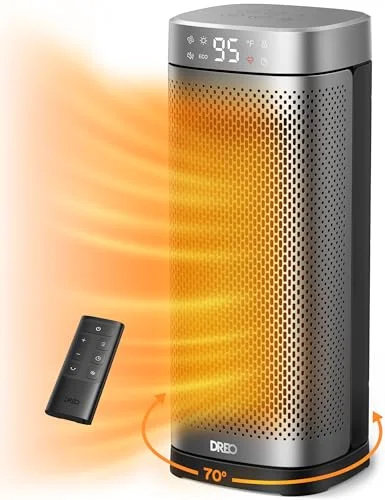
DREO Quiet Space Heater
The one built specifically around low noise, with a remote
PTC ceramic·1,500W·34 dB stated·Remote included·15 inch
DREO built this one around the same noise problem the thermostat model addresses, but with a different fix: a brushless DC motor paired with winglet-shaped fan blades specifically engineered to reduce turbulence, stated at the same 34 dB figure. It ships with a remote rather than a thermostat, so you're setting the output level from across the room instead of handing temperature-holding to the unit itself — a meaningfully different kind of convenience, and worth weighing against the thermostat model if remote control matters more to you than automatic temperature tracking. It carries the same child-lock, tip-over protection, V0 flame-retardant housing and overheat protection, ETL-certified, as the rest of the bracket.
The pick for a bedroom or a shared space where fan noise is the thing you actually notice at night.
03Best for spreading heat wide
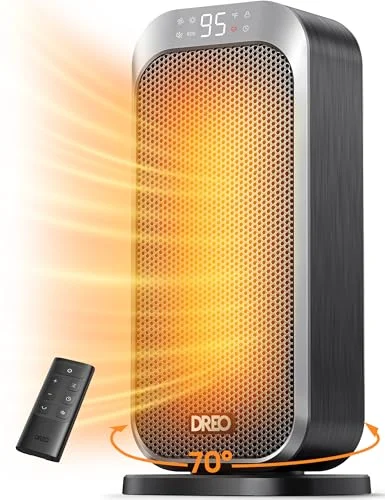
DREO 16 Inch Electric Heater for Large Room
The one that trades a thermostat for a 70-degree spread
PTC ceramic·1,500W·70° oscillation·24-hour auto-off·16 inch
Where the other two heaters in this bracket compete on precision and quiet, this one competes on reach. DREO states a 70-degree wide-angle heating capability and a heating speed figure of 11.8 feet per second, aimed at a room up to 250 square feet — again, a best-case figure, not a promise about a room with a vaulted ceiling or an open floor plan. The safety stack is the same ETL-listed, V-0 flame-retardant combination as its siblings, badged here as a Shield360° system, with tip-over and overheat protection plus a 24-hour auto-off on top of the usual shutoffs. There's no stated noise figure in the listing data we have for this one, so we're not assigning it a number either way.
The pick if you want the heat to reach both ends of a room rather than holding one exact temperature in the middle of it.
Where $100 stops buying you anything new
The pattern holds past the top of this bracket, too, and it's worth knowing before spending more. Cross $100 and the wattage ceiling doesn't move — it can't, for the same circuit reasons covered above — so a heater north of $100 isn't warming a room faster than the three above. What it typically adds is a different heating mechanism entirely rather than a stronger version of the same one: a cabinet-style unit that pairs an infrared element with a PTC ceramic element in a single housing, for instance, so it warms the people and furniture in a room as well as the air moving through it. We cover that category, and when it's actually worth the jump, in our large-room roundup.
What that extra money buys is a second heat-delivery method, not a bigger version of the one you already have. If a thermostat, a quiet motor and a sealed housing cover what you need — which, for a single room, is most of what any plug-in heater can offer — the $50–$100 bracket is very likely the top of the useful curve for your money. Past it, you're paying for a different physical approach to the same fixed wattage, and whether that approach suits your room is a separate question from how much it costs.
The sub-$50 alternative, if you only need one season
Not every use case justifies this bracket. If you need a heater for a single cold spell, a dorm room you won't be in next year, or a backup for one unheated room you rarely use, the honest advice is to not overbuy. A basic heater under $50 still runs the same 1,500 watts, still carries tip-over and overheat protection on any model worth buying, and still gets a room from cold to tolerable. What it typically skips is the thermostat precision and the stated noise engineering covered above — you'll set a level and live with the fan noise rather than dial in an exact temperature and forget about it.
Our dedicated guide to that lower tier covers what you're trading away at that price and which compromises are worth making for a heater you might only plug in a handful of times. If you expect to use the heater every winter, in the same room, for years, the math tends to favor spending the extra $20–$30 to land in the bracket covered here instead.
How we picked
We started from our own database of space heaters listed for sale in the US and filtered to the $50–$100 price band specifically, then looked for products that took genuinely different approaches within that band rather than three near-identical towers in different colors. The three heaters here represent three different priorities at the same wattage and roughly the same price — thermostat precision, stated quiet operation, and wide-angle coverage — chosen because the mechanism and control method matter more at this price point than any single spec taken alone.
How we compared
We compared these three heaters on their published titles, stated specifications and current Amazon prices, all current as of late October 2026. Where a listing states a figure — the thermostat model's 34 dB and 12-hour timer, the Quiet model's 34 dB and brushless DC motor, the Large Room model's 70-degree oscillation and 11.8 ft/s heating speed — we cite it directly from the manufacturer's own listing data. Where a listing doesn't state a figure, such as a decibel rating for the Large Room model, we say so plainly rather than estimate one to fill a gap.
We do not run a testing lab. We do not own these three heaters and have not run them in a room ourselves, so you won't find an invented decibel reading or a score out of ten anywhere on this page. We also don't show star ratings, review counts or paraphrased owner sentiment here, because we don't have manufacturer-published figures for these specific listings — a limitation of the data available to us, not a judgment on the heaters themselves.
Frequently asked questions
What actually changes once a heater crosses $50?
Not the wattage — that stays at roughly 1,500 watts across almost the entire plug-in heater category, cheap or not. What changes is the control mechanism and the stated engineering behind it: a digital thermostat instead of fixed settings, a stated noise figure backed by a named motor or fan design, and a flame-retardant housing grade spelled out rather than implied. You're paying for precision and build quality, not more heat.
Is a digital thermostat worth paying more for than three power settings?
If you'll use the heater regularly in the same room, generally yes. A thermostat cycles the heating element to hold a target temperature, which in practice runs the heater below full output once the room reaches that target, rather than leaving you to choose between too hot and not quite warm enough on a fixed setting. Of the three heaters compared here, only the DREO Space Heater with Thermostat states this feature.
Do the "quiet" claims on these heaters hold up, or is that marketing?
Two of the three heaters here back the claim with a specific, measurable figure — 34 dB, roughly equivalent to a quiet library — and attribute it to named engineering: a brushless DC motor and winglet fan blades on one, an angled "oblique airflow" fan design on the other. A stated decibel number from the manufacturer is a real claim you can compare across products; an unquantified "whisper-quiet" on a listing with no number attached is the one worth treating skeptically.
Does spending more than $100 get me more heat?
No. Nearly every plug-in space heater sold for a standard US outlet, regardless of price, tops out around 1,500 watts because that's close to the practical ceiling of a 15-amp residential circuit. Heaters priced above $100 typically add a different heat-delivery method — commonly a cabinet pairing an infrared element with a ceramic one — rather than a stronger version of the heating already covered in this bracket.
Written by Ilane Tall. Research-based comparisons of published specifications, current prices and public product data — we do not physically test these units and we do not publish invented scores.