By Ilane Tall · Updated October 21, 2026 · Research-based.
Reader-supported: we may earn a commission when you buy through the links on this page, at no additional cost to you. It never changes which product we recommend. Prices quoted below were correct at the time of writing and move often.
Quick answer
Oscillation doesn't make a heater produce more heat — it changes where that heat ends up. A heater that stays still warms whatever sits directly in its path and leaves the rest of the room exactly as cold as it found it; a heater that sweeps side to side spreads the same output across an arc instead of a point. The OLIXIS 23" Space Heater ($39.95) is our pick if you want the widest published sweep at the lowest price: a stated 70° oscillation with four operating modes in a 23.62-inch tower.
If floor space and budget matter more than modes, the JIBUFI Portable Space Heater ($29.99) packs the same stated 70° sweep into a 9.96-inch compact body with a remote. The PELONIS 23” Oscillating Ceramic Tower ($66.99) is the pick if a built-in timer matters as much as the arc does. What that published angle actually buys you is worth reading before you choose between them.
What oscillation actually changes about where the heat ends up
Every heater in this category is drawing roughly the same wattage through roughly the same kind of ceramic or PTC element, so the honest starting point is: oscillation changes distribution, not output. A fixed heater throws its heat in a narrow, continuous column — aim it at an armchair and the armchair gets warm fast, while the rug six feet to the left stays exactly as cold as it was before you plugged the heater in. A heater on a motorized swivel base takes that same column of warm air and sweeps it back and forth across an arc, so instead of one hot lane it produces a wedge-shaped zone of gradually warming air.
That distinction sounds cosmetic until you think about how a room is actually used. A living room is rarely one seat; it's a sofa, a chair at an angle to it, maybe a reading corner by a window. A heater that stays fixed on the sofa does nothing for the chair. The three heaters in this guide — the JIBUFI, the OLIXIS and the PELONIS — are all built on the premise that most rooms need a spread, not a beam, and all three put a motorized oscillating base on what is otherwise a fairly ordinary ceramic or PTC tower heater.
The trade isn't free, and the honest version of this guide says so upfront: a moving heater has more to go wrong than a stationary one, and we get into exactly what that costs in the noise and failure-point section below. But for the specific problem of warming a room rather than a chair, oscillation is the mechanism that does it, and it's the reason all three heaters here earn a place on this page instead of a plain fixed tower.
70 degrees, 45 degrees, wide: what the published angle actually means
Oscillation angle is one of the few numbers in this category manufacturers do publish, and it's worth reading literally rather than skimming past. Both the JIBUFI Portable Space Heater and the OLIXIS 23" Space Heater state a 70° oscillation angle in their own product titles — a specific, checkable figure rather than a vague "wide sweep" claim, and the number we're working from for both of those two heaters.
Seventy degrees is a meaningfully wide arc: picture the heater as the point of a wedge, with each edge of that wedge roughly 35 degrees off dead center. In a typical living room, that's usually enough to cover a sofa and an adjacent chair set at a slight angle to it, though not necessarily a chair set at a full right angle across the room. Elsewhere in this category, manufacturers also publish narrower figures — 45° is a common alternative spec on compact personal heaters, built more for a desk or a single nearby seat than a shared room — and some towers advertise a full 180° "wide" sweep meant to cover nearly everything in front of the unit. The angle a given heater ships with is a deliberate design choice, not an afterthought, and it's worth matching to the actual shape of the room before you buy rather than after.
The PELONIS 23” Oscillating Ceramic Tower is, by its own name, an oscillating heater, and it ships with a remote and a timer. What we don't have from the listing data we're working from is a specific degree figure for its sweep — and rather than guess a number to make the comparison tidy, we're saying so plainly: if the exact angle matters to your room layout, check the current PELONIS listing directly before buying. That's an honest gap in the data, not a judgment on the heater.
The practical rule: a wider published angle covers more of an irregularly shaped room, a narrower one concentrates more consistently on a smaller zone. Neither is objectively better — a 45° sweep aimed at a desk and a nearby chair does its one job well, while a 70° sweep wasted on a small, square room just means the heat spends part of every cycle pointed at a wall.
What the mechanism costs you: noise, and the parts most likely to fail
A fixed heater has one motor, for the fan that pushes air across the heating element. An oscillating heater has that same fan motor plus a second, smaller motor and a gear or belt assembly that physically rotates the heater body or an internal louver back and forth on a timer. That second mechanism is the entire story of what oscillation costs you, in two separate ways.
The first cost is noise. None of the three listings we're working from states a decibel figure, so we won't invent one — but the general mechanical reality of the category is worth stating plainly: an oscillation motor adds its own low hum or click to the fan noise a heater already makes, audible at close range even when the fan itself is quiet. If near-silent operation in a bedroom matters more to you than coverage, that's worth weighing against the appeal of a wide sweep; our separate guide on the quietest space heaters we could find published noise figures for goes deeper on that trade-off specifically.
The second cost is mechanical. Any motorized moving part is one more thing that can wear out, seize, or develop play over years of daily use, in a way a sealed, stationary heater simply can't. This isn't a defect unique to any one of these three products — it's true of every oscillating appliance ever built, from box fans to desk fans to these heaters. It's also not a reason to avoid the category; it's a reason to treat the tip-over switch, the overheat cutoff and the auto-shutoff timer as the parts actually worth checking before you buy, since those are the safety systems doing the real work regardless of whether the oscillation motor itself is still perfectly smooth five years from now. Our guide to what those shut-off systems actually cover is the place to read that in full.
None of this is a reason to default to a fixed heater out of caution. It's a reason to be clear-eyed about the trade: you're buying coverage of a wider area, and paying for it with one more moving part and a few more decibels. For most living rooms, that trade is worth making.
Why a still heater warms a chair and a moving one warms a room
It's worth stating the physical reason this works, because it's simpler than it sounds. Warm air rises and mixes, but it does so slowly relative to how fast a heater's fan pushes it out in one direction. Point a 1,500-watt-class heater at a single spot and most of that output arrives as a column of warm air hitting that one spot, repeatedly, for as long as the heater runs — which is exactly why sitting directly in front of a space heater feels noticeably warmer than standing a few feet to either side of it, even in the same small room.
An oscillating base breaks that column into a series of shorter pulses distributed across an arc instead of one continuous stream aimed at one point. No single part of the room gets the full, continuous blast a stationary heater delivers to its one target — but a much larger share of the room gets some of it, repeatedly, over the course of the time the heater runs. Over an hour, that adds up to a more evenly warmed space rather than one hot seat and a cold room around it.
This is also why oscillation matters more in some rooms than others. A small, square bedroom with one bed and one obvious spot for a heater doesn't need the sweep — a fixed heater aimed at the right spot does the job, and our guide to heaters built specifically for a bedroom covers what matters more there instead. A home office with a desk chair that's the only seat in the room has the same logic, which is part of why our home-office picks lean toward compact, directional heaters rather than wide-sweep towers. Oscillation earns its keep specifically in rooms with more than one place to sit, or an irregular shape that puts the obvious heater placement off to one side of where people actually spend time.
The picks
Three heaters, each handling the same oscillation trade a little differently — by price, by footprint, and by what else is bundled alongside the sweep.
01Widest sweep for the price
OLIXIS 23" Space Heater
Best overall oscillating pick
70° oscillation·4 modes·23.62" tower·9.09" × 7.87" × 23.62"
A 23-inch tower that states the same 70° oscillation figure as the JIBUFI below, but in a taller, standing-tower format with four operating modes rather than a compact tabletop body. The listing advertises four distinct modes without detailing exactly what each one changes beyond the heat output, so if the specific mode behavior matters to your routine, check the current listing before buying. At this height, the sweep clears a coffee table or an ottoman in a way a low tabletop unit can't, which is the practical reason it's the pick for a living room over a desk.
The pick if the room has more than one seat and you want the widest published arc covering all of them.
02Smallest footprint
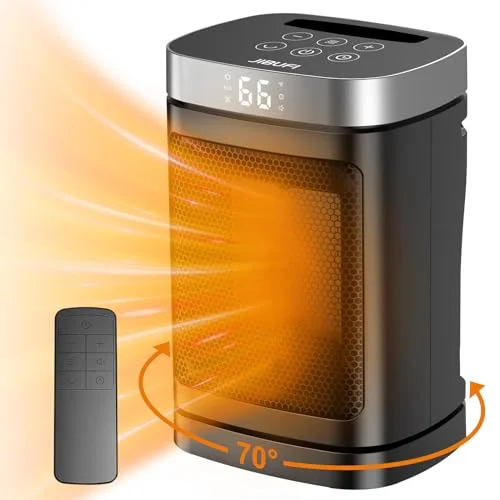
JIBUFI Portable Space Heater
Best for a desk or a small room on a budget
70° oscillation·Remote included·9.96" body·Compact / tabletop
The same stated 70° oscillation angle as the OLIXIS, built into a 9.96-inch body small enough for a desk, a side table or a narrow gap between furniture where a 23-inch tower won't fit. It ships with a remote, so the sweep, like the heat setting, doesn't require getting up to adjust. At $29.99 it's the least expensive of the three picks here, and the one to check first if budget is the deciding factor — our roundup of heaters under $50 covers more of that end of the category.
The pick if floor space is tight and you still want the wider sweep rather than a fixed beam.
03Best with a built-in timer
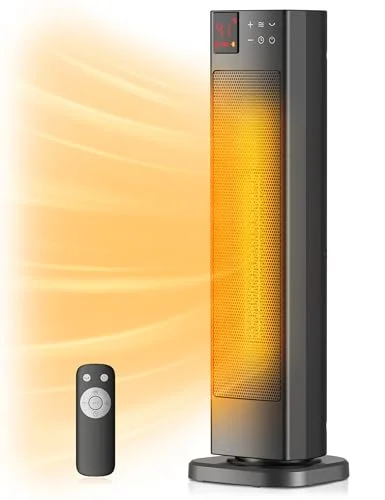
PELONIS 23” Oscillating Ceramic Tower
Best for pairing the sweep with a shut-off timer
Ceramic·Oscillating·Timer & remote·23-inch, Premium variant
A 23-inch ceramic tower built around the same oscillating-base concept as the other two picks, with a built-in timer and remote control bundled in. We don't have a specific oscillation-angle figure for this listing the way we do for the JIBUFI and OLIXIS, so we're not stating one — what the listing does confirm is the timer, which matters if you want the heater to stop sweeping and shut off on its own rather than running until you remember to switch it off. Our guide to how these timers actually work covers that spec in more depth.
The pick if an automatic shut-off matters to you as much as the sweep does.
When you want oscillation switched off
Every heater in this roundup lets the sweep be switched off, holding the unit in a fixed position instead, and that setting earns its place on the remote for real reasons — not just as a fallback.
Leave oscillation on when
The room has more than one seat, an irregular layout, or you want a generally warmer room rather than one hot spot — a living room, a shared space, or any room where people move around rather than staying in one chair.
Switch oscillation off when
You have one specific target — a desk chair, a reading chair, the side of a bed — and want the fastest, most concentrated heat at that one spot rather than a wider, slower-building spread across the room.
There's a second, quieter reason to switch it off: a stationary heater is marginally quieter than a sweeping one, since the oscillation motor itself goes silent along with the movement. In a bedroom at night, aimed at the side of the bed rather than the whole room, a fixed setting both heats the one spot that matters faster and removes one more sound from the room. It's part of why bedroom-specific heaters in our separate guide don't always foreground oscillation as a selling point the way a living-room tower does.
There's also a case for switching it off temporarily rather than permanently: if you walk into a cold room and want it to feel warm as fast as possible, a few minutes of fixed, concentrated heat aimed at the chair you're about to sit in will get there faster than the same output spread thin across a 70° arc. Once the room has come up to a comfortable baseline, switching oscillation back on is what keeps it that way rather than letting the rest of the room drift cold again.
How we picked
We started from our own database of space heaters listed for sale in the US and filtered specifically for products that state an oscillating base as part of the listing itself, rather than heaters where oscillation is a vague, unverified add-on mentioned once in passing. From that filtered set, we kept the three where the title or listing data gives us something checkable — a stated degree figure, a timer, a remote, a finished size — rather than adjectives alone. We did not expand the list to products where "oscillating" is the only detail available, since a single word in a title isn't a specification.
How we compared
We compared the three heaters on their published titles, available listing specifications and current Amazon prices. The JIBUFI and the OLIXIS both state a 70° oscillation figure directly in their product titles, and we've used that exact number rather than rounding or approximating it. The PELONIS listing we're working from confirms an oscillating ceramic tower with a timer and remote, but not a specific degree figure, and we've said so plainly above rather than estimate one.
We do not run a testing lab. We do not own these three heaters and have not run them in a room ourselves, so you won't find an invented decibel reading, a stopwatch-timed warm-up claim, or a score out of ten anywhere on this page. We also don't show star ratings, review counts or paraphrased owner sentiment, because we don't have manufacturer-published figures for these specific listings — a limitation of the data available to us, not a judgment on the heaters themselves.
Frequently asked questions
Does oscillation make a space heater heat a room faster?
No — it changes where the same output goes, not how much heat the unit produces. A fixed heater delivers its full output to one narrow column of air; an oscillating heater spreads that identical output across a wider arc. A single seat directly in a fixed heater's path will actually feel warm faster than it would under an oscillating heater's sweep, because it isn't sharing the output with the rest of the arc.
What does a "70° oscillation" spec actually mean?
It's the total angle the heater's base or louver sweeps through, measured roughly 35 degrees to either side of dead center. Both the JIBUFI and the OLIXIS in this guide state that exact figure. A wider published angle, like 70° or a full 180° "wide" setting, covers more of an irregularly shaped room; a narrower one, such as the 45° sweep common on compact personal heaters, concentrates more consistently on a smaller zone like a desk.
Are oscillating space heaters noisier than fixed ones?
The oscillation motor adds its own small mechanical sound on top of whatever noise the fan already makes, audible at close range even when the fan itself is quiet. None of the three listings here states a decibel figure, so we won't invent one, but if near-silent operation matters more to you than wide coverage, it's worth checking heaters with a published noise rating instead, or simply leaving the oscillation switched off on the heaters covered here.
Should I turn oscillation off at night?
Often, yes, if there's one specific spot you want warm — the side of a bed rather than the whole room. A fixed setting delivers more concentrated heat to that one spot and removes the oscillation motor's own sound from an otherwise quiet room. Leave it on when the room has more than one seat or an irregular layout where a single fixed beam would miss part of the space entirely.
Written by Ilane Tall. Research-based comparisons of published specifications, current prices and public product data — we do not physically test these units and we do not publish invented scores.