By Ilane Tall · Updated October 13, 2026 · Research-based.
Reader-supported: we may earn a commission when you buy through the links on this page, at no additional cost to you. It never changes which product we recommend. Prices quoted below were correct at the time of writing and move often.
Quick answer
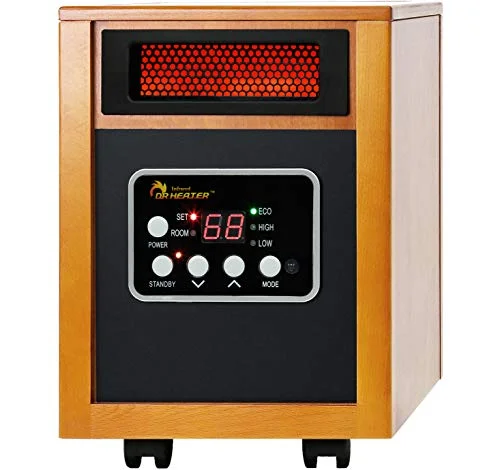
Noise is one of the few space-heater specs that is almost never published, so the honest way to shop for a quiet one is to separate the heaters that give you an actual number from the ones that only give you the word "quiet." Of the three we looked at here, only the Dr Infrared Heater DR-968 ($104.99) states a figure — a 39 dB blower — which is the closest thing to a verifiable noise spec in this entire category.
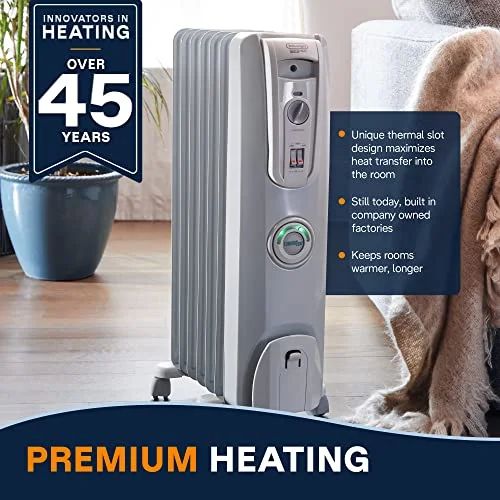
If you want something closer to true silence rather than a low number, skip the fan question altogether: the De’Longhi EW7707CM ($129.95) is an oil-filled radiator with no fan at all. The budget pick, DREO's Quiet Space Heater ($59.43), puts the word "quiet" directly in its name but states no decibel figure in the listing — treat that as marketing language worth noticing, not a spec worth trusting on its own.
Why noise figures are nearly absent from this category
Start with what is not on the box. Wattage is printed on nearly every space heater because UL and ETL safety certification effectively force the issue, and a US wall outlet's 15-amp ceiling makes the number predictable across the whole category anyway. A decibel rating has no equivalent pressure behind it. No regulator requires a space-heater brand to publish how loud its own fan is, so most simply don't, and a reader skimming listings quickly learns that words like "quiet," "whisper-quiet" or "silent operation" show up constantly while an actual number in decibels almost never does.
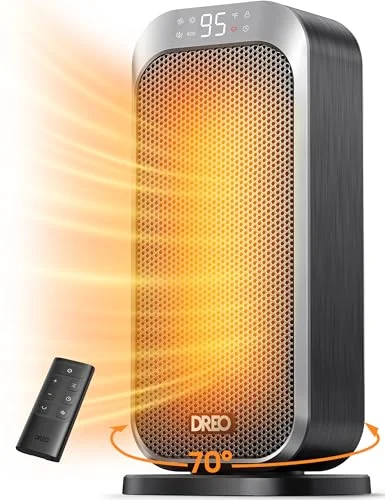
DREO's own listing for its Quiet Space Heater is a clean example of the pattern rather than an exception to it: the word is built into the product's name, the listing we have for it states the wattage (1,500W) and that it ships with a remote, but it does not state a decibel figure anywhere we can verify. That is not unusual for this category — it is close to the norm. A name is marketing copy a brand chose; a decibel rating is a measurement a brand would have to publish and stand behind, and far fewer of them choose to.
Even where a number does appear, it deserves a second look rather than blind trust, because decibel claims in this category are self-reported and rarely come with the testing conditions attached. A brand rarely states the distance from the unit, the fan speed the reading was taken at, or whether it is an A-weighted measurement (the standard that approximates how the human ear perceives loudness) or something looser. That does not make a stated figure worthless — a published 39 dB is still more useful than no number at all, and a company willing to attach a specific figure to its product has more skin in the game than one that only offers an adjective. It just means a decibel claim should be read as a data point to compare against the competition, not as a guarantee of what you will hear three feet from your pillow.
No fan at all: what an oil-filled radiator trades for silence
The most reliable way to buy quiet is to buy a heater that has nothing spinning inside it. The De’Longhi EW7707CM is exactly that: a 1,500-watt oil-filled radiator with no fan, sized at 5.9 inches deep by 13.78 inches wide by 24.8 inches tall. A sealed column holds a fixed volume of thermal oil, an electric element heats that oil, and the heat conducts out through the radiator's metal fins into the room by natural convection — warm air rising off the fins, not air being pushed by a motor. There is no blade, no motor and no bearing to generate the broadband whir that almost every other heater on this page produces, because the entire mechanism moving the heat is a slow column of warming oil.
That silence is a direct trade against speed. An oil-filled radiator takes noticeably longer to bring a room up to temperature than a fan-driven heater does, because it is heating a column of liquid before that liquid can radiate warmth outward, rather than blasting already-hot air directly at you. The De’Longhi's ComfortTemp setting is built around that reality: rather than cycling hard between fully on and fully off, it holds a moderate output automatically, which suits a heater that is meant to run for hours rather than deliver an instant blast of warmth. The same thermal mass that makes it slow to heat up also means it keeps radiating warmth for a while after it switches off — a genuine advantage overnight, and a genuine frustration if you walk into a cold room wanting heat in the next ninety seconds.
The other honest trade is size and weight. Without a compact fan-and-blower assembly doing the work, an oil-filled radiator needs more surface area — fins, essentially — to radiate the same wattage into a room, which is why the De’Longhi stands nearly 25 inches tall rather than tucking into a corner the way a slim tower can. If floor space next to the bed is already tight, that is worth weighing against the silence it buys you.
Reading a decibel claim, and what 39 dB sounds like
The Dr Infrared Heater DR-968 is the one heater in this roundup that actually states a noise figure: a 39 dB blower, alongside a stated 1,500 watts, a combined infrared-quartz-and-PTC-ceramic heating design, and a 12-hour automatic shut-off timer. Because it is the only verifiable number among the three products here, it is worth spending a moment on what that number means rather than just repeating it.
The decibel scale is logarithmic, not linear, which is the part that trips most readers up. A jump from 30 to 40 dB is not "ten more units" of sound the way a thermometer reading jumps ten degrees — each additional 10 dB represents roughly a doubling in perceived loudness to the human ear. Commonly cited reference points put a quiet library or a soft whisper in the 30 dB range, normal background conversation somewhere around 60 dB, and a vacuum cleaner well above that. A stated 39 dB sits close to that quiet-library reference point — noticeably hushed, the kind of sound you register as a low background hum rather than something that competes with a conversation or the television.
The honest caveat is the same one that applies to any manufacturer-reported figure: we don't know the exact distance or fan setting the DR-968's 39 dB figure was measured at, because the listing doesn't say. What we can say is that it is a specific, checkable number rather than an adjective, which already puts it ahead of most of the category on transparency alone — including, notably, a product in this very roundup that markets itself as "quiet" without offering any number to back the claim up.
Brushless motors and blade shaping: what they actually change
Beyond "quiet" as a marketing word and "39 dB" as a specific one, there is a layer of actual engineering worth understanding before you shop on either. Small heater fans are driven by one of two motor types: a traditional brushed DC motor, where physical carbon brushes make continuous contact with a spinning commutator to deliver current, or a brushless design, where that mechanical contact is removed entirely and the motor is driven electronically instead. The brushes in a brushed motor are a built-in source of friction and, over the unit's life, of wear-related noise — a brushless motor doesn't have that particular noise source to begin with, which is why brushless designs tend to run with a smoother, lower-pitched hum rather than a buzzier whine.
Separately from the motor, the shape of the fan blades themselves affects how much turbulence noise the airflow generates. A flat, simple paddle blade tends to create more audible turbulence as air separates off its edges; blades that are curved or swept — shapes borrowed from quieter industrial and HVAC fan design — are engineered specifically to let air move across them with less disruption, which translates to less of the rushing, airy noise that makes a fan heater sound busier than its decibel rating alone might suggest.
Both of these are real, well-understood pieces of acoustical engineering, and they are worth knowing before you shop — but they are also exactly the kind of under-the-hood detail that a product listing frequently doesn't spell out. None of the three listings we have for this page explicitly states a brushless motor or a specific blade profile as a confirmed spec, so we are not going to credit any one of them with it here. If a specific heater's listing does state "brushless motor" or describes its blade design, that is worth taking seriously as a genuine mechanism for lower noise — just confirm it is actually written into the listing you're buying from, rather than assumed from the word "quiet" alone.
The picks
Three different answers to "which one is quiet," because the honest answer depends on whether you want a verified number, true silence, or the lowest price among heaters that at least market themselves on noise.
01Best stated number
Dr Infrared Heater DR-968
The only pick here with a published decibel figure
39 dB stated·Infrared quartz + PTC·1,500 Watt·12-hour timer
The one heater in this roundup that actually commits to a noise figure in writing: a stated 39 dB blower, in the neighborhood of a quiet library. It pairs that with an infrared quartz tube and a PTC ceramic element in one cabinet, so it is warming the room's air and the people in front of it at once rather than leaning on the fan alone, and its 12-hour shut-off timer is long enough to cover a full night. It is a cabinet rather than a slim tower, so it asks for real floor space, and at roughly 12.5 amps it wants an outlet of its own.
Buy it if a verifiable number matters more to you than true silence — it's the only pick here that gives you one.
02Best for true silence
De’Longhi EW7707CM Oil-Filled Radiator
No fan, no motor, nothing to hear
Oil-filled·No fan·1,500 Watt·5.9″ D × 13.78″ W × 24.8″ H
The only pick here with no fan at all, which is the entire argument for it: nothing spinning, nothing to generate a blower hum in the first place. A sealed column of thermal oil carries the heat and radiates it into the room through the unit's fins, with De’Longhi's ComfortTemp setting holding a steady moderate output rather than cycling hard. The honest trade is speed and footprint — it takes longer to warm a room than a fan heater does, keeps radiating after it switches off, and stands almost 25 inches tall to make up in surface area what it gives up by not moving air.
Buy it for a bedroom where silence matters more than how fast the room comes up to temperature.
03Best budget, read the name honestly
DREO Quiet Space Heater
Marketed on noise, with no number attached
1,500 Watt·Remote included·15 Inch·Portable tower
DREO builds the word "quiet" directly into this heater's name, and the product photography shows a digital display, a remote and an oscillation icon on the housing — but the listing data we have doesn't include a decibel figure to back the name up. That's the exact pattern covered above: this is the budget tower pick, and the cheapest way to shop it honestly is to treat "Quiet" as a hint about the brand's intent rather than a verified spec, and to check the current listing yourself if a stated number matters to your decision.
A reasonable budget bet on noise — just don't mistake the product name for a published measurement.
The quietest setting is not always the lowest
It's tempting to assume that turning a heater down to its lowest heat setting also makes it the quietest it can be. That isn't reliably true, and the mechanism explains why. On a fan-driven heater, the fan's job is to move air across the heating element and out into the room; many ceramic and PTC units keep the fan running at or near a fixed speed across several heat levels specifically to maintain safe, even airflow over the element, rather than slowing the fan in lockstep with the heat output. Turn the heat down and you may still hear the same fan at close to the same volume — you've reduced the warmth, not the noise.
Thermostatically controlled heaters introduce a second, separate noise source: the click of a relay or switch as the unit cycles on and off to hold a set temperature. Set a heater to its lowest useful thermostat level in a room that's already fairly warm, and it may spend most of its time switching on and off in short bursts rather than running continuously — and each of those cycles is an audible click, even on an otherwise silent oil-filled radiator like the De’Longhi. A heater running continuously at a moderate, steady setting can end up quieter over the course of an hour than the same heater cycling rapidly at its lowest one.
If a heater offers a dedicated low-fan or night mode separate from its thermostat heat settings, that mode — not the lowest number on the dial — is usually the one built to minimize noise. Otherwise, a steady mid-level setting that avoids constant on/off cycling is often the quieter real-world choice overnight.
How we picked
We looked specifically for space heaters where noise is either a stated, checkable spec or a defining mechanical fact about how the unit works — rather than pulling together three heaters that merely use the word "quiet" in their titles. That filter is why an oil-filled radiator with literally no fan sits alongside the one heater in our database that states an actual decibel figure, and alongside a budget tower that markets quietness by name so we could show, honestly, what that claim does and doesn't tell you.
How we compared
We compared these three heaters on their published titles, available specifications and current Amazon prices. Where a figure is stated — the DR-968's 39 dB blower, its 1,500 watts, the De’Longhi's dimensions — it comes directly from the product's own listing. Where a listing doesn't include a number, as with the DREO Quiet Space Heater's noise level, we say so plainly rather than estimate one to fill a gap, and we do not show star ratings, review counts or paraphrased owner sentiment, because we don't have manufacturer-published figures for these specific listings. We do not run a testing lab, we do not own these three heaters, and we have not measured decibel levels ourselves — every noise figure on this page is the manufacturer's own stated claim, read critically rather than repeated uncritically.
Frequently asked questions
What decibel level actually counts as "quiet" for a space heater?
There's no official threshold specific to space heaters, but reference points help: a quiet library or a soft whisper sits around 30 dB, and normal conversation is roughly 60 dB. The Dr Infrared DR-968's stated 39 dB sits close to that quiet-library range — a low background hum rather than something that competes with conversation. Because the scale is logarithmic, even a few decibels' difference between two stated figures represents a real, audible gap, not a rounding error.
Are oil-filled radiators actually silent?
Mechanically, yes for the fan noise specifically — a unit like the De’Longhi EW7707CM has no fan or motor to generate the broadband whir that fan-driven heaters produce, because heat moves by natural convection off the radiator's fins rather than by moving air with a blade. The one sound an oil-filled radiator can still make is a thermostat relay clicking as it cycles on and off to hold temperature, which is a different and much quieter noise than a running fan.
Does a lower heat setting mean a quieter heater?
Not reliably. Many fan-driven heaters run the fan at a similar speed across several heat levels to maintain safe airflow over the heating element, so turning the heat down doesn't necessarily turn the fan down with it. And a thermostat set low enough to cycle on and off frequently can produce more audible switching clicks over an hour than the same heater held at a steady, moderate setting. A dedicated low-fan or night mode, where a heater offers one, is usually a more reliable route to quiet than the lowest number on the heat dial.
Why don't more space heaters publish a noise rating?
No regulator requires it the way UL and ETL safety testing effectively standardizes wattage disclosure across the category, so publishing a decibel figure is entirely a brand's own choice, and most skip it in favor of a word like "quiet" or "whisper-quiet" instead. A published number, like the DR-968's stated 39 dB, is still more useful than an adjective — it's specific and comparable — even without knowing the exact distance or fan speed the manufacturer measured it at.
Written by Ilane Tall. Research-based comparisons of published specifications, current prices and public product data — we do not physically test these units and we do not publish invented scores.