By Ilane Tall · Updated October 17, 2026 · Research-based.
Reader-supported: we may earn a commission when you buy through the links on this page, at no additional cost to you. It never changes which product we recommend. Prices quoted below were correct at the time of writing and move often.
Quick answer
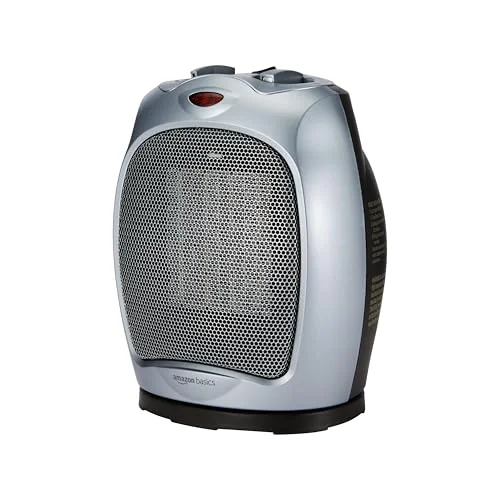
A modern electric space heater with an ETL listing, tip-over protection and automatic overheat shut-off is safe to run unattended for reasonable stretches — those three things are now standard on nearly every unit sold in the US, including budget models like the Amazon Basics Oscillating Ceramic Heater ($26.39). What isn't automatic is everything outside the appliance itself: a hard, level floor; three feet of clearance from curtains and furniture; a direct wall outlet instead of an extension cord; and a plug or cord that stays cool to the touch. The certification protects you from the heater. It doesn't protect you from a stack of extension cords or a curtain that drifted six inches closer than it was yesterday.
And one habit overrides every safety feature on the spec sheet: if the plug, the outlet faceplate or the cord itself is warm after normal use, the heater gets replaced, not repaired or kept running "for now."
What an ETL listing actually means — and what it doesn't
ETL is a safety certification mark, administered by Intertek, that functions the same way UL's mark does: it means an independent lab tested a sample of that specific model against a recognized safety standard — for space heaters, the relevant standard covers things like fire resistance of internal components, stability under a tip test, insulation of live parts, and the behavior of the thermal cutoffs under fault conditions. Seeing "ETL Listed" or "UL Listed" printed on the box or in the product title is a real, checkable claim, not marketing language, and it's worth treating as a baseline requirement rather than a bonus feature. Every heater worth considering in 2026 carries one mark or the other.
What the mark does not do is certify your installation. ETL testing happens in a lab, on a sample unit, under the conditions the standard specifies. It doesn't know whether your unit will sit on carpet instead of the hard floor the standard assumes, whether it will be three feet from the nearest curtain or three inches, or whether it will share a circuit with a space heater in the next room. The certification is a statement about the appliance as built. Everything downstream of the outlet — placement, clearance, what else is plugged in nearby — is still entirely on the person setting it up, and that's true whether the heater cost $26 or $260.
It's also worth being precise about what the mark doesn't claim. It doesn't mean the heater is "safe" in some unconditional sense — it means a sample passed a specific battery of tests at a specific point in time, and a unit can be ETL listed and still fail years later as components age. That's one reason the symptom described near the end of this piece, a warm cord or plug, matters more than the certification sticker once a heater has been in service for a while.
Tip-over and overheat shut-off: two different sensors, two different jobs
These two features get mentioned in the same breath so often that it's easy to assume they're one feature with two names. They aren't. A tip-over switch is typically a mechanical or gravity-based sensor — often a simple plunger or tilt mechanism — that interrupts power the moment the unit is no longer upright within its designed tolerance. It responds to orientation. Knock a heater over, or have a pet or a vacuum cord catch it, and the tip-over switch is what cuts power before the unit is left running on its side against a rug or a pair of curtains.
An overheat cutoff is a thermal sensor — usually a bimetallic switch or a thermal fuse — that watches the internal temperature of the heating element or the housing around it and interrupts power if that temperature exceeds a safe threshold, regardless of orientation. This is the feature that matters when a heater is standing perfectly upright but something else has gone wrong: a vent has been blocked by a cushion pushed too close, dust has built up and is restricting airflow, or a fan has failed and the element is no longer being cooled the way it was designed to be. The unit can be standing exactly where you left it and still need to shut itself off.
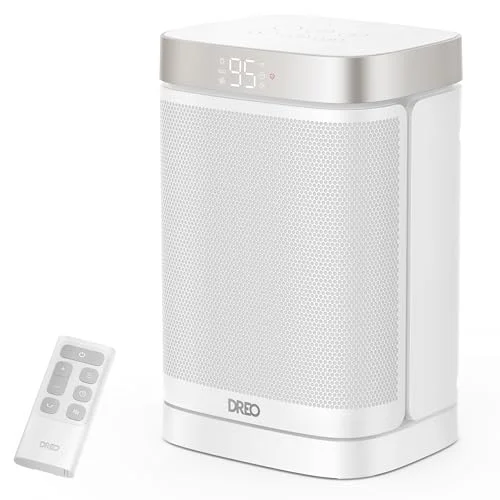
The Amazon Basics Oscillating Ceramic Heater shows how standard both features are even at the entry end of the price range: its own product title lists "Overheat and Tip-Over Protection" on a $26.39, 1,500-watt unit. The DREO Atom One ($66.89) markets itself around "Quiet Safety Heating," on the same premise — these cutoffs are table stakes, not a premium add-on. Don't pay extra expecting "better" protection up the price ladder; confirm both are present, which they almost always are, then spend the rest of your attention on placement and habits, where the real variation in risk lives.
Cool-touch housing: what it covers, and the one thing it doesn't
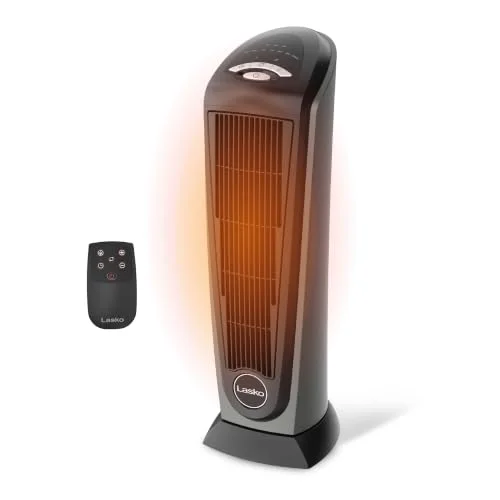
A "cool-touch" or "cool-touch housing" claim means the exterior casing is designed to stay at a touchable temperature even while the heating element inside is running hot, usually through a combination of insulating plastic, airflow design and distance between the element and the outer shell. It's a genuinely useful feature around kids and pets, and ceramic PTC heaters in particular are built around this principle — the Lasko 23" Ceramic Tower ($71.99) and the DREO Atom One both use self-regulating ceramic elements inside housings designed to stay cool enough to touch briefly without injury.
What "cool-touch" does not cover is the air actually coming out of the heater, the grille directly in front of the element, or anything placed in the heater's direct output path. A cool-touch housing describes the sides and top of the unit a hand might brush against — it says nothing about the vents themselves, which are designed to pass hot air through and run considerably warmer than the casing around them. It's not a claim about what happens to fabric or paper draped over the unit, either. "Cool-touch" is a casing spec, not a license to treat the whole appliance as inert; the vents stay the genuinely hot part by design.
Placement: the floor, the clearance, the curtain
Placement is where most of the real-world risk actually lives, because it's the one layer of safety that no certification or sensor can enforce for you. Three specific habits do most of the work.
The floor. A hard, level, non-flammable surface is the standard every manufacturer assumes: tile, hardwood, concrete. A heater on thick carpet sits at a slight, uneven angle that can fool a tip-over switch's tolerance, and it sits directly on a flammable material. If a hard floor isn't available, the unit needs to go somewhere else in the room rather than onto the rug by default.
The clearance. Three feet in every direction — sides, output, and above — is the widely repeated minimum from fire-safety guidance, worth treating as a floor, not a target. That three feet needs to stay clear of furniture, bedding and paper, including anything that could drift closer over the evening, not just at the moment the heater was switched on.
The curtain. Curtains deserve their own line because they move on their own: a draft, a door opening down the hall, or the heater's own airflow can push fabric several inches closer to the element than when it was first positioned. A heater placed a safe three feet from curtains at 6 p.m. can be well inside that margin by 11. The fix isn't a better heater — it's placing the unit somewhere a moving curtain physically cannot reach, not somewhere it merely doesn't reach yet.
Reasonable to leave running
ETL-listed unit, on a hard level floor, three-plus feet from anything flammable in every direction, plugged directly into a wall outlet, in a room someone checks on periodically.
Turn it off until the setup changes
On carpet or an uneven surface, near curtains or bedding that can drift closer, sharing a power strip or extension cord, or in a room nobody will check for hours.
The outlet, never the extension lead
A 1,500-watt heater — the output nearly every model on the market is built to, including all three heaters named in this piece — draws roughly 12.5 amps continuously. A standard US household circuit is rated for 15 amps, which means the heater on its own, plugged straight into a wall outlet, is working within specification with some margin to spare. That margin disappears the moment the same current is asked to pass through a lightweight extension cord or a power strip rated for lamps and electronics rather than sustained high-draw appliances.
Extension cords and power strips are rated in amps the same way circuits are, and a thin, long or coiled cord has more electrical resistance than a short, direct run of house wiring — resistance that turns into heat under sustained load, concentrated at the weakest point in the chain, often the connector itself, buried under a rug where nobody is watching it. This is why fire-safety guidance is unusually blunt on this single point: plug a space heater directly into a wall outlet, full stop, and never into an extension cord, a power strip or a splitter, even briefly.
The outlet itself matters too. An outlet shared with another high-draw appliance — a space heater and a hair dryer, say — can push a single circuit toward or past its 15-amp rating even with both devices plugged in correctly. A breaker tripping under that load is the circuit doing exactly what it's designed to do. An outlet, switch plate or cord that feels warm under that same load is the circuit not managing to do that job quietly — the subject of the next section.
A warm plug or cord means replace, not repair
Every certification and sensor discussed above is about catching failure after it starts. This section is the one piece of evidence that failure is already underway, and it's simple to check by hand: if the plug, the cord along its length, or the wall outlet's faceplate is warm to the touch after normal use — warmer than the heater's housing typically runs — something downstream of the heating element has degraded. That could be a loosening connection inside the plug, insulation beginning to break down, or a cord nicked, pinched under furniture, or coiled tightly enough to trap heat.
The reason this calls for replacement rather than repair is that the failure sits at a connection point designed to be sealed, not serviced. There's no safe way to open a molded plug or patch damaged cord insulation on a 120-volt appliance and restore it to the condition it shipped in. A heater exhibiting this symptom should be unplugged and not used again, regardless of how new it is or how much it cost — a $22 heater and a $260 one fail the same way at the plug, and both get retired the same way.
Separate this from the ordinary warmth every heater produces by design: the housing of a ceramic or infrared heater running at full output will be warm, sometimes noticeably so near the vents, and that's expected — it's what "cool-touch" housing is built to manage at the casing level. The plug and cord should stay close to room temperature no matter how long the heater runs, because current passing through a healthy cord generates negligible heat. Warmth there, specifically, is the signal — not warmth at the grille, which is normal.
What the standard features actually look like, on real listings
None of this is theoretical — the three safeguards above show up explicitly in current listings at very different price points, which is itself the point: certification and shut-off protection aren't a premium tier.
01Tip-over + overheat, budget tier
Amazon Basics Oscillating Ceramic Heater
Both cutoffs stated directly in the listing, at $26.39
Ceramic, 1,500W·Overheat + tip-over protection·Adjustable thermostat·7.52"D x 6.34"W x 9.45"H
The product's own title states "Overheat and Tip-Over Protection" rather than burying it in fine print — these two cutoffs are no longer a feature you pay up for, they're the baseline on a sub-$30 ceramic heater. The adjustable thermostat lets it cycle rather than run flat out, which matters for the outlet-sharing math covered above.
The example that the two core safety cutoffs are standard equipment, not an upsell.
02ETL-listed tower
Lasko 23" Ceramic Tower Space Heater
The certification mark to look for, on a self-regulating element
Ceramic, oscillating·ETL listed·Cool-touch housing·22.5-inch tower
A self-regulating ceramic element paired with a cool-touch exterior and the ETL mark — the independent safety certification this piece opens with. It's a useful reminder that the mark and the cool-touch casing are two separate, stackable safeguards rather than one feature described two ways, and that both are available well under $75.
Worth checking any heater's listing for this exact mark before anything else on the spec sheet.
03Timer as a placement backstop
DREO Atom One Space Heater
A 12-hour timer that limits how long a placement mistake can run unnoticed
PTC ceramic, 1,500W·12-hour timer·70° oscillation·Digital thermostat
Marketed explicitly around "Quiet Safety Heating," with a 12-hour timer on top of the standard cutoffs. A timer isn't a substitute for correct placement, but it does cap how long a curtain that has drifted closer, or a room nobody checked on, can go unnoticed before the unit shuts itself down regardless.
A long timer narrows the window for a placement mistake to matter — it doesn't replace checking the room.
How we researched this
We compared published specifications, current Amazon prices and public safety guidance for the certification marks and shut-off mechanisms described here, rather than running any of these units ourselves. We don't run a testing lab, we don't own these three heaters, and nothing here is an invented decibel reading, a score out of ten, or paraphrased review sentiment we don't have data to support — every product claim traces back to that model's own listing.
The safety guidance itself — clearance distances, the warning against extension cords, the logic behind tip-over and overheat sensors — reflects widely published fire-safety recommendations repeated across manufacturer manuals and safety organizations, not a claim specific to any one brand. The three named heaters illustrate a point because their own listings state the feature plainly, not because we verified in person that it performs as described.
Frequently asked questions
Is it actually safe to leave a space heater running overnight?
With an ETL-listed unit on a hard, level floor, three or more feet from anything flammable, plugged directly into a wall outlet, most current heaters are built to run for extended periods safely — that's what the automatic shut-off, tip-over switch and overheat cutoff are specifically for. The honest caveat is that none of those features correct a bad setup: carpet instead of a hard floor, a curtain that can drift closer, or a shared extension cord all sit outside what certification covers, and they're the more common real-world cause of problems than a certified heater failing on its own.
What's the real difference between tip-over protection and overheat protection?
Tip-over protection is a mechanical sensor that responds to orientation — it cuts power if the unit is no longer standing upright, whatever the cause. Overheat protection is a thermal sensor that cuts power if internal temperature climbs too high, regardless of orientation, which is what catches a blocked vent or a failing fan on a heater that's standing exactly where it should be. They're both standard on nearly any current listing, but they're answering two different failure modes, not the same one twice.
Does an ETL or UL listing mean the heater can't cause a fire?
No. It means a sample of that model passed an independent lab's safety testing against a recognized standard — a real and worthwhile claim, but one about the appliance as built, not about your specific floor, clearance, outlet or extension cord. The certification is a baseline to require on any heater you buy; it isn't a substitute for correct placement and a direct wall-outlet connection.
Why does a warm cord or plug mean I should replace the heater instead of fixing it?
A warm plug, cord or outlet faceplate after normal use points to a degraded connection or damaged insulation at a point that was sealed during manufacturing and isn't meant to be opened or re-serviced on a 120-volt appliance. There's no safe at-home repair that restores that connection to its original condition, which is why the right response is to stop using the unit and replace it, regardless of its price or age.
Written by Ilane Tall. Research-based comparisons of published specifications, current prices and public safety guidance — we do not physically test these units and we do not publish invented scores.