By Ilane Tall · Updated October 18, 2026 · Research-based.
Reader-supported: we may earn a commission when you buy through the links on this page, at no additional cost to you. It never changes which product we recommend. Prices quoted below were correct at the time of writing and move often.
Quick answer
Below $50, the spec sheet usually gets shorter, not just the price. The GiveBest Space Heater ($25.99) is the cheapest pick here with a checkable spec behind it — two heat settings plus a fan, stated plainly as 1500W/750W. The DREO Space Heater with Thermostat ($35.13, 10 inch) publishes an actual temperature range rather than just the word "thermostat."
We also looked at the DREO Atom One ($66.89) on purpose: it answers what the next roughly thirty dollars buys — a stated shut-off timer, oscillation and a digital display, none of which show up in either sub-$50 listing. That comparison is below.
What disappears first below $50
Spend an evening reading space heater listings in this price band and a pattern shows up fast: the copy gets longer while the numbers get shorter. "Fast heating," "whole-room comfort," "premium quality" cost nothing to write and nothing to verify. A stated shut-off timer in hours, a published temperature range in degrees, an explicit certification mark — those cost the manufacturer something, because a reviewer or a regulator can check them. Below $50, the second category thins out faster than the first.
Take the two heaters that anchor this guide. The GiveBest Space Heater ($25.99) states its two heat settings as 1500W and 750W, plus a cool-air fan mode, and describes "automatic thermostat control" that cycles the unit on and off to hold whatever temperature you've left it at — real, useful behavior, but with no stated temperature range or increment behind it. The DREO 10-Inch ($35.13) closes exactly that gap: its listing states a 41–95°F range adjustable in 1°F increments, driven by what DREO calls an NTC chipset. Same price tier, same basic job, and one of the two gives you a figure to hold it to.
Certification is the other thing that thins out first. The DREO 10-Inch and the pricier DREO Atom One both state an ETL listing in their safety copy. The GiveBest listing describes "V0 flame retardant material" and a multi-protection system — tip-over shutoff with an audible beep, automatic overheat shutoff — but doesn't state an ETL mark anywhere in the data we have. That isn't proof the unit lacks one; it's the cheapest heater here being least explicit about third-party certification, a pattern worth noticing rather than a verdict.
A countdown shut-off timer with a stated number of hours is the clearest casualty. Neither the GiveBest nor the DREO 10-Inch lists one. Both have automatic safety shutoff — cutting out if the unit overheats or tips over — which is a protection feature, not a timer that ends the session on a schedule whether anything's wrong or not. Only the DREO Atom One, at $66.89, states one: 12 hours. More on what that changes a little further down.
The three specifications still worth demanding
Not every number on a listing page is worth your attention, and in a category this crowded with adjectives, it helps to know which three are. These are the ones that actually predict how a cheap heater behaves, rather than how it reads on the page.
Wattage, stated as a number. Nearly every plug-in space heater sold for a standard US outlet runs at or near 1,500 watts at its highest setting — close to the practical ceiling of a 15-amp household circuit, true whether the heater costs $20 or $200. Both the GiveBest and the DREO 10-Inch state 1500W as their top setting, and the Atom One states the same figure in its title. You're not checking for a bigger number than 1,500; you're checking that a number is stated at all, rather than hidden behind "powerful heating" with nothing underneath it.
What the automatic protection actually covers. Tip-over protection and overheat protection aren't the same feature, and a listing that mentions one isn't necessarily covering the other. The GiveBest listing is explicit about both: an automatic safety shutoff tied to overheating, and a separate tip-over system that shuts the unit off with a beep if knocked over, restarting once it's upright again. That's the behavior worth demanding from anything you'll leave running around a pet or a toddler. If a listing only mentions one of the two, treat the other as unconfirmed.
Whether the control is a number or a word. "Thermostat" on its own is marketing language unless it comes with a range. The DREO 10-Inch states 41–95°F in 1°F increments — a specification you can hold the product to. "Automatic thermostat control" without a stated range, which is what the GiveBest listing offers, describes real behavior but gives you nothing to verify it against. Neither is dishonest. One just gives you more to check.
What you won't find for any of the three heaters here, at any price point, is a star rating or a review count — Amazon's product data for all three currently returns neither. We're not going to paraphrase "reviewers say" or "owners report" when we have no review data to paraphrase; inventing sentiment to fill that gap is the same offense as inventing a number.
Thermostat or just three power settings: a real difference
This is the single most useful distinction in the entire under-$50 tier, and it's easy to miss because both kinds of heater use the word "thermostat" somewhere in their copy.
The GiveBest Space Heater gives you three positions: a 750W low setting, a 1500W high setting, and a cool-air fan mode with no heating element running — useful in summer, per the listing. Layered on top is what it calls "automatic thermostat control": leave it on a setting, and it cycles the element on and off to hold roughly whatever temperature the room was at when you turned it on, rather than running continuously. Genuinely useful for not wasting electricity overnight. What it isn't is a dial you can set to a specific number and trust the room to reach.
The DREO 10-Inch works differently: its NTC chipset lets you set a target temperature anywhere from 41°F to 95°F in single-degree steps, and the heater manages its own cycling to hit and hold that number. The practical difference shows up on a cold morning. With the GiveBest, you pick high or low and the room settles wherever that lands it. With the DREO 10-Inch, you set 68°F specifically, walk away, and the heater does the work of holding that figure.
Neither approach is wrong for every buyer. Three fixed settings are simpler, which matters in a guest room or garage workspace where nobody wants to learn a menu. A stated numeric range is worth the extra roughly nine dollars if you want a bedroom held at a specific, repeatable temperature. The mistake is assuming the word "thermostat" on a $25 listing buys the same precision as on a $35 one — on the data we have, it doesn't.
The picks
Two heaters that hold the line under $50, and the one just above it that we're including on purpose, because it's the honest answer to "what if I spent a little more."
01Cheapest checkable pick
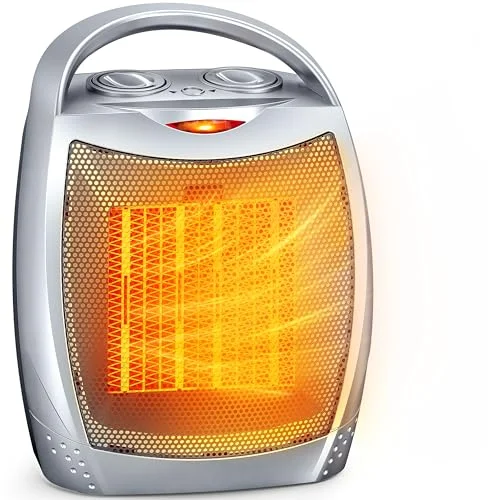
GiveBest Space Heater
Best for a single room, on a strict budget
1500W / 750W / fan·Automatic thermostat cycling·Small·Tip-over + overheat shutoff
Three positions — 750W, 1500W, and a cool-air fan with the heating element off — plus automatic cycling that holds the room at whatever temperature it was set to run, so it isn't drawing full power the entire time. Protection is explicit: a V0 flame-retardant housing, automatic overheat shutoff, and a separate tip-over system that cuts power with an audible beep if knocked over, restarting once upright. Built with a carry handle, sized small, priced to be a second or third heater rather than the only one. It doesn't state an ETL listing or a specific temperature range — check the current listing if either matters to you.
The pick if $25.99 and a plug is the entire budget, and you're comfortable choosing between high, low and fan rather than a specific number.
02Best under-$50 control
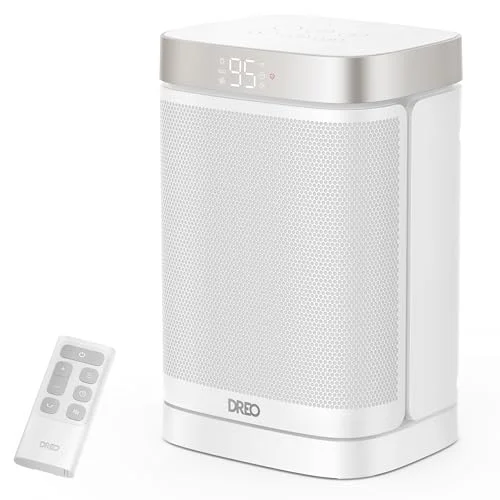
DREO Space Heater with Thermostat
Best for a room you want held at a specific temperature
1500W PTC·41–95°F, 1°F steps·10 inch·ETL listed
The listing states exactly what its thermostat does, rather than just using the word: an NTC chipset holds a target you set anywhere from 41°F to 95°F, adjustable one degree at a time, so the room settles at a number rather than a position. DREO pairs its 1500W PTC element with a heat-funnel design it says pushes warm air roughly twice as far as a comparable heater without one — the manufacturer's own figure, not an independently verified one. Protection matches the Atom One's: a tilt-detection tip-over sensor, V0 flame-retardant housing, overheat protection and a safety plug, all stated as ETL certified.
The pick if the extra roughly nine dollars over the GiveBest buys you the one thing you actually want: a number to set and trust.
03What the next tier buys
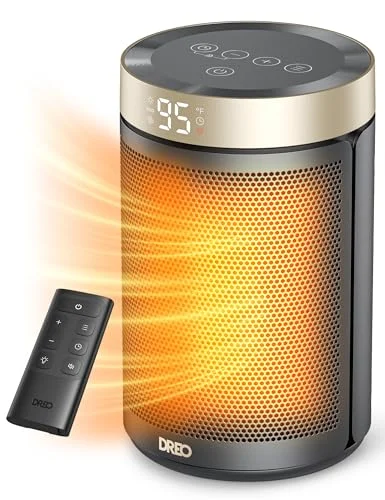
DREO Atom One
Best if you can stretch past $50
1500W PTC·12-hour timer·70° oscillation·Digital thermostat + remote
Everything the two heaters above do, plus what specifically disappears below $50: a stated 12-hour shut-off timer, 70-degree oscillation to spread the same 1500W PTC output across more of a room, a remote, and a brushless DC motor with nine shaped blades DREO states is built to cut fan noise. ETL-listed, with the same tip-over and overheat protection as the rest of DREO's lineup here. At $66.89 it's the most expensive pick and not a pure under-$50 heater — included specifically to show what crossing that line gets you.
Buy this if a timer and oscillation are worth roughly thirty dollars to you; buy one of the two above if they aren't.
When $20 more changes what you own
The honest number here is closer to thirty dollars than twenty — the gap between the DREO 10-Inch at $35.13 and the DREO Atom One at $66.89 is $31.76 — but the question underneath that heading is the right one: what does the next price tier actually hand you?
On the data we have, three things. First, a stated shut-off timer: 12 hours on the Atom One, versus none stated on either sub-$50 pick. That's a heater that turns itself off on a schedule you set once, rather than one that relies entirely on safety cutoffs that only trigger if something's actually wrong. Second, oscillation: the Atom One states 70 degrees of movement, spreading its 1500W output across an arc instead of one spot, which matters more in a living room than the tight footprint either cheaper pick is built for. Third, a remote and a digital display — convenience rather than performance, but real.
Stay under $50 when
You need a single-room, single-person heater — a desk, a workbench, a guest room used a few nights a month — and you're comfortable adjusting it in person rather than from a remote. The GiveBest or the DREO 10-Inch cover that job honestly.
Spend the extra thirty when
You want it to turn itself off on a schedule without you remembering, you want the heat spread across an arc rather than aimed at one spot, or you're buying one heater to do a bigger room's worth of work. That's what the Atom One is actually for.
What doesn't change between the two tiers is the core heating technology or the wattage ceiling. All three heaters here run PTC ceramic elements at or near 1500W on their top setting. You're not buying more heat for more money — you're buying a timer, a wider spread, and a remote. If none of those three things matter for how you'll actually use the heater, the extra thirty dollars isn't buying you anything.
The buy order for a first heater
If this is the first space heater for a room rather than a replacement, here's the order worth going through before clicking "buy," in the sequence that actually matters.
- Confirm the outlet isn't shared with anything heavy. A 1500W heater draws roughly 12.5 amps, close to a standard 15-amp circuit's limit on its own. Check this before the spec sheet — no amount of research into wattage or timers fixes a breaker that trips the first cold night.
- Decide if you need a number or just a direction. If "warmer" and "cooler" are enough, the GiveBest's three positions do the job for less. If you want a room held at a repeatable figure, the DREO 10-Inch's stated range is worth the roughly nine extra dollars.
- Check whether you actually need a timer. If you're in the room and will unplug it when you leave, a shutoff timer is a convenience, not a necessity. If it'll run unattended for a set stretch, the Atom One's 12-hour timer is the more honest fit — worth reading whether it's safe to leave a heater running at all first.
- Match the heat type to the room, not just the price. All three picks here are PTC ceramic with a fan, which heats a room quickly but means you'll hear the fan. If silence matters more than speed, see our breakdown of ceramic versus infrared versus oil-filled heaters first.
- Work out roughly what it'll cost to run. A 1500W heater at full output costs real money by the hour, worth knowing before the first electric bill arrives. Our running-cost breakdown has the arithmetic with its assumptions stated in the open.
That order isn't arbitrary — it runs from what can actually go wrong (an overloaded circuit) down to what only affects comfort (noise and running cost).
How we picked
We started from our own database of space heaters currently listed for sale in the US and filtered for the under-$50 band, then looked for listings that published a number we could check — a wattage figure, a temperature range, a named protection feature — rather than adjectives alone. That filter is aggressive at this price point: most sub-$50 listings describe heat output and safety in marketing language with no figure attached, and we excluded those rather than fill the gap with a guess. We added the DREO Atom One deliberately, above the $50 line, to answer what the next tier of spending buys, since that's more useful to a first-time buyer than three near-identical sub-$50 heaters.
How we compared
We compared the three heaters on their published titles, listed features and current Amazon prices, pulled from the same product data at the same time. Where a figure is stated — the GiveBest's 1500W/750W dual mode, the DREO 10-Inch's 41–95°F range, the Atom One's 12-hour timer and 70-degree oscillation — it comes directly from that listing data. Where a figure is absent, such as a shutoff timer on the two cheaper picks or an explicit ETL mention on the GiveBest, we say so rather than assume the feature exists because a pricier heater has it.
We do not run a testing lab. We have not plugged in these three heaters ourselves, we do not own them, and nothing on this page is an invented decibel reading or a score out of ten. None of the three listings currently carries a published star rating or review count, so we don't show one and we don't paraphrase review sentiment that doesn't exist.
Frequently asked questions
Is a $25 space heater actually safe to use?
The GiveBest Space Heater's listing states the same categories of protection you'd want from any plug-in heater: a flame-retardant housing, automatic shutoff if it overheats, and a tip-over sensor that cuts power with an audible alert if it's knocked over. What its listing doesn't explicitly state is a third-party certification mark like ETL, which the two DREO heaters in this guide do state. That's a gap in the published data, not proof of an unsafe product — but it's worth checking the current listing for a certification mark before you buy, and reading our broader take on what "safe to leave on" actually requires.
What's the real difference between "thermostat" and "power settings" on a cheap heater?
A stated temperature range. The DREO 10-Inch's listing gives you a specific number — 41–95°F in 1°F increments — that the heater is built to hit and hold. The GiveBest's "automatic thermostat control" describes real cycling behavior (it turns the element on and off to hold roughly whatever temperature was set) but without a published range to check it against. Both are legitimate; only one gives you a number.
Should I buy the $25 heater or spend more?
If you need basic warmth in one small room and are comfortable with high, low and fan as your only choices, the GiveBest at $25.99 does that job honestly. If you want the room held at a specific temperature, the extra roughly nine dollars for the DREO 10-Inch buys a real, stated range. If you want a timer, oscillation and a remote on top of that, the DREO Atom One at $66.89 is where those features start showing up — see the full breakdown above.
Does a cheaper heater cost more to run?
Not based on wattage. All three heaters here state the same 1500W ceiling on their top setting, which is what actually drives the electricity cost, not the sticker price of the unit. A cheaper heater without precise thermostat cycling can run closer to that ceiling more of the time, though, since it's holding a position rather than a specific number. The full arithmetic, with the rate assumption stated in the open, is in our running-cost guide.
Written by Ilane Tall. Research-based comparisons of published specifications, current prices and public product data — we do not physically test these units and we do not publish invented scores.