By Ilane Tall · Updated October 16, 2026 · Research-based.
Reader-supported: we may earn a commission when you buy through the links on this page, at no additional cost to you. It never changes which product we recommend. Prices quoted below were correct at the time of writing and move often.
Quick answer
Every heater here is built around the same roughly 1,500-watt ceiling, so the choice between ceramic, infrared and oil-filled is really a choice about sensation, noise and patience — not output. The DREO Atom One ($66.89) is a PTC ceramic fan heater: point it at a cold room and you feel moving warm air within a minute, at the cost of an audible fan. The Dr Infrared Heater DR-968 ($104.99) pairs an infrared quartz tube with a PTC ceramic element, so it warms you and your furniture directly as well as the air around the cabinet — good for a room you sit in for hours. The Amazon Basics Oil Radiator Heater ($67.95) has no fan at all: it warms slowly, runs silently, and its seven oil-filled steel fins keep radiating heat for a while after you switch it off.
Which one is right depends less on the room's square footage and more on what you want that room to feel like — instant and audible, direct and focused, or slow and silent.
Same wattage, three different sensations
Start with the number all three heaters share, because it's the reason this comparison is interesting rather than a simple matter of picking the biggest number on the box. A standard US household circuit runs 120 volts at 15 amps — about 1,800 watts in theory — and portable electric heaters sold for that outlet are built to roughly 1,500 watts, leaving headroom under safety testing rather than running a circuit at its rated limit continuously. That ceiling isn't something any one brand chose as a marketing number. It's close to the practical maximum a single US wall outlet can deliver to a plug-in appliance without an electrician getting involved.
All three heaters on this page state 1,500 watts directly in their own listings, which makes this an unusually clean comparison: the DREO Atom One's title specifies "1500W PTC Ceramic Heater," the Amazon Basics radiator's title specifies "1500W," and the Dr Infrared DR-968's title specifies "1500-Watt." None of these numbers is estimated or carried over from a similar model. Each heater is drawing essentially the same amount of electrical power, and each will cost roughly the same amount to run for the same number of hours, whatever the sticker price in the box says.
What differs completely is the mechanism each one uses to turn that 1,500 watts into something you feel. A ceramic heater with a fan moves warm air at you mechanically. An infrared element warms whatever sits in its direct line of sight, the way sunlight warms skin before it warms the surrounding air. An oil-filled radiator heats a sealed liquid and lets that thermal mass radiate slowly into the room with no moving air at all. Three genuinely different experiences, built on the same electrical foundation — which is exactly why reading only the wattage on a space heater tells you almost nothing about what owning it will actually feel like. For the arithmetic behind what that shared 1,500 watts costs to run, see our running-cost breakdown, which applies equally to all three heaters here.
Ceramic with a fan: fastest to feel, and audible
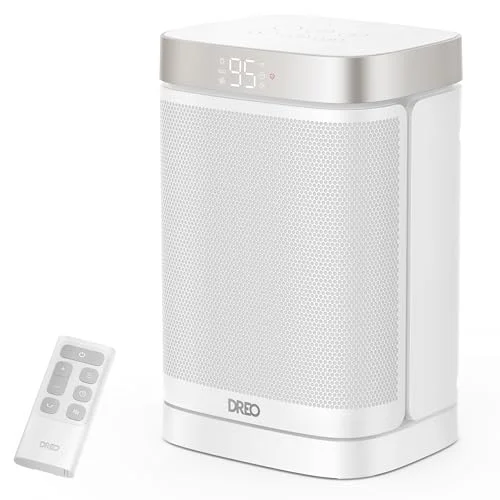
The DREO Atom One Space Heater is built around a PTC (positive temperature coefficient) ceramic heating element, paired with a fan that pulls air across that element and pushes it back out into the room at a stated 70-degree oscillation. PTC ceramic is self-regulating by design: as the element heats up, its own electrical resistance rises, which naturally limits how hot it can get without a separate thermostat circuit doing all the work. DREO pairs that element with a digital thermostat and a 12-hour timer, and the unit ships with a remote so you can adjust either setting without getting up.
The reason a ceramic-and-fan heater is the fastest of the three to feel is simple physics rather than marketing: it is mechanically moving already-warm air directly at your body, instead of waiting for radiant heat to travel in a straight line or for a room's ambient air temperature to drift upward on its own. Stand in front of it and you feel a change within a minute, because the fan is doing the delivery work a quiet room otherwise has to do by slow convection alone.
That speed has one unavoidable trade-off, and it's the same trade-off every fan-driven heater makes: moving air requires a motor and blades, and a motor and blades make noise. DREO's specific answer is a brushless DC motor with shaped blades, engineered to cut down on the turbulence that makes cheaper fan heaters whine, and the unit is ETL-listed with tip-over protection, overheat protection and a V-0 flame-retardant housing. Those details make it a quieter example of the category, not a silent one — there is still a fan spinning inside it. If the fan noise of any heater in this category is the deciding factor for you, we cover the handful of models that publish an actual noise figure or remove the fan altogether in a separate guide.
The DREO Atom One's compact size cuts the other way: it's built and marketed as a personal or home-office heater, not something meant to carry heat across an open floor plan. Point it at a desk or an armchair and it earns its $66.89 price quickly; expect it to warm one zone, not a whole living room.
Infrared: warms what it points at, stops where the beam stops
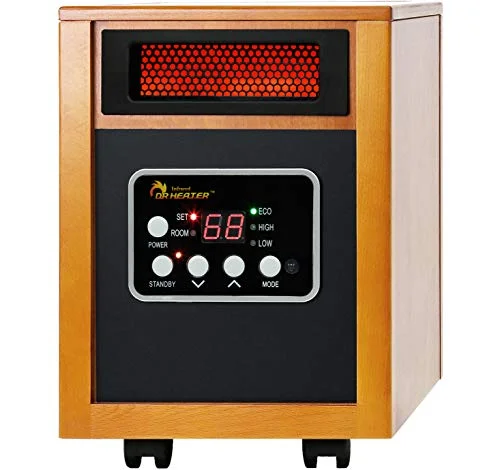
The Dr Infrared Heater DR-968 takes a different approach, and it's worth being precise about what "infrared" means here rather than treating it as a single mechanism. The DR-968 combines an infrared quartz tube with a PTC ceramic element inside one cabinet, so it is a hybrid rather than a pure radiant heater — it does two jobs rather than one. The quartz tube radiates infrared energy directly at whatever sits in its line of sight, the same way sunlight through a window warms your arm before it warms the air in the room. The PTC ceramic element, meanwhile, warms the air passing through the cabinet the way the DREO does, just without an oscillating fan pushing it across a wide arc.
The quartz tube's half of that equation is the part worth understanding on its own terms, because it behaves nothing like a convection heater. Infrared heat doesn't fill a room the way warm air does; it travels in a straight line and transfers energy to the first solid surface it hits — you, a sofa cushion, a rug — rather than warming the air in between. Stand directly in front of the DR-968 and you feel warmth immediately, in the specific sense of a direct line-of-sight transfer rather than a rising room temperature. Step behind a piece of furniture, or far enough to one side that you're outside the quartz tube's effective angle, and that direct warmth drops off sharply, even though the cabinet is still drawing the same 1,500 watts a few feet away.
Dr Infrared states a 12-hour automatic shut-off timer for the DR-968, a stated 39 dB blower noise figure, and a working draw of roughly 12.5 amps at full output — close enough to a standard 15-amp circuit's rating that the heater wants an outlet of its own rather than one shared with a microwave or a hair dryer. It ships with a remote, tip-over protection and overheat protection, and comes in a Cherry-finished cabinet rather than a slim tower, which is the honest trade for combining two heating elements: it takes real floor space in exchange for warming the people in a room as well as the air around them. That combination of direct and ambient heat is exactly why it suits a larger room you actually sit in for hours, rather than a hallway you only pass through.
Oil-filled: slow, silent, and still warm after it stops
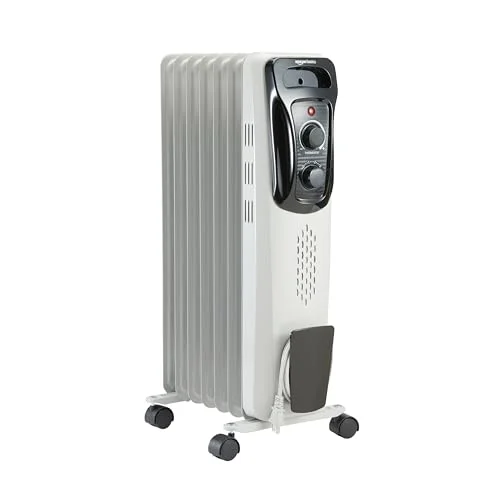
The Amazon Basics Portable Oil Radiator Heater works on a mechanism closer to a century old than either of the other two: an electric element heats oil sealed permanently inside seven steel fins, and those fins radiate that heat slowly into the room by a combination of radiation and gentle convection off their warm surface — no fan, no element glowing in a straight line, nothing moving except warm air rising naturally off the metal. The listing specifies 1,500 watts, three heat settings, over-heat protection, tip-over protection and ETL-certified safety, in a cabinet measuring 11 inches deep by 14.8 inches wide by 25.2 inches tall, finished in white.
Slow is the correct word for how this heater starts, and it's a direct consequence of the mechanism rather than a flaw in this specific unit. The oil inside the fins has real thermal mass, which means the element has to heat the liquid before the liquid can radiate meaningfully into the room — there's a warm-up period measured in minutes, not the near-instant draft of warm air you get from a fan heater. The payoff for that patience is the same thermal mass working in reverse: once the oil is hot, the fins keep radiating heat into the room for a noticeable stretch of time after the element itself has cycled off or the unit has been switched off entirely, in a way a ceramic or infrared heater's output does not.
The silence is the other half of the trade, and it's close to absolute by design: with no fan moving air and no element exposed to glow or hum, there is nothing in this heater's mechanism built to make noise. We don't have a manufacturer-stated decibel figure for this specific listing, and we're not going to invent one, but a sealed oil radiator has no fan to generate the noise a figure like that would even be measuring. The listing also doesn't include a stated automatic shut-off timer the way the other two heaters here do; the unit's three heat settings are adjusted manually rather than through a digital thermostat, so check the current listing directly if a specific timer duration matters to your routine. What it reliably offers instead is tip-over protection and overheat protection built into the same safety certification as the other two picks, which is the baseline this category requires regardless of mechanism.
That combination — no fan, no exposed element, heat that lingers after the unit cycles down — is exactly why an oil-filled radiator is the heater of choice for a bedroom you want warm through a full night without hearing it run. It is also the heater most willing to be left running quietly in a corner for hours, precisely because there's so little happening mechanically that could draw attention to it.
Which one suits which room
None of these three mechanisms is better than the others in the abstract; each is built for a specific relationship between a person and a room, and the right pick follows from that relationship more than from the room's square footage.
Choose ceramic with a fan when
You want heat fast and don't mind hearing it arrive — a cold home office before a call, a bathroom while you get ready, a desk where you're only there for an hour or two.
Choose infrared (hybrid) when
You're furnishing one room you actually sit in for a long stretch, want the people and furniture in it warmed directly, and have the floor space for a cabinet rather than a slim tower.
The bedroom case is the clearest of the three, and it's the one where mechanism matters more than almost anything else on the spec sheet. A fan running for eight hours overnight is a fan you will hear for eight hours overnight, however quiet its motor is engineered to be; an oil-filled radiator removes that variable entirely, which is why it's the pick for a room you sleep in rather than one you merely sit in. A home office or a bathroom, by contrast, rewards speed over silence — you're there for an hour, not all night, and a ceramic fan heater's near-instant warmth matters more than a few extra decibels. A living room or a larger shared space tends to reward the hybrid: enough direct warmth for the people actually in it, plus the ceramic element's ambient contribution for the air around them, in a single unit rather than running two heaters to cover the same ground.
It's also worth remembering that none of these three mechanisms changes the electrical math covered above. Whichever one you choose, it's still drawing roughly 1,500 watts and still wants an outlet it isn't sharing with another high-draw appliance. The decision that actually matters here is about the sensation in the room, not the number on the circuit breaker.
The picks, by what you want the room to feel like
One heater of each type, matched to the room where its particular mechanism does the most good.
01Fastest to feel
DREO Atom One Space Heater
The ceramic pick: point it at a cold room, feel it in a minute
PTC ceramic·70° oscillation·12h timer·Digital thermostat, remote
A brushless DC motor and shaped blades push air across a self-regulating PTC ceramic element and out at a 70-degree oscillating spread, with a digital thermostat and a 12-hour timer controllable from the included remote. ETL-listed, with tip-over protection, overheat protection and a V-0 flame-retardant housing. The fan makes it the fastest of the three to feel and the loudest of the three to live with — a trade that favors a desk or a bathroom over a bedroom you're trying to sleep in.
Buy it for speed. If the fan noise matters more than the wait, look at the other two picks here instead.
02Most direct
Dr Infrared Heater DR-968
The infrared-hybrid pick: warms you directly, and the air around you
Infrared quartz + PTC·1,500W·12-hour timer·39 dB stated, 12.5 amps
An infrared quartz tube and a PTC ceramic element share one Cherry-finished cabinet, so it warms whatever sits directly in front of it the way sunlight warms skin, while the ceramic element handles the air moving through the unit. A 12-hour timer, a 39 dB stated blower, a remote, and tip-over and overheat protection round it out. At roughly 12.5 amps it wants its own outlet, and as a cabinet rather than a slim tower it asks for real floor space — the honest cost of combining two heating mechanisms in one unit.
The pick for the one room you actually live in, where you want to feel warm, not just read a thermostat that says so.
03Slowest, and silent
Amazon Basics Portable Oil Radiator Heater
The oil-filled pick: no fan, and warm for a while after it stops
7 oil-filled steel fins·3 heat settings·1,500W·11"D x 14.8"W x 25.2"H
Seven steel fins filled with sealed oil, heated by a 1,500-watt element and left to radiate that heat slowly into the room with no fan and nothing exposed to glow or hum. Three manual heat settings, over-heat protection, tip-over protection and ETL-certified safety in an 11-inch by 14.8-inch by 25.2-inch white cabinet. It takes longer to feel than either heater above, and that thermal mass is exactly why it keeps the room warm for a while after you've switched it off.
Buy it for the bedroom, or any room where you'd rather not hear the heater working at all.
How we picked
We started from our own database of space heaters listed for sale in the US and deliberately chose one representative of each major heat-delivery mechanism — ceramic-with-fan, infrared-hybrid, and oil-filled radiator — rather than three near-identical towers that differ mainly in color or price. The goal of this comparison is the mechanism, not a ranked winner: each heater here does its job well within the room it's built for, and badly outside it.
How we compared
We compared the three heaters on their published titles, available specifications and current Amazon prices. Where we cite a specific number — the DREO's 70-degree oscillation and 12-hour timer, the Dr Infrared's 12.5 amps and 39 dB blower figure, the Amazon Basics radiator's seven fins and case dimensions — it comes directly from that product's own listing. Where a listing doesn't state a figure, such as a decibel rating or a shut-off timer for the oil radiator, we say so plainly rather than estimate one to fill a gap.
We do not run a testing lab. We do not own these three heaters and have not run them side by side in a room ourselves, so you will not find an invented decibel reading or a score out of ten anywhere on this page. We also don't show star ratings, review counts or paraphrased owner sentiment here, because we don't have manufacturer-published figures for these specific listings — a limitation of the data available to us, not a judgment on the heaters themselves.
Frequently asked questions
Do ceramic, infrared and oil-filled heaters use different amounts of electricity?
Not meaningfully. All three heaters compared here state 1,500 watts directly in their own listings, the practical ceiling for a plug-in heater on a standard US 15-amp circuit. Running cost comes down to wattage and hours run, not which mechanism delivers that heat, so the choice between them is about comfort and noise, not electricity use.
Why does a ceramic fan heater feel warm so fast, and is that a sign it's more powerful?
No — it feels faster because a fan is physically moving already-heated air at you, rather than waiting for radiant heat to travel in a straight line or for the room's ambient temperature to rise on its own. The DREO Atom One isn't drawing more power than the infrared or oil-filled picks here; it's just delivering the same 1,500 watts by a mechanism built for speed, with an audible motor as the trade-off.
Can an infrared heater like the Dr Infrared DR-968 warm an entire room?
Its PTC ceramic element contributes some ambient air warming, but the quartz tube's infrared output only transfers heat directly to whatever sits in its line of sight — it doesn't fill a room's air volume the way a fan-driven heater does. It suits a seating area you're facing directly far better than a room you're moving around in or sitting off to one side of.
Is an oil-filled radiator safe to leave running in a bedroom overnight?
The Amazon Basics radiator carries over-heat protection, tip-over protection and ETL-certified safety, the same baseline safety features as the other two picks here. Its listing doesn't state a specific automatic shut-off timer duration, so check the current listing if that detail matters to your routine; the heater's appeal for overnight use comes from having no fan to hear, not from a timer feature.
Written by Ilane Tall. Research-based comparisons of published specifications, current prices and public product data — we do not physically test these units and we do not publish invented scores.