By Ilane Tall · Updated October 20, 2026 · Research-based.
Reader-supported: we may earn a commission when you buy through the links on this page, at no additional cost to you. It never changes which product we recommend. Prices quoted below were correct at the time of writing and move often.
Quick answer
A home office heater doesn't need to compete with a living-room heater on wattage, because it isn't doing the same job: it's warming one person sitting still at one desk, not a whole room. The BLACK+DECKER BHDC201 ($22.99) is our pick if you want one heater that covers the whole year — fan-only, 750 watts or 1,500 watts, so it's also a desk fan in August, not just a heater in January.
If floor space under the desk is the real constraint, the Amazon Basics Mini ($17.73) is smaller and lighter than either alternative here, at 500 watts flat. If you want a dedicated thermostat so the heater holds a temperature rather than you adjusting a dial, the Amazon Basics 1500W Ceramic ($20.69) is built for that. All three are well under the wattage that makes the office circuit worth thinking about before 3pm.
Heating a person, not a room
Most of the buying advice written about space heaters assumes you're trying to warm a living room, a bedroom, or an open-plan floor — the kind of job we cover in our guide to heaters for a large room. A home office is a different problem, and a smaller one. You are one person, sitting mostly still, at one fixed desk, usually for several hours at a stretch. You don't need the air in the whole room to change temperature. You need the air immediately around your hands, feet and back to change temperature, and you need it to happen fast enough that you stop reaching for a second sweater between video calls.
That distinction matters because it changes what "enough heater" looks like. A living room heater is judged on how far its heat reaches and how evenly it fills a volume of air. A desk heater is judged on how quickly it warms the six or eight cubic feet of space you're actually sitting in, and how little floor space it steals from the chair you need to roll back and forth. A compact unit that would be hopeless in a 300-square-foot living room can be the right answer under a desk, because the job it's being asked to do is an order of magnitude smaller.
All three heaters in this guide are built around that smaller job. None of them is marketed with a square-footage rating for a reason: a desk heater isn't trying to heat square footage, it's trying to heat you. That's also why none of them needs to be large — the ceramic heating element all three use responds fast, which matters more at a desk than the slow, even warmth an oil-filled radiator provides overnight in a bedroom.
750 watts is usually enough under a desk
The number that gets repeated across this category is 1,500 watts — roughly the ceiling of what a standard US wall outlet can deliver to a single plug-in heater continuously, and the figure most living-room heaters are built to. Under a desk, warming one person rather than one room, that ceiling is frequently more than the job calls for.
The BLACK+DECKER BHDC201 makes this explicit by offering three settings rather than one: fan only, 750 watts, and 1,500 watts. The existence of a 750-watt middle setting on a heater built specifically as a "personal" heater is itself the useful data point — the manufacturer is telling you that half output is a normal, expected way to run this thing, not a compromise. For one person at one desk in a room that already has some ambient heat, 750 watts is frequently the setting you'll actually leave it on, with 1,500 watts reserved for a genuinely cold morning before the rest of the house has warmed up.
The Amazon Basics Mini goes further in the other direction: it's built as a 500-watt heater with no higher setting at all, specifically for an office desk. That's a smaller draw than a hair dryer, which is the right comparison to make — it's sized for a task that's closer to "keep my hands from going cold while I type" than "heat a room." The Amazon Basics 1500W Ceramic sits at the other end of this group, running at a flat 1,500 watts with a thermostat to cycle it on and off rather than offering a lower fixed wattage, which suits a slightly larger or draftier home office where the full 1,500 watts is doing real work rather than overkill.
The practical takeaway: before assuming you need the biggest heater on the page, think about how much of that heat you can actually feel at a desk versus how much is warming air behind you that drifts toward the ceiling. For a budget under $50, as all three heaters here are, a lower wattage setting isn't a lesser product — it's frequently the more correctly sized one.
The office circuit, and why it trips at 3pm
A standard US household circuit is rated for 15 amps, which at 120 volts works out to roughly 1,800 watts of theoretical capacity, and closer to 1,500 watts of what you should actually load onto it continuously. A 1,500-watt heater on its own, on its own outlet, is within that rating. The trouble starts when the heater isn't alone on the circuit, and in a home office it rarely is.
A typical desk setup already draws a running total before the heater is even plugged in: a laptop charger, an external monitor or two, a desk lamp, a phone charger, sometimes a printer or a small space for a mini-fridge. None of those individually is large, but a monitor and a laptop charger together can draw more than a casual estimate suggests, and a printer warming up to print draws a brief spike well above its resting number. Add a 1,500-watt heater at roughly 12.5 amps to a circuit that's already carrying two or three amps of desk electronics, and you're pushing past what a 15-amp breaker is rated to carry continuously.
The "3pm" in this section's heading isn't arbitrary. It's the point in a typical workday when load on a shared office circuit tends to be highest: everything that was going to be turned on for the day is already running, a second monitor or a laptop that was on battery that morning is now plugged in and charging, and if the room has gotten colder as the afternoon goes on, the heater has likely been nudged up from 750 watts to 1,500. That's also often the point furthest from when anyone last reset a tripped breaker, so it reads as unexplained rather than as the predictable result of adding up what's actually plugged in.
Lower risk
The heater is the only thing on its circuit, or it's running on its 750-watt or 500-watt setting rather than the full 1,500. One desk's worth of electronics plus a part-power heater rarely approaches 15 amps.
Higher risk
The heater shares a circuit with a second desk, a printer, or a space heater one room over, and it's running at full 1,500 watts. Check your panel, not the wall, to know what's really sharing a breaker.
None of this means a home office heater is dangerous — all three picks here carry tip-over protection, and the two that run at 1,500 watts also carry overheat protection. It means the breaker tripping is a predictable outcome of arithmetic, not a defect, and the fix is usually either a lower wattage setting or knowing which outlets in the room actually share a circuit before you plug in. We go through that circuit math in more depth, including what running a heater actually costs over a full workday, in our guide to space heater running costs.
Fan-only mode: the same object in August
A heater that only heats is a seasonal object: useful for a few months, then stored in a closet until the weather turns again. The BLACK+DECKER BHDC201's fan-only setting is the detail that changes that math, because it means the exact same unit sitting under your desk in January is still doing something useful in August — moving air across your feet when the office is too warm rather than too cold.
This matters more for a home office than for most rooms in a house, because a home office is often the room with the least say over the building's heating and cooling. Central air may be set for the whole house, a shared thermostat may not reflect the temperature at your specific desk, and a room with a west-facing window or a laptop running hot all day can swing from needing heat at 8am to needing airflow by 2pm. A heater with a fan-only mode covers both ends of that swing with one object rather than two, and it's one less thing to find storage space for when the season changes.
The Amazon Basics Mini and the Amazon Basics 1500W Ceramic don't offer this — both are heat-only units, which is a reasonable trade for their price and size, but it does mean they're genuinely seasonal purchases rather than year-round desk equipment. If a fan-only mode matters to you, it's effectively a feature decision made by which of these three you buy, not something available across all of them.
Noise on a video call
None of the three heaters in this guide publish a decibel figure, and we're not going to invent one — a specific noise rating for any of them isn't data we have, so we're telling you that plainly rather than guessing a number that sounds authoritative. What we can say, based on how these heaters are built, is where the noise is likely to come from and how to reduce it, which matters more at a desk than almost anywhere else a heater gets used.
All three are ceramic heaters with an internal fan, which is the mechanism that moves warm air off the heating element and toward you — the same reason they respond faster than an oil-filled radiator, and the same reason they're not silent. A fan running continuously a foot or two from a microphone, on a desk shared with a laptop taking video calls, is a more sensitive noise environment than a living room where a heater runs across the room from anyone's ears. The fix most people land on isn't a quieter heater; it's running the heater on a lower setting during the call and letting the room coast on stored warmth for twenty minutes, which the 750-watt middle setting on the BHDC201 is well suited to, or muting the microphone between turns rather than between sentences.
If noise during calls is a dealbreaker rather than a minor annoyance, it's worth reading our guide to the quietest space heaters we could find published figures for — none of those are desk-sized the way the three in this guide are, but the trade-off between a fan-driven ceramic heater and a genuinely silent oil-filled radiator is the same one, just scaled up.
The picks
Three small heaters, each solving the home-office problem a slightly different way — one covers the whole year, one is built to take up almost no space, and one holds a set temperature on its own.
01Best overall
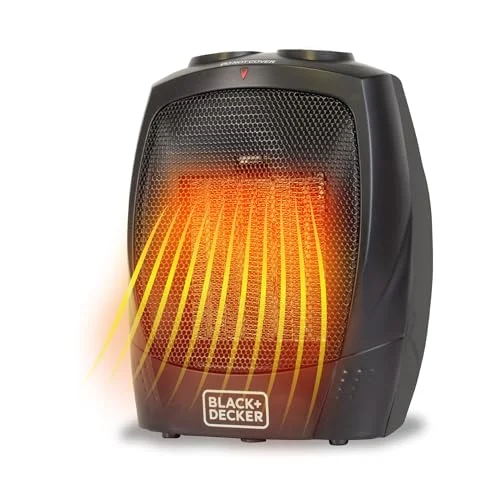
BLACK+DECKER Personal Ceramic Heater, BHDC201
The year-round pick: fan-only, 750 watts or 1,500 watts
Ceramic·Fan / 750W / 1500W·Adjustable thermostat·Tip-over and overheat shut-off
The only one of the three with a setting for every season. Fan-only keeps it useful on a warm afternoon rather than sitting unused in a closet from April to October; 750 watts covers most of a working day once the room has some ambient warmth in it; the full 1,500 watts is there for a cold morning. The adjustable thermostat and both tip-over and overheat shut-off are built in, and at $22.99 it's the only pick here you don't have to put away for most of the year.
The right answer if you want one object under the desk, not two, for the whole year.
02Best for a small desk
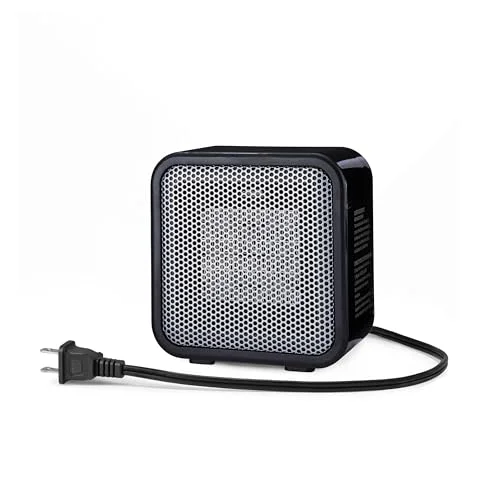
Amazon Basics Ceramic Portable Mini Space Heater
The compact pick: 1.4 pounds, built for an office desk
500W·1.4 lbs·5.87"D × 3.15"W × 5.95"H·Tip-over protection
At 1.4 pounds and under six inches in any dimension, this is the one that disappears under a desk rather than competing with your feet for floor space. It's a flat 500 watts with no higher setting, which is the point: Amazon built and markets it specifically for an office desk, not as a scaled-down living-room heater. That lower ceiling also means it's the easiest of the three to run on a shared circuit without thinking twice about what else is plugged in nearby.
The pick if the desk is small, the circuit is already busy, or you just want the smallest possible object doing the job.
03Best with a thermostat
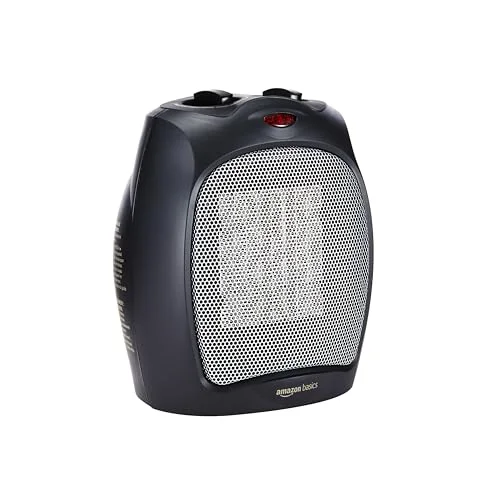
Amazon Basics Ceramic Space Heater, 1500W
The set-and-hold pick: a thermostat for a larger home office
1,500W·Thermostat·Non-oscillating·7.52"D × 6.34"W × 9.45"H
A step up in both size and output from the Mini, built with a thermostat so it cycles on and off to hold a temperature rather than running flat out until you reach over and switch it off. Non-oscillating means the heat stays aimed where you point it, which suits a desk heater better than it would a living room — you want this one pointed at you, not sweeping across a room with nobody else in it. Overheat and tip-over protection are both built in, and the fixed 1,500 watts makes the most sense in a home office that's larger than a single desk nook or runs genuinely cold.
The pick if your home office is really a small room, not just a desk, and you don't want to babysit a dial.
Worth noting: leaving any of these three running unattended through a back-to-back string of meetings is a reasonable thing to do with built-in tip-over and overheat protection, but it's not the same as leaving one running overnight in an empty room. We cover that distinction, and what each kind of safety feature actually does and doesn't cover, in our guide to leaving a space heater on.
How we picked
We started from our own database of space heaters listed for sale in the US and filtered specifically for units marketed around a desk or personal use, rather than pulling three small living-room heaters and calling them office-sized. All three published a specific wattage figure, which matters in a category where plenty of listings describe heat in adjectives instead of numbers; that filter alone removed most of the field we looked at.
How we compared
We compared these three on their published titles, listed specifications and current Amazon prices. Where a figure is specific — the BHDC201's three wattage settings, the Mini's 500 watts and 1.4-pound weight, the Ceramic's thermostat and dimensions — it comes directly from the product's own listing. None of the three publishes a decibel rating, a star rating or a review count in the data we worked from, so none of those numbers appears on this page; we'd rather tell you a figure is missing than estimate one to fill the gap.
We don't run a testing lab, and we haven't plugged these three heaters in ourselves and sat beside them through a workday. We compare specifications, prices and public product data, and we say so plainly rather than describe a process that didn't happen. We also don't show star ratings, review counts or paraphrased owner sentiment on this page, because we don't have manufacturer-published figures for these specific listings — a limitation of the data available to us, not a judgment on the heaters themselves.
Frequently asked questions
Do I need a 1,500-watt heater for a home office, or is that overkill?
For most desks, it's more than the job needs. A home office heater is warming one person sitting still, not a room, which is why the BLACK+DECKER BHDC201 includes a 750-watt setting and the Amazon Basics Mini runs at a flat 500 watts with no higher option at all. Reserve the full 1,500 watts for a genuinely cold morning and run lower the rest of the day.
Why does my office heater seem to trip the breaker in the afternoon rather than the morning?
Because load on a shared circuit tends to peak in the afternoon, not the morning. By 3pm a typical desk is running everything it's going to run that day — monitors, chargers, sometimes a printer — and if the heater has also been turned up as the room cooled, a 1,500-watt heater plus that accumulated load can exceed what a standard 15-amp circuit is rated to carry continuously. It's arithmetic, not a fault with the heater.
Is a fan-only setting actually useful, or is it just a marketing feature?
It's genuinely useful if you want one object at your desk year-round rather than a heater that gets packed away every spring. The BLACK+DECKER BHDC201 is the only one of our three picks with this setting, which means it also functions as a desk fan once the office gets too warm rather than too cold. The other two picks here are heat-only, which is a reasonable trade for their lower price but makes them seasonal purchases.
Will a desk heater's fan be picked up on video calls?
None of the three heaters here publish a noise rating, so we won't claim a specific decibel figure for any of them. What we can say is that all three use an internal fan to move heat, the same mechanism that makes them respond faster than a silent oil-filled radiator, and a fan a foot or two from a microphone is more noticeable than the same fan across a living room. Running on a lower wattage setting during a call, where that option exists, is the practical workaround.
Written by Ilane Tall. Research-based comparisons of published specifications, current prices and public product data — we do not physically test these units and we do not publish invented scores.