By Ilane Tall · Updated October 15, 2026 · Research-based.
Reader-supported: we may earn a commission when you buy through the links on this page, at no additional cost to you. It never changes which product we recommend. Prices quoted below were correct at the time of writing and move often.
Quick answer
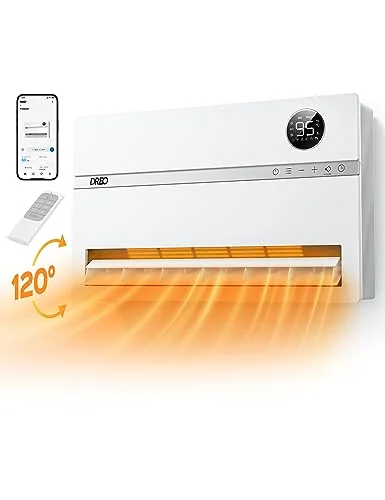
A bedroom heater needs to survive a full night and stay out of the way while it does it, which is a different brief than "heat a room." Our pick is the DREO Smart Wall Heater ($116.96), because it's the only one of the three built and marketed specifically for a bedroom and it mounts on the wall, which means it never occupies the floor space a bedside table, a rug or bare feet need at 6 a.m.
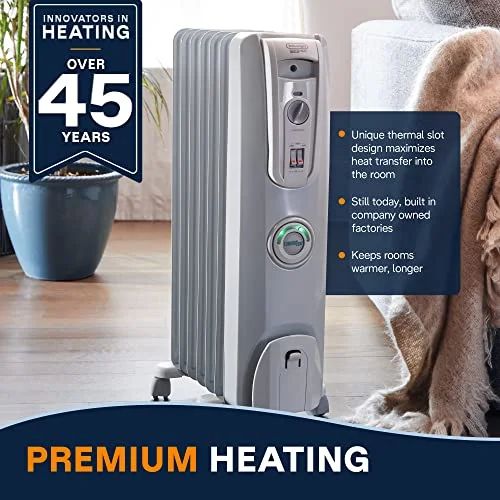
If near-silence matters more than wall mounting, the De’Longhi EW7707CM ($129.95) is the one with no fan to hear in the first place — it's an oil-filled radiator, a mechanism that is quiet by design rather than by marketing claim. The DREO 16-Inch Heater ($59.46) is the budget floor-standing option, best suited to a smaller bedroom or a secondary room where price matters more than the extras.
Eight hours is the requirement, and most timers are shorter
Every other room in a house gets used for an hour or two at a stretch. A bedroom, if you're sleeping in it, gets used for roughly eight hours straight with nobody awake to notice if the heater stopped running three hours in. That single fact changes what "automatic shut-off" means for a bedroom heater compared to anywhere else in the house: a timer that's generous for an evening on the sofa can be a heater that quietly switches itself off at 1 a.m. and leaves the room cold for the rest of the night.
Across this category, shut-off timers commonly run anywhere from a couple of hours to around twelve, and the interval is almost always a specific, published number rather than something you can assume. None of the three listings we have for the heaters on this page states a shut-off-timer duration in hours, so if an overnight auto-off interval matters to your decision, check the current Amazon listing for each model directly before buying rather than assuming it.
What we can say with more confidence is how each of these three heaters behaves mechanically over a long run, which matters almost as much as a stated timer number. The De’Longhi EW7707CM is an oil-filled radiator: a sealed column of thermal oil absorbs heat from an internal element and then radiates it out slowly through the unit's fins, via natural convection rather than a fan blasting hot air. That design is inherently suited to running for long, steady stretches rather than short bursts — it's built to hold a moderate temperature over hours, not to blast a room warm in minutes and then idle. It also keeps radiating heat for a while after it's switched off, which works in your favor on a timer that ends before you wake rather than after.
The DREO Smart Wall Heater carries "Smart" in its own product name, which typically implies some form of app or voice-assistant control in this category, though the listing data we have doesn't spell out which scheduling or timer features are included — confirm that on the current listing rather than assuming it from the name alone. The DREO 16-Inch Heater's listing likewise doesn't state a wattage or timer figure; treat 1,500 watts as the reasonable default for this category unless its listing says otherwise, as covered in more depth in our breakdown of what a space heater actually costs to run.
The practical takeaway: don't shop a bedroom heater on the assumption that any unit will cover a full night unless its listing says so in writing, and where a timer isn't stated, lean toward a mechanism like an oil-filled radiator that's built for long, steady operation rather than short cycles.
Fan noise in a room you sleep in
Noise is a different problem in a bedroom than anywhere else in the house, because in a living room a fan hum competes with a television or conversation and mostly loses; in a bedroom at midnight, it's often the loudest thing in the room. The three heaters here split cleanly into two camps on this point, and the split comes from mechanism rather than marketing.
The De’Longhi EW7707CM has no fan and no motor at all. It is, by product class, mechanically silent in the way a fan-driven heater simply cannot be — there is nothing spinning inside it to generate the broadband whir that a blower produces. The honest trade, covered in more detail in our full look at the quietest space heaters we could find, is that an oil-filled radiator takes longer to bring a room up to temperature than a fan-driven unit does, because it's warming a column of liquid before that liquid can radiate heat outward rather than pushing already-hot air directly at you.
The DREO Smart Wall Heater and the DREO 16-Inch Heater are both fan-driven, and neither listing states a decibel figure we can verify. That's not unusual — no regulator requires a space-heater brand to publish how loud its own fan is, and most simply don't. It means we can't tell you how either will actually sound next to a pillow; check the current listing if a specific noise level matters to your decision, rather than assuming it from the word "smart" or "compact."
One mechanical detail worth knowing regardless of which heater you choose: on most fan-driven heaters, turning the heat setting down does not reliably turn the fan down with it. Many ceramic and PTC units run their fan at or near a fixed speed across several heat levels to keep airflow safely moving across the heating element, so a "low" setting can sound almost identical to a "high" one. If quiet matters as much as warmth, a heater's lowest heat setting is not a dependable way to get there on its own.
Where it sits: floor, wall or bedside — and the clearance each needs
A bedroom is a smaller, more cluttered room than most of the spaces a space heater gets marketed for, and where a heater physically sits changes both how safe it is and how much it gets in your way at 6 a.m. in the dark.
A wall-mounted heater, like the DREO Smart Wall Heater, is mounted above the floor and stays out of the walking path entirely — there's nothing to trip over between the bed and the door, and nothing for a pet to knock into a rug. The trade is installation: a wall heater has to go somewhere specific and usually stays there, so its position needs to be planned once rather than adjusted room to room the way a floor unit can be. It still needs clear air space around its vents and should sit away from curtains, hanging fabric or anything that could drift into contact with it.
A floor-standing heater, like the DREO 16-Inch Heater or the De’Longhi radiator, is the more familiar and flexible option — move it between rooms, reposition it seasonally, store it in summer. The cost is floor space and a cord across the room, both of which matter more in a bedroom you walk through half-asleep than in a living room you're alert in. A hard, level, non-flammable surface is the baseline requirement, with clear space on every side, not just the side facing you.
A heater that sits directly on a nightstand or bedside surface is generally the one placement to avoid with any of the three products here. None of them is marketed or sized as a bedside unit, and putting a heater within arm's reach of bedding or a stack of books shrinks the safety margin that floor or wall placement is built to preserve.
Floor-standing
Most flexible, but needs a clear radius on every side — not just the side facing the bed — and a cord routed away from a path you'll walk in the dark.
Wall-mounted
Frees the floor entirely once it's installed, but the install itself is a one-time decision — choose the spot with curtains, bedding and vent clearance in mind before mounting.
The picks
Three different answers to the same bedroom brief — wall-mounted and bedroom-branded, fan-free and near-silent, or compact and inexpensive — rather than a single ranked winner, since the right one depends on floor space and how much silence is worth to you.
01Best for a bedroom
DREO Smart Wall Heater
Mounted on the wall, marketed specifically for bedroom use
1,500 Watt·Wall-mounted·White, Standard·Smart controls
DREO built and named this heater for exactly this room: "Smart Wall Heater... Space Heater for Bedroom" is the product's own title, not our framing. Mounting on the wall rather than standing on the floor means it never competes with a rug, a bedside table or bare feet crossing the room in the dark, and the "Smart" branding points toward some form of app or voice-assistant control, though the specific scheduling features aren't spelled out in the listing data we have — confirm what "smart" actually includes on the current listing before buying if that's the feature you want. At 1,500 watts, it draws the same ceiling as every other plug-in heater on this page; what you're paying the premium for here is the wall mount and the bedroom-specific design, not extra heat.
Buy it if keeping the floor completely clear overnight matters more than anything else on this list.
02Best for near-silence
De’Longhi EW7707CM Oil-Filled Radiator
No fan, no motor, nothing to hear overnight
Oil-filled·1,500 Watt·No fan·5.9″ D × 13.78″ W × 24.8″ H
The one pick here that's quiet by mechanism rather than by claim. A sealed column of thermal oil carries the heat and radiates it into the room through the unit's fins, with no fan, blower or motor anywhere in the design — there is simply nothing moving fast enough to generate the broadband whir a fan-driven heater produces. De’Longhi describes it as suited to "full room like office and bedroom" use, and its own thermal mass means it keeps radiating warmth for a while even after it switches off, which works in your favor through the back half of a long night. The honest trade is size and speed: it stands nearly 25 inches tall and takes longer to bring a cold room up to temperature than a fan-driven heater would.
Buy it if you'd rather wait a little longer for warmth than hear anything at all while you fall asleep.
03Best budget floor option
DREO 16-Inch Electric Space Heater
The compact, inexpensive floor-standing pick
16 Inch·Floor-standing·$59.46·Indoor use
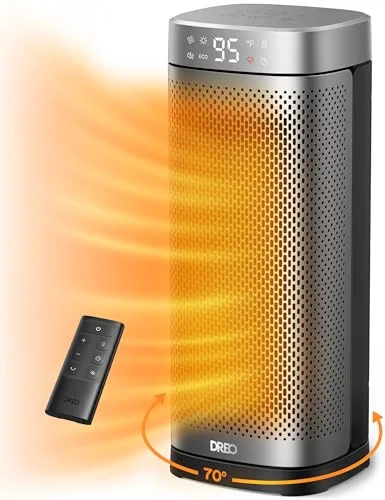
This model is marketed by DREO for large-room use, but a 16-inch-tall unit is compact enough to tuck beside a dresser or at the foot of a bed in a smaller bedroom too, and at under $60 it's the least expensive of the three picks here by a wide margin. The listing data we have doesn't state a specific wattage, noise figure or shut-off-timer interval, so we're treating 1,500 watts as the reasonable category default rather than a confirmed spec, and we'd recommend checking the current listing directly if any of those three numbers would change your decision. What it buys you honestly is price and a small footprint, not confirmed bedroom-specific features.
The pick if the budget matters more than a wall mount or a verified noise number.
The safety habits that matter overnight
A heater running while you're awake is a different risk than one running while you're asleep next to it for eight hours. None of the three listings we have states a confirmed ETL or UL certification or a specific tip-over and overheat shut-off feature, so treat a safety certification and automatic shut-off protection as baseline questions to confirm on the current listing for whichever model you're considering, rather than assuming either applies.
A handful of placement habits apply regardless of which of these three you choose. Plug the heater directly into a wall outlet rather than an extension cord or a power strip; a heater drawing close to 1,500 watts is close to the working limit of what an extension cord is rated to carry continuously, and that's a common, preventable source of overheating unrelated to the heater's own build quality. Keep a minimum of roughly three feet of clear space on every side — bedding, curtains, clothing draped to dry and stacks of books on a nightstand all count as the kind of nearby material that clearance is meant to protect.
Specific to the wall-mounted DREO Smart Wall Heater: mount it at the height and clearance the manufacturer's instructions specify, since a fixed mount means you can't move it away from something later the way you could a floor unit. Specific to the De’Longhi or the DREO 16-Inch on the floor: route the cord away from the path between the bed and the door. And independent of which heater you buy, a working smoke detector in the room is worth confirming — a baseline habit for running any electric heater unattended through a night of sleep.
Dry air and sleep: general information, not medical advice
Running any electric space heater for hours lowers the relative humidity of the air in a closed room, because warming air increases how much moisture it can hold without raising the actual amount of water vapor present — the air effectively "dries out" relative to how humid it felt before the heat came on. This is a basic property of air, true of a furnace vent or a radiator just as much as a portable heater, and it's more noticeable overnight in a bedroom simply because you're in that one room, breathing that air, for hours without a break.
Some people notice drier air more than others — dry skin, a scratchy throat on waking, or sinuses that feel less comfortable are commonly reported experiences in heated rooms generally, not claims specific to any of the three heaters on this page. This is general information about how heated indoor air behaves, not medical advice. It isn't a reason to avoid heating a bedroom; it's a reason some people pair a heater with a humidifier, independent of which heater is running. If dry air is a persistent concern for you, that's a conversation for a doctor, not a buying guide, and the effect applies equally to all three picks here regardless of how each one generates heat — an oil-filled radiator doesn't blow air directly, but it still warms the room's existing air and lowers its relative humidity the same way a fan-driven unit does.
How we picked
We looked specifically for heaters that address the two things a bedroom actually asks for that most "best space heaters" roundups don't emphasize: running for a long, unattended stretch, and doing it without adding fan noise to a room meant for sleeping. That's why an oil-filled radiator with no fan at all sits alongside a heater explicitly marketed and named for bedroom use, and alongside a lower-priced floor-standing option for readers where budget outweighs either of those two features.
How we compared
We compared these three heaters on their published product titles, available listing specifications and current Amazon prices. Where a figure is stated directly — the De’Longhi's and DREO Smart Wall Heater's 1,500 watts, the De’Longhi's dimensions, each product's size variant — it's quoted from that listing. Where a listing doesn't include a number, such as a timer duration, a decibel figure, or a safety certification, we say so plainly above rather than estimate one to fill a gap, and we do not show star ratings, review counts or paraphrased owner sentiment, because we don't have manufacturer-published figures for these listings. We do not run a testing lab, do not own these three heaters, and have not run them in a bedroom ourselves — every spec on this page is quoted from published data, not assumed.
Frequently asked questions
How long does a bedroom space heater actually need to run?
Long enough to cover a full night's sleep, which for most people is somewhere around seven to eight hours. That's longer than many shut-off timers in this category, which commonly range from a couple of hours up to around twelve. None of the three listings we have for the heaters on this page states a specific timer duration in hours, so if an overnight auto-off interval matters to your decision, check the current listing for the exact figure rather than assuming any heater covers a full night by default.
Is an oil-filled radiator actually silent?
Mechanically, yes, for fan noise specifically. A unit like the De’Longhi EW7707CM has no fan or motor to generate the broadband whir that fan-driven heaters produce, because heat moves by natural convection off the radiator's fins rather than by a blade moving air. The trade is speed: it takes longer to bring a cold room up to temperature than a fan-driven heater does, because it's warming a column of liquid first.
Is a wall-mounted heater or a floor heater better in a bedroom?
It depends mainly on floor space and how the room is laid out. A wall-mounted heater like the DREO Smart Wall Heater keeps the floor entirely clear, which matters if there's little space beside the bed or if a half-asleep walk across the room is a real concern. A floor-standing heater is more flexible to reposition or move between rooms, but it needs a clear radius on every side and a cord kept away from the path you'll walk in the dark. Neither placement is inherently safer than the other as long as clearance and cord routing are handled properly.
Does running a space heater overnight dry out the air, and is that a problem?
Warming a room's air lowers its relative humidity, a basic property of air that applies to any heater in this category, fan-driven or not. Some people notice dry skin or a scratchy throat more than others in a heated room; this is general information about how heated air behaves, not medical advice, and many people simply pair a heater with a humidifier if dry air becomes a persistent issue. It isn't a reason to avoid heating a bedroom, and it isn't specific to any one heater on this page.
Written by Ilane Tall. Research-based comparisons of published specifications, current prices and public product data — we do not physically test these units and we do not publish invented scores.