By Ilane Tall · Updated November 9, 2026 · Research-based.
Reader-supported: we may earn a commission when you buy through the links on this page, at no additional cost to you. It never changes which product we recommend. Prices quoted below were correct at the time of writing and move often.
Quick answer
A DREO 25-Inch tower ($79.93) and two BLACK+DECKER BHDC201 personal heaters ($22.99 each, $45.98 total) land within a few dollars of each other. The difference that matters isn't total wattage — it's whether that wattage lands on one circuit or splits across two. One large heater asks a single outlet to carry its full load and fill a room alone. Two small heaters almost always end up on separate circuits, which avoids a tripped breaker but risks neither heater doing a full room's worth of work.
One room and one trusted outlet: the large tower is the simpler buy. Two people in two spots, or an unverified circuit: two small heaters are the safer arrangement — provided you check the panel first.
Same total wattage, two different strategies
Start with the number that makes this question worth asking in the first place. The DREO 25 Inch Electric Space Heater is marketed for large-room use and, like almost every plug-in heater sold for a standard US wall outlet, sits at or near the practical 1,500-watt ceiling a 15-amp residential circuit supports. The listing data we have doesn't state a wattage figure directly, and we're not going to invent one — but nothing about its size, price or "Large Room" positioning suggests an exception to how this category is built. Treat 1,500 watts as the working assumption unless a listing says otherwise.
The BLACK+DECKER Personal Ceramic Heater, model BHDC201, states its wattage outright in the product title: 1,500 watts. That's the heater's maximum setting; lower settings are also available, which matters later in this piece. Buy two and run both at their top setting, and you've assembled 3,000 watts of total heating capacity — double a single large tower, not equal to it.
The genuinely useful framing isn't "one large tower versus two personal heaters at full blast" — it's the strategy question underneath the wattage: do you want one heater built to fill a room's worth of air on its own, or two smaller heaters that each cover a person rather than a room? A $79.93 tower and a $45.98 pair of personal heaters aren't actually interchangeable purchases; they're sized for different jobs, and total wattage is a poor proxy for which one you need.
One large heater: the circuit it needs and the room it can actually fill
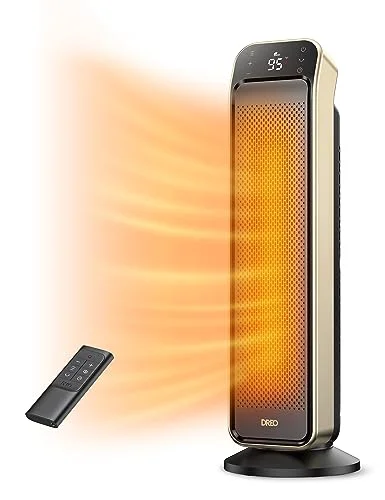
A tower built for large-room use, like the DREO 25-Inch, is doing one job: moving the air in a single room so the far corner feels roughly as warm as the corner next to the unit. That's a convection-style approach — a vertical fan path that pulls air in low and pushes it out across the floor, rather than radiating from a fixed point the way an infrared heater does. The listing's own imagery shows a digital display and an included remote, consistent with a unit meant to be set once at the start of the evening and left running rather than adjusted room to room.
The thermostat built into the DREO 25-Inch is the detail that makes a single large heater viable at all. Without one, a 1,500-watt heater left running flat out all evening would both overheat the near side of the room and waste power once the room reaches a comfortable temperature. With a thermostat, the heater cycles on and off to hold a set point, so its real average draw over an evening is well under its rated maximum — even though the maximum is still what the circuit needs to supply at the moment the heater is running.
That circuit requirement is the part a large single heater can't get around. At roughly 1,500 watts, a plug-in heater draws close to 12.5 amps on a standard 120-volt circuit — close enough to the 15-amp rating on most US household circuits that it wants that outlet to itself. Share it with a space heater's usual rivals — a hair dryer, a toaster, a window air conditioner in summer — and you're asking one circuit to carry more than it was built for. One large heater is simple precisely because it's one draw on one circuit; the tradeoff is that the one outlet you plug it into has to be able to carry the whole load by itself.
What a large tower is good at: a single enclosed room, seating within roughly ten to twelve feet of the unit, and a floor plan that doesn't bleed heat into a hallway or an open kitchen. What it's not good at is covering two separate zones in a genuinely large or open room — a physical limitation of a fixed heat source, not a flaw in this particular tower, and a cold, open basement runs into the same ceiling.
Two small heaters: why they usually end up on two circuits, not one
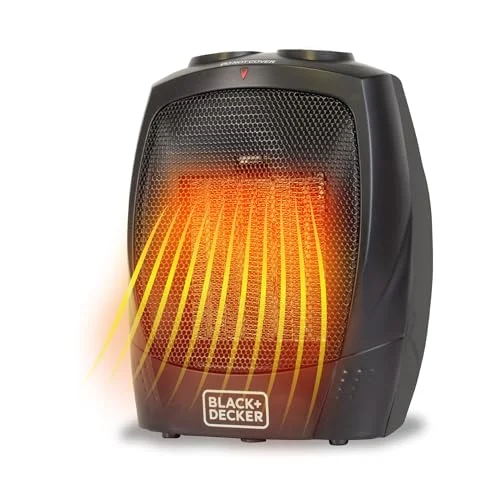
The BLACK+DECKER BHDC201 is built for the opposite job: it heats a person, not a room. It's a ceramic heater with a fan, sized for a desk or a single chair, with settings for fan-only, 750 watts and 1,500 watts, plus an adjustable thermostat. Buy two for two people in two different spots — one at a desk, one at a reading chair across the room — and you're not trying to fill the room's air volume at all. You're running two small, independent heat sources, each doing a one-person job well, rather than one bigger source trying to do a whole-room job.
This usually ends up safer than it sounds because of where the outlets are. A desk and a reading chair across a room are, in most houses, plugged into different wall outlets, and different outlets are frequently — though not always — wired to different circuits. Two 1,500-watt heaters running flat out simultaneously draw roughly 25 amps combined, well past what a single 15-amp circuit is rated to carry. Spread across two circuits, each heater's draw stays within its own circuit's limit; concentrated on one, running both at full power is exactly how a breaker trips.
That split is a function of house wiring, not a guarantee. Older homes sometimes run several outlets in a single room off one circuit, in which case "two small heaters" quietly becomes "two 1,500-watt loads on one 15-amp breaker" the moment both are plugged in nearby. The fix isn't a different heater — the BHDC201's 750-watt setting halves its draw and is the more honest setting to use if you suspect, or confirm, both outlets share a breaker. Wattage planning for a room only works if you also know which outlets are wired together, and the only reliable way to find that out is checking your panel, not guessing from which wall the outlets sit on.
Worth stating plainly: a personal heater pointed at a chair does nothing for the rest of the room, by design. That's the entire premise, not a shortcoming — and it's exactly the failure mode the next section works through.
The failure mode each strategy avoids and the one it risks
One large heater avoids the failure mode two small heaters are most prone to: an unheated gap. A single tower aimed at the center of a room, even imperfectly, tends to raise the average temperature across the whole space, because a convection design circulates air rather than aiming a beam at one spot. Two personal heaters pointed at two chairs do nothing for the open floor between them — walk across the room and you walk into air neither heater was built to touch.
What one large heater risks instead is a single point of failure on a single circuit. If that outlet is already carrying something else — a window unit, a chest freezer on the same circuit in a garage conversion — the breaker trips and the entire room goes cold at once, with no partial coverage to fall back on.
Two small heaters risk the opposite failure: partial, uneven heat that looks adequate on paper but leaves whoever isn't sitting directly in front of one of them cold. It's a quieter failure than a tripped breaker — nothing shuts off, nobody notices immediately — but it means the strategy can under-deliver on room-wide warmth while still succeeding at its actual job of keeping two specific people warm in two specific chairs.
One large heater fits when
You have a single room, one seating zone, and one outlet on a circuit you're confident isn't already loaded — and you'd rather have one simple heater to manage than two.
Two small heaters fit when
You're heating two people in two different spots, you want the flexibility to turn one off without losing all heat, or you've confirmed the outlets you'd use are on separate circuits.
Neither failure mode is hypothetical, and neither is a defect in either product — a tower heater isn't badly designed because it can't solve a two-circuit problem, and a personal heater isn't badly designed because it leaves the middle of the room cold. They're built for different jobs, and the failure each one risks is the direct consequence of the job it's actually doing.
Cost to run: the arithmetic is nearly identical
Here's where the two strategies genuinely tie, with the assumption stated plainly: electricity is priced per kilowatt-hour, not per heater, so what you pay depends on total wattage consumed over time, not how many boxes that wattage came in. At the US residential average of roughly 17 cents per kilowatt-hour, a single 1,500-watt heater at full output costs about 26 cents an hour. Two running simultaneously at full output cost about 52 cents combined — exactly double, because you're drawing exactly double the power.
What actually moves the bill is how much of that rated wattage each setup spends most of its time drawing. A thermostatic tower like the DREO 25-Inch cycles on and off to hold a set point, so its average draw across an evening sits meaningfully below its peak rating once the room reaches temperature. The BHDC201's 750-watt setting, used deliberately, cuts a personal heater's draw in half outright. Two personal heaters on their lower setting can cost less per hour than one large heater cycling at a higher thermostat setting — because actual wattage drawn, not wattage printed on the box, is what the meter counts.
The honest comparison isn't "one heater versus two." It's "total watts actually consumed, at whatever settings you run, for however many hours" — the dial on each heater matters more to the bill than which strategy you picked.
The picks, for each strategy
Not a ranked list — the right pick depends entirely on which strategy fits your room, and the two don't compete with each other directly.
01Best for the one-heater strategy
DREO 25 Inch Electric Space Heater
The tower pick: one heater, one room, one circuit
25-inch tower·Thermostat·Large, size variant·Remote included
A 25-inch tower marketed by DREO for large-room use, with a built-in thermostat so it cycles to hold a set temperature rather than running flat out all evening. We don't have a stated wattage or square-footage figure for this listing, so we're treating 1,500 watts as the standard category assumption rather than asserting a number the listing doesn't give. It's the simpler strategy: one heater, one outlet, one room to fill — provided that outlet isn't already sharing its circuit with something else.
The pick if you have one room, one seating zone, and want to be done shopping with a single purchase.
02Best for the two-heater strategy, under a desk
BLACK+DECKER Personal Ceramic Heater, BHDC201
The personal pick: buy two, put one on each circuit
Ceramic·Fan / 750 W / 1500 W·Adjustable thermostat·$22.99 each
Three settings — fan only, 750 watts, 1,500 watts — plus an adjustable thermostat, in a heater sized for a desk or a single chair rather than a room. Buy a second one for a second person in a second spot and you've built the two-heater strategy for $45.98 total, less than the single tower above, provided both outlets don't share a breaker. Default to the 750-watt setting if you haven't confirmed that — it halves the draw without turning the heater off.
Buy two if you're warming two people in two spots, and check the panel before you run both at full power.
03Best middle ground
DREO Space Heater (10-inch)
The in-between pick: smaller than the tower, more room coverage than a personal heater
10-inch·Thermostat·Portable·$33.36
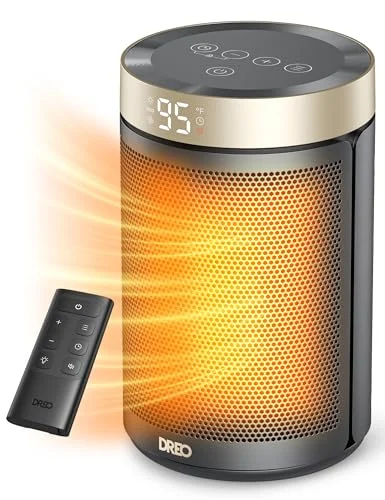
A smaller, 10-inch DREO heater with a thermostat, positioned between the large tower and the under-desk personal heater on both size and price. It's a reasonable second heater to pair with the 25-inch tower to cover a second, smaller zone — a reading corner, say — without doubling up on two identical personal heaters. As with the 25-inch model, the listing doesn't state a specific wattage, so treat the standard 1,500-watt assumption as the working figure when sizing your circuit plan.
The pick if neither "one big tower" nor "two desk heaters" quite matches your room.
How to actually check which outlets share a circuit
Everything above depends on one piece of information most people don't have before buying a second heater: which outlets in the room are wired to the same breaker. Worth confirming before committing to either strategy, not after a breaker trips.
The simplest method doesn't require an electrician. Plug a lamp into the outlet you're testing, turn it on, then flip breakers off one at a time at the panel until the lamp goes dark, and label that breaker. Repeat for the second outlet. If both go dark on the same flip, they share a circuit — running two 1,500-watt heaters on both at once is the scenario that trips it. If they go dark on different breakers, you're clear to run both at full power.
This matters more in older homes, where an entire room — sometimes an entire floor — is sometimes wired to a single circuit, a convention that predates today's high-draw appliance habits. Renters in particular often have no wiring records and no way to find out except this test.
How we picked
We started from our own database of space heaters listed for sale in the US and selected products that represent the two strategies directly: a tower built for large-room coverage, and a personal heater explicitly sized and marketed for one-person use near a desk or chair, plus a mid-size model to show the strategies aren't strictly binary. The goal wasn't to crown a winner between "one big heater" and "two small ones," since the right answer depends on the room and the wiring, not on which product is objectively better.
How we compared
We compared the three heaters on their published titles, available specifications and current Amazon prices. The BLACK+DECKER BHDC201 states its wattage and settings directly in the listing; neither DREO model here states a wattage figure in the data we have, and we say so plainly rather than estimate one to fill a gap. The circuit and amperage figures cited throughout come from how US household electrical systems are built and rated, not from any single product listing.
We do not run a testing lab. We have not plugged these units into a breaker panel and watched what trips, so you won't find an invented decibel reading or a real-world amp-draw measurement here beyond the standard electrical assumptions stated above. We also don't show star ratings, review counts or paraphrased owner sentiment, because we don't have manufacturer-published figures for these specific listings — a limitation of the data available to us, not a judgment on the heaters themselves.
Frequently asked questions
If the total wattage is the same, does it matter which strategy I pick?
Yes, because total wattage only predicts your electric bill, not how the heat actually reaches you. One large heater fills a single room's air more evenly but puts its whole load on one outlet. Two smaller heaters split the load across what are usually, but not always, separate circuits, while leaving the space between them less heated. Same watts, different results in the room.
Will two small heaters trip a breaker the same way one big heater's circuit would?
Only if both heaters end up on the same circuit. Two 1,500-watt heaters running at full output simultaneously draw roughly 25 amps combined, which exceeds a standard 15-amp circuit whether that load comes from one big heater sharing its outlet, or two small heaters plugged into outlets that turn out to be wired together. Check which outlets share a breaker before assuming either arrangement is safe.
How do I decide which strategy fits my room?
One enclosed room, one seating zone, a trustworthy single outlet: a large tower is the simpler purchase. Two people in two different spots, or a room too open for one heater's airflow to reach both ends: two smaller heaters — ideally confirmed to be on separate circuits — generally serve it better than one heater straining to cover all of it.
Should I ever run a personal heater on its lower wattage setting instead of the max?
Yes, specifically if you haven't confirmed the outlets you're using are on separate circuits. The BHDC201's 750-watt setting halves its draw compared to its 1,500-watt maximum — the easiest way to run two personal heaters simultaneously without risking a shared circuit's limit, at the cost of less total heat output.
Written by Ilane Tall. Research-based comparisons of published specifications, current prices and public product data — we do not physically test these units and we do not publish invented scores.