By Ilane Tall · Updated October 24, 2026 · Research-based.
Reader-supported: we may earn a commission when you buy through the links on this page, at no additional cost to you. It never changes which product we recommend. Prices quoted below were correct at the time of writing and move often.
Quick answer
A space heater rarely replaces central heat, and it was never designed to. It is supplemental — a tool for warming the one or two rooms you are actually sitting in, so the thermostat for the rest of the house can come down a few degrees. Run the arithmetic honestly and a single 1,500-watt heater in one occupied room, paired with a lower whole-house setpoint, usually costs less than heating every room to the same temperature around the clock — but only if you genuinely spend most of your day in one or two rooms. If you move through a four-bedroom house all day, or if three people are in three different rooms, a space heater stops saving anything and starts adding a second bill on top of the first.
If you intend to try it, a unit built for the room you actually live in matters more than its price. The De’Longhi EW7707CM oil-filled radiator ($129.95) suits a bedroom you want warm and silent all night; the DREO 25-Inch tower ($79.93) suits a living room where you want air moving end to end. See the picks below, and read the arithmetic in the next section before you commit to turning the thermostat down.
Why supplemental heat is the actual use case
Almost nobody buys a space heater instead of a furnace. They buy one alongside a furnace, a boiler, or a heat pump that is already keeping the house above freezing and already paid for. That changes the question: the comparison isn't "space heater versus no heat," it's "space heater plus a lower central setpoint" versus "central heat alone at the setpoint you'd otherwise use." The space heater's job is narrow — make one occupied room feel as warm as it would at the higher setpoint, while the rest of the house is turned down.
This is also why a space heater's wattage ceiling, covered on this site's large-room coverage, matters less here than people expect. A plug-in heater tops out around 1,500 watts almost regardless of price — enough to raise one room several degrees, but never engineered to do that job for an entire floor plan. The economic case for supplemental heat rests on concentrating that fixed, modest power into the small volume of air you're actually using, rather than spreading the furnace's larger output across square footage nobody is standing in most of the day.
That framing also explains why a home office is the place this trade works most cleanly: one person, one room, for hours at a stretch, while the rest of the house sits empty. Our home office coverage goes into the specifics. The math gets messier the moment more than one room is in regular use.
The arithmetic, with the assumptions stated
Every cost comparison on the internet skips the assumptions and just states a number. Here are ours, stated first, so you can swap in your own rate and your own routine rather than trust a figure that was never calculated for your house.
The space heater side. A 1,500-watt heater is 1.5 kilowatts. At the US residential average of roughly 17 cents per kilowatt-hour — a figure that varies by more than double between states, so check your own utility bill — that's about 26 cents an hour at full output, or close to $2 for an eight-hour stretch. A thermostatically controlled heater cycles off once the room reaches its set temperature rather than running flat out, so real consumption is usually well under that ceiling once a room is holding steady rather than warming from cold.
The central heating side. This number is genuinely hard to pin down, since it depends on fuel type, climate, insulation and house size in ways no single figure captures honestly. What's well established, per the US Department of Energy's thermostat guidance, is the relationship rather than a dollar figure: turning a whole-house setpoint down for several hours a day reduces that system's heating load by roughly one percent per degree, per hour it's down — a direction and scale that holds regardless of whether the furnace burns gas, burns oil, or is electric resistance.
Put the two together and the comparison becomes answerable for your own house: work out what a few degrees off the whole-house setpoint would plausibly save using that one-percent-per-degree relationship, and compare it against roughly $2 a day for the heater. If the whole-house saving comfortably covers that, the setback wins. If it doesn't — a small house, good insulation, an already-low setpoint — the margin narrows fast, and it's entirely possible to come out behind by adding a second device on top of a system that wasn't using much extra energy to begin with.
The piece that's easy to miss: this only works if the setback and the heater run together. A heater running while the rest of the house stays at its normal setpoint is pure addition — extra cost, no offsetting saving.
How many rooms you occupy at once
This is the variable every generic cost comparison leaves out, because it depends on how you actually live, not on a spec sheet. A space heater saves money by letting you lower the setpoint for square footage nobody is using, and the number of rooms you occupy at once is a direct measure of how much square footage that is.
A person living alone, working from one room and sleeping in another, is close to the ideal case: two rooms need heat at any given time, and the rest of a small floor plan can run cooler without anyone noticing. A household of four, with people in the kitchen, an office, a kid's bedroom and a living room simultaneously through the evening, is close to the worst case: there's no square footage left to lower, because every room already has someone in it who'd feel the setback immediately. In that house, a heater in one room doesn't free up savings elsewhere — it adds a second running cost next to a furnace already at full occupancy.
Most households sit between those extremes, and the honest exercise is to count rooms rather than guess: walk through an average day and tally how many rooms are occupied at once, and for how many hours. A studio where you're in the same room for twelve hours is an easy case for a single heater and a lower setpoint. A larger house where occupied rooms rotate through the day — bedroom, then office, then living room — can still work, but typically means moving one heater between rooms rather than buying several, since covering every room you might sit in erodes the saving you were chasing.
What it does not replace: pipes, humidity, the rest of the house
A space heater warms the air and the surfaces directly in front of it. It does nothing for everything else a central system is quietly doing throughout the rest of the house, and treating it as a full substitute is where this strategy causes actual problems rather than just a smaller saving than hoped.
The most consequential is plumbing. Pipes running through exterior walls, an unheated basement, a garage, or a crawl space depend on the room around them staying above freezing, and a setback deep enough to let one room drop into the 50s on a cold night can let an unoccupied bathroom or laundry room drop further, especially overnight. A burst pipe costs vastly more than anything a space heater was ever going to save, so know which rooms carry plumbing before deciding how far the whole-house setback goes.
Humidity is the second thing a central system manages that a space heater doesn't touch. Heated air holds less relative moisture, which is why heating season dries out skin, sinuses and wood furniture regardless of how that heat is generated. Lowering the whole-house setpoint while concentrating dry heat into one occupied room doesn't fix this — it can make dryness more noticeable in that specific room, even as the rest of the house gets no drier than before. None of the three products on this page add or remove humidity; that's a separate problem, usually solved with a standalone humidifier for the room you're actually heating.
And a lower whole-house setpoint is still felt everywhere you walk through but don't linger — hallways, bathrooms, a kitchen you pass through for coffee. If you intend to leave a heated room for any stretch and want it warm and safe unattended, read our coverage of leaving a space heater on unattended before running one overnight at a lower central temperature than usual.
The picks, if you intend to lower the thermostat
These aren't ranked against each other — they answer different versions of "which room am I actually in." Match the pick to the room you're trying to keep warm while the rest of the house comes down, not to a general notion of which heater is "best."
01Best for a bedroom overnight
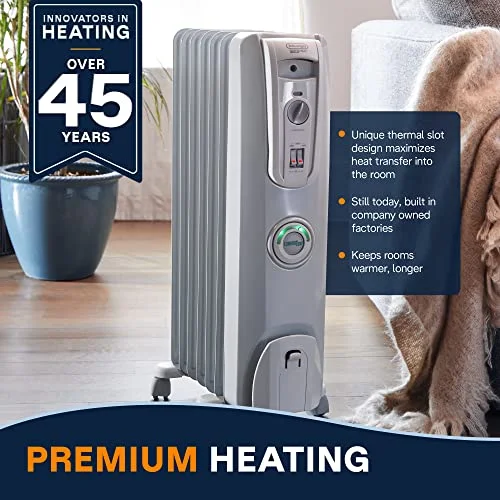
De’Longhi EW7707CM Oil-Filled Radiator
Silent heat for the one room you lower the furnace for at night
Oil-filled·1,500W·No fan·5.9″D x 13.78″W x 24.8″H
If the setback happens overnight while you sleep, the room needs a heater that makes no noise and isn't blowing air you'll feel from across the bed. The EW7707CM has no fan at all — it radiates from heated oil inside sealed panels, warming slowly and continuing to radiate after it switches off, which suits a setback set once and left running. It's the slowest of the three to warm a cold room from scratch, the trade for silence.
Pair it with turning the hallway and spare-room registers down, not off — the pipes in those rooms still need to stay above freezing.
02Best for the room you live in all day
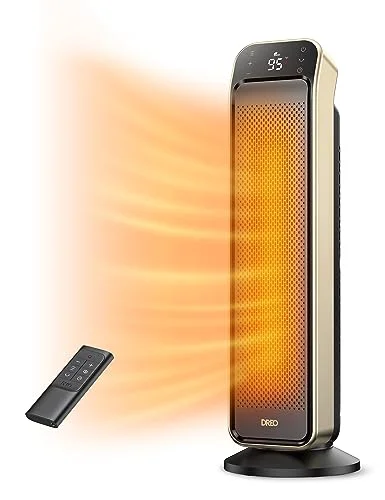
DREO 25 Inch Electric Space Heater
A tower built to cover a living room or office you occupy for hours
25-inch tower·Thermostat·Large, size variant·Remote included
For the room where the setback saves the most — the one you're sitting in for most of the day — a tower built to move air end to end does more work than a heater aimed at one chair. The DREO has a built-in thermostat, so it cycles rather than running at full output the whole time, the behavior the running-cost math above assumes. It ships with a remote, useful for a room set once and left alone until evening.
The pick for the one room doing the most hours of occupied duty — put the saved central-heating budget toward keeping this one genuinely comfortable.
03Best for the room you don't want to feel like a setback
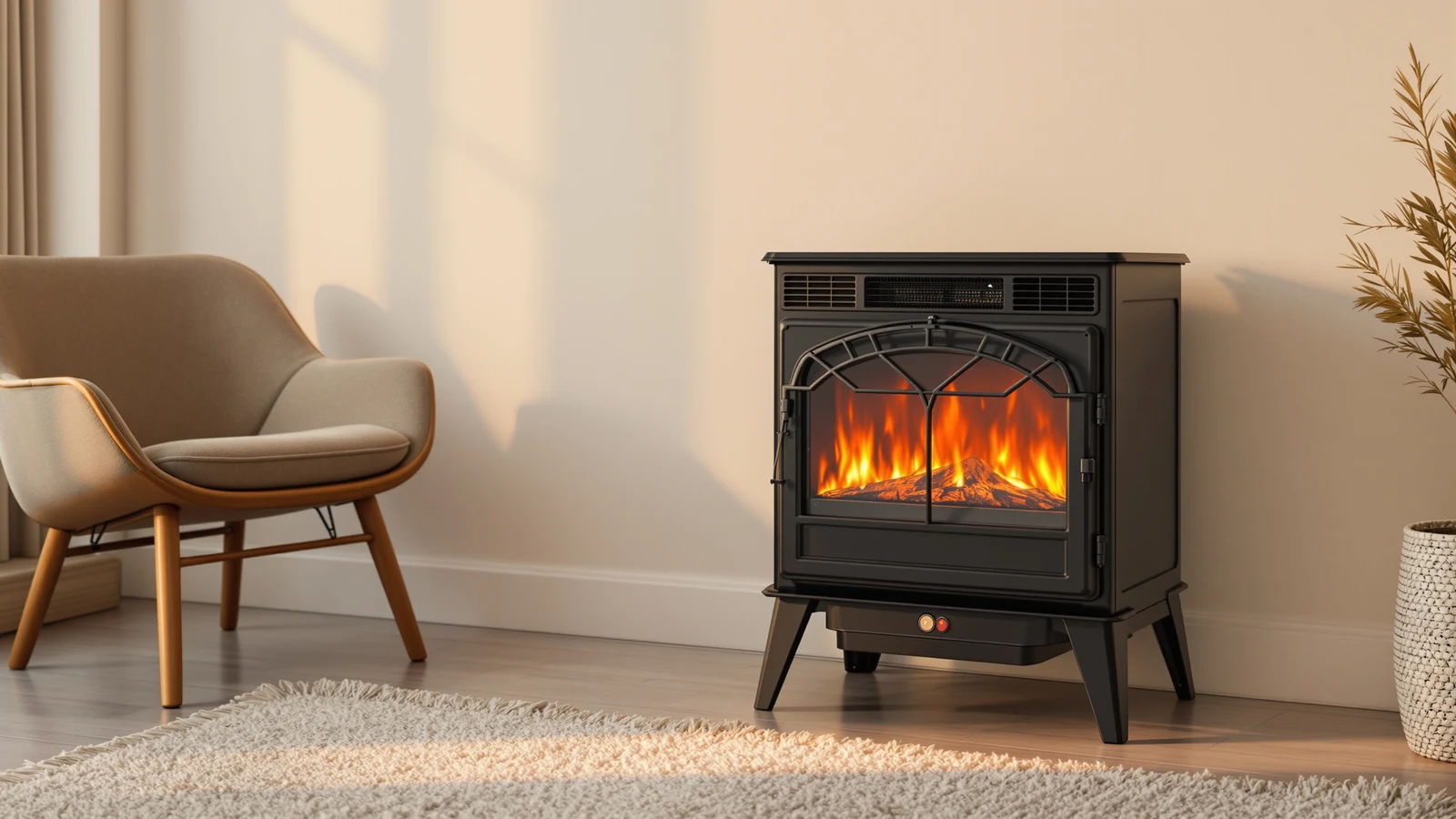
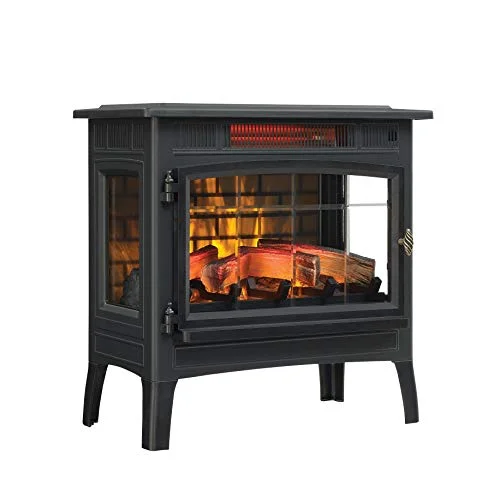
duraflame Freestanding Electric Fireplace Stove
Heat plus a reason to actually want to be in the room you're heating
Infrared·3D flame effect·Rated for 1,000 Sq. Ft.·13.07″D x 24″W x 23.4″H
Turning the whole house down a few degrees is easier to live with when the room you're spending it in feels like an upgrade, not a compromise. The duraflame pairs an infrared element with a glass-fronted 3D flame display, so the room looks and feels like the warmest one in the house, not just the one with a heater plugged in. Its 1,000-square-foot rating is a manufacturer's figure measured under favorable conditions — treat it as a ceiling, not a guarantee.
The pick if the plan is to make the family room the obvious place to be once the rest of the house is a few degrees cooler, not just the warmest room by default.
Whichever you choose, give it a shut-off interval that matches how long you're actually in the room rather than leaving it to guesswork; our timer and auto-shutoff coverage covers how to match that setting to the room's real occupied hours instead of a factory default.
Where this stops being true
The setback-plus-space-heater strategy is genuinely sound in the right house, and a wash or a loss in the wrong one. A few conditions flip it.
More than one or two rooms occupied at once is the single biggest factor, covered above: if there's no square footage left to lower because every room already has a person in it, there's no saving for the heater to offset.
Multiple heaters covering multiple rooms scale the running cost linearly while the whole-house saving doesn't scale the same way, so the arithmetic stops favoring the heater. There's also a hard electrical ceiling: two 1,500-watt heaters draw roughly 25 amps combined, more than a standard 15-amp circuit is rated for. Our breaker coverage has the full math.
A heat pump as the central system moves existing heat rather than generating it from resistance, typically delivering several times more heat per dollar of electricity than a 1,500-watt resistance heater. The per-degree setback saving is still real, but the space heater becomes a comparatively inefficient way to spend electricity next to it.
A home that's already set low or well insulated has less slack to turn into savings, since the one-percent-per-degree relationship assumes there's meaningful room to come down from.
Genuinely extreme outdoor temperatures expose the real ceiling on how warm a single 1,500-watt heater can make a room while its walls lose heat fast — and a heater struggling to hold comfort isn't saving anything if the central system still has to run hard regardless.
How we picked
We looked for heaters built around different delivery mechanisms — a silent oil-filled radiator, an airflow-focused tower, and a radiant stove — because the "which room" decision here depends on mechanism more than on any single spec, and three near-identical fan heaters wouldn't answer the question most readers have.
How we compared
Running costs are calculated from each heater's stated wattage and a published US residential average electricity rate, both stated as assumptions rather than constants, since your own rate and room will differ. Where a listing states a dimension or rated wattage, we quote it directly; where it doesn't, we say so rather than estimate a number to fill a gap. We do not run a testing lab, do not own these three heaters, and have not run them in a house ourselves — this page compares published specifications, current prices and widely cited public guidance on thermostat setbacks, not a lived-in trial. We also don't show star ratings, review counts or paraphrased owner sentiment, because we don't have manufacturer-published figures to cite honestly.
Frequently asked questions
Is a space heater actually cheaper than central heat?
Only in combination with a lower whole-house setpoint, and only if that setback covers rooms nobody is currently using. Run on its own, a space heater is pure additional cost. Paired with turning the thermostat down for unoccupied square footage, the math above usually favors the heater — roughly $2 a day to run one unit, against a whole-house saving that scales with how many degrees and how many rooms come down with it.
How many degrees can I lower the thermostat if I'm using a space heater?
There's no universal number; it depends on your house, climate and tolerance for cooler hallways and bathrooms. The well-established relationship is roughly one percent of heating energy saved per degree, for every degree the setpoint comes down. Most people who try this settle around three to five degrees for the whole house, while keeping occupied rooms comfortable with the heater.
What happens to the rooms I'm not actively heating?
They get cooler, which is where the saving comes from. The risk worth managing is any room with exposed plumbing — a bathroom, laundry room, or a room with pipes in an exterior wall needs to stay well above freezing regardless of occupancy. Comfort setbacks and pipe-safe setbacks are two different numbers; know which rooms carry plumbing before deciding how far to go.
Does this still make sense with a heat pump?
The setback saving still applies, since a heat pump responds to a lower setpoint the same directional way any central system does. What changes is the other side: a heat pump typically delivers more heat per dollar of electricity than a 1,500-watt resistance heater, so the gap between "cheap to run" and "cheap compared to the system already heating the house" narrows. It can still be worth it for one consistently occupied room, but the margin is smaller than in a gas- or baseboard-heated home.
Written by Ilane Tall. Research-based comparisons of published specifications, current prices and public product data — we do not physically test these units and we do not publish invented scores.