By Ilane Tall · Updated October 14, 2026 · Research-based.
Reader-supported: we may earn a commission when you buy through the links on this page, at no additional cost to you. It never changes which product we recommend. Prices quoted below were correct at the time of writing and move often.
Quick answer
A 1,500-watt space heater is 1.5 kilowatts. At the US residential average of roughly 17 cents per kilowatt-hour, running it flat out costs about 25.5 cents an hour, call it a little over $2 for an eight-hour evening and around $60 for a full month of nightly use. That's the number almost every article skips past, and it assumes your rate is the national average and your heater never shuts off — neither is likely to be exactly true for you.
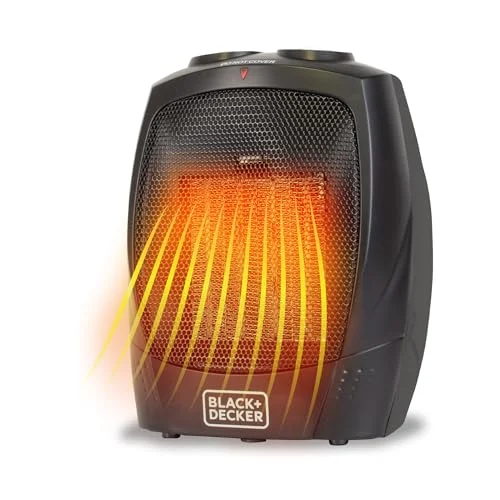
The arithmetic matters less than two things it leaves out: a thermostat makes a heater cycle on and off rather than run continuously, which can cut real consumption well below the ceiling figure, and the real comparison isn't "heater versus nothing" — it's heating the one room you're in versus raising the thermostat for an entire house. Get those two right and the honest answer is usually that a heater like the BLACK+DECKER BHDC201 ($22.99) run on its 750-watt setting in one occupied room beats warming the whole house for the evening.
1,500 watts is 1.5 kilowatts: the only number you need
Your electricity bill is denominated in kilowatt-hours, not watts, so the first step in any running-cost calculation is converting the heater's wattage into the same unit the utility charges you for. A watt is a rate of energy use; a kilowatt-hour is that rate sustained for one hour. 1,000 watts run for one hour uses exactly one kilowatt-hour. Almost every plug-in space heater sold for a standard US wall outlet is built to roughly 1,500 watts — the practical ceiling of a 120-volt, 15-amp residential circuit — so running one flat out for an hour uses 1.5 kilowatt-hours.
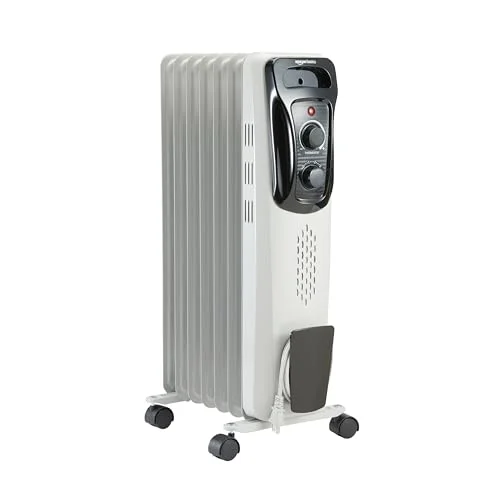
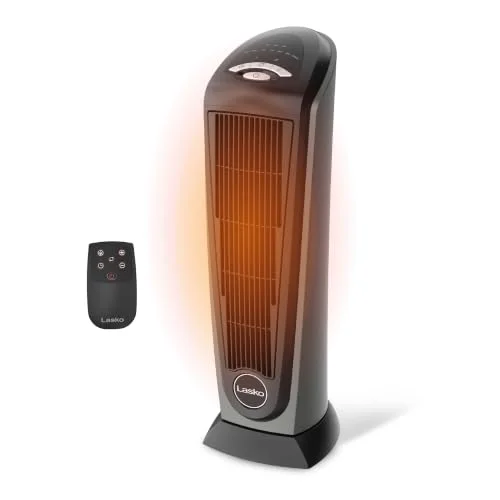
That's it. That's the entire physical fact underneath every running-cost article you'll ever read about space heaters. The Amazon Basics Portable Oil Radiator states 1,500 watts directly in its listing, and the Lasko 23" Ceramic Tower runs at the same wattage on its high setting. The BLACK+DECKER Personal Ceramic Heater is the exception worth noting here, because it's built with a second, lower setting — more on that below. Beyond the number of watts, nothing else about a heater's internal construction, brand or price changes this arithmetic. A $23 ceramic heater and a $260 cabinet both burn through 1.5 kilowatt-hours for every hour they run at full output, because both are built around the same wattage ceiling. The only genuine variables are how much your utility charges per kilowatt-hour, and how much of that hour the heater actually spends running.
Our rate assumption, and why yours is probably different
Every dollar figure in this article is built on one assumption: 17 cents per kilowatt-hour, which is close to the US residential average reported by the Energy Information Administration in recent years. We're stating that number in the open because almost no running-cost article does, and the gap between "25 cents an hour" and the real figure in your kitchen can be enormous once you plug in your own rate instead of ours.
Residential electricity rates vary by more than double across the country. States with heavy hydroelectric or nuclear capacity and less transmission congestion tend to sit well under 15 cents per kilowatt-hour; several states in the Northeast and parts of California routinely bill above 30 cents, and some utilities add time-of-use pricing that makes evening hours — exactly when a space heater runs — the most expensive hours of the day. A heater that costs 25.5 cents an hour on our assumed rate can cost under 20 cents an hour in a cheap-power state, or close to 50 cents an hour in an expensive one. That's not a rounding error; it roughly doubles or halves every figure further down this page.
The fix is simple and takes less time than reading this paragraph: open your most recent electric bill, or your utility's online account, and find the rate per kilowatt-hour — sometimes listed as "energy charge" separately from delivery or fixed fees, sometimes bundled into one effective rate. Divide your total bill by your total kilowatt-hours used for a rough blended number if the statement doesn't break it out cleanly. Whatever number you find, swap it for our 17 cents in the math below. Every figure here is a formula with your rate as the missing input, not a fixed truth.
Cents per hour, dollars per evening, dollars per month
With the rate assumption stated, the arithmetic is one multiplication, repeated at three different time scales.
Per hour: 1.5 kilowatts × $0.17 per kilowatt-hour = $0.255, about a quarter, for every hour a 1,500-watt heater runs continuously at full output.
Per evening: an eight-hour evening — dinner through bedtime — at full output comes to 8 × $0.255 = $2.04. Scale that to a full overnight run of ten hours and it's $2.55; a shorter three-hour stretch while you're reading in one room is closer to $0.77.
Per month: here's where the number people actually care about comes from. Run a heater for eight hours a night, every night, for thirty nights, and you get 8 × 30 = 240 hours, or 240 × $0.255 = $61.20 for the month. Cut that to five nights a week instead of seven and it drops to roughly $43.70. Run it only on the coldest nights — say ten nights a month — and it's about $20.40.
The honest caveat on all three numbers: every one of them assumes the heater runs continuously at full output for the stated hours, with no thermostat cycling it off. That's the ceiling, not the typical outcome. The next section is why the real number is usually lower.
Why a thermostat changes the answer: cycling versus running flat out
The monthly figures above describe a heater that never shuts off — it runs at its full stated wattage for every minute of every hour you count. In practice, almost no heater does that for very long, because almost every heater sold with any kind of thermostat or temperature setting is designed to stop doing that once the room reaches the target temperature.
A heater with an adjustable thermostat, like the BLACK+DECKER BHDC201's dial control, heats the room until the air near the sensor reaches the set point, then cuts the heating element and either shuts off or idles on fan-only until the room cools enough to call for heat again. That's cycling, and it's the same principle behind a home furnace or a window air conditioner: the equipment is rated for its peak draw, but it spends a meaningful share of its running time not drawing that peak at all. A small, well-insulated room that reaches a comfortable temperature in twenty minutes and then only needs the element back on for five minutes out of every thirty is using a fraction of the "continuous" cost calculated above — closer to one-sixth of the per-hour figure during the idle stretches, averaged across the whole session.
The Amazon Basics Portable Oil Radiator illustrates the other side of cycling. An oil-filled radiator heats slowly and keeps radiating stored heat into the room even after its thermostat cuts the element, which means its effective duty cycle — the share of each hour actually drawing full wattage — tends to be lower than a fan heater's once the room is up to temperature, because the oil itself is doing heating work without the element switched on. The three heat settings and over-heat protection on that unit are both evidence it's built to run unattended for stretches, cycling rather than continuously drawing 1,500 watts.
What this means for your own number: treat the per-hour and per-month figures above as the ceiling for a room with no thermostat control, run on a single fixed-heat setting with nothing to tell it to stop. A heater actually holding a set temperature in an insulated room will typically land meaningfully under that ceiling — how far under depends on your room's insulation, the outdoor temperature and the target you set, none of which we can calculate for you from a product listing. The honest version of "what will this cost me" sits somewhere between the continuous-run number above and roughly half of it, and the only way to know exactly where is to watch it run for an evening.
The real comparison: one room heated versus the whole house warmed
All the arithmetic above answers "what does the heater itself cost," which is the wrong question if you're deciding whether to buy one at all. The question that actually determines whether a space heater saves you money is what it's being compared against, and the honest comparison isn't "heater running versus nothing running." It's a space heater warming the one room you're actually occupying versus raising a central thermostat to warm every room in the house, including the ones nobody is sitting in.
A central furnace or heat pump, once it's running, is heating the entire conditioned square footage of a home — bedrooms with the doors closed, a guest room, a hallway, a kitchen nobody's standing in at 9 p.m. A single 1,500-watt heater run in the living room while everyone is in the living room is heating roughly that one room's worth of air and the objects in it, at the cost calculated above. If the alternative is running a furnace for the whole house for the same evening, the space heater is very often the cheaper option, because 1.5 kilowatts applied to one occupied room is a fraction of what a furnace burns heating square footage nobody's using.
This comparison flips the other direction in a specific, common case: if the house's heating system is already running to keep the rest of the home at a baseline temperature — pipes from freezing, other people comfortable, a thermostat set and left alone — then adding a space heater in one room is pure addition, not substitution. You're not avoiding the cost of heating the house; you're adding the cost of the heater on top of it. The savings case for a space heater depends entirely on whether you're using it to avoid running central heat, or using it in addition to central heat that's running anyway. The Lasko tower heater's oscillation and remote control exist specifically to make one-room use comfortable without walking over to adjust it, which is the use case where the substitution math actually pays off.
A space heater likely saves money when
You'd otherwise be running or raising central heat for an entire home to keep one occupied room comfortable — working from a home office during the day, or staying up later than the rest of the household.
A space heater likely adds cost when
Central heat is already running for other people or other reasons, and the heater is extra warmth on top of a baseline that exists regardless of whether you turn it on.
When a 750-watt setting is the cheaper way to stay warm
The BLACK+DECKER Personal Ceramic Heater (BHDC201) is the one product in this comparison built with a second, genuinely lower-power setting rather than only a high-and-off switch, and it's worth working through because the math is more favorable than most buyers expect. Dropping from its 1,500-watt setting to 750 watts doesn't cut the heater's usefulness in half the way it might sound — it cuts its running cost in half, from $0.255 an hour down to about $0.1275 an hour on our assumed rate, while still delivering real, felt heat in the small, personal-scale space this heater is built for.
The reasoning is specific to what this heater is actually for: a product described and sized as a personal ceramic heater is aimed at warming one person at a desk or in a chair, not a whole room. For that use case — feet and hands in one small radius, not a 12-by-15 bedroom — 750 watts of ceramic heat at close range frequently feels like enough, because the heat doesn't need to travel far or fight the volume of a full room. Running the same unit at 1,500 watts to heat that same small personal space is often more output than the use case needs, which means it's wattage, and cost, spent without a corresponding gain in comfort.
The practical rule this points to: match the setting to the job, not to the highest number on the dial. A 750-watt setting aimed at one person under a desk, run for the same eight-hour workday that the full-output math above assumes, comes to roughly $1.02 instead of $2.04 — half the monthly cost for a job that a low setting may do just as well for a single occupant at close range. The fan-only mode on the same unit, which draws a small fraction of either heat setting, is the cheapest option of all for the stretches where moving air without heat is what's actually wanted, such as warm months when the same heater earns its desk space as a personal fan instead.
How we picked
This page isn't a product roundup, so "how we picked" means how we chose which products to use as worked examples rather than how we ranked a field. We used three heaters from our own database that between them cover the three mechanisms and price points relevant to a running-cost discussion: a low-cost personal ceramic heater with a genuine low-wattage setting, a 1,500-watt oil-filled radiator built for slow, sustained cycling, and a 1,500-watt ceramic tower built for one-room, thermostat-free use. We excluded products without a clearly stated wattage, because a running-cost calculation built on a guessed wattage isn't honest arithmetic.
How we compared
Every dollar figure on this page is arithmetic, not a measurement: wattage from each product's own listing, converted to kilowatt-hours, multiplied by a stated electricity rate we chose from published national averages and disclosed up front. We did not run these heaters, time how long their thermostats actually cycle, or measure real household consumption with a meter — we don't own a testing lab, and a running-cost figure built on watching one unit in one room for one evening wouldn’t generalize to your room anyway. Where the math depends on a variable we can't know for you — your local electricity rate, your room's insulation, how long your thermostat actually holds between cycles — we say so and show you how to find your own number rather than present a single confident figure as universal.
The heaters used in this comparison
01Lowest cost, two settings
BLACK+DECKER Personal Ceramic Heater (BHDC201)
The one with a genuine 750-watt setting
Ceramic·750 / 1,500 Watt·Fan-only mode·Pack of 1
A personal-scale ceramic heater with fan-only, 750-watt and 1,500-watt settings, which makes it the one product here where the running-cost math genuinely changes based on which button you press. At $22.99 it's the cheapest heater in this comparison to buy, and on its low setting it's close to the cheapest to run — about half the hourly cost of any heater fixed at 1,500 watts, for a use case — warming one person at close range — that often doesn't need the higher number.
The pick for understanding that running cost isn't fixed by a product category; it's fixed by which setting you actually use.
02Slow heat, built to cycle
Amazon Basics Portable Oil Radiator Heater
The one that keeps radiating after the element shuts off
Oil-filled, 7 fins·1,500 Watt·3 heat settings·14.8 x 11 x 25.2 in
Fixed at 1,500 watts on its highest setting, so its hourly ceiling matches the arithmetic above exactly — but the steel fins stay warm and keep heating the room for a stretch after the thermostat cuts the element, which an instant-response fan heater simply doesn't do. That lag is why an oil-filled radiator's real duty cycle, and therefore its real monthly cost, tends to sit further under the continuous-run ceiling than a ceramic fan heater held at the same room temperature.
The example for why "1,500 watts" describes the ceiling of a heater, not necessarily its average draw over an evening.
03Full output, one room
Lasko 23" Ceramic Tower Space Heater (751320)
The one-room, full-wattage reference point
Ceramic, oscillating·1,500 Watt·Remote control·22.5 in
A straightforward ceramic tower built for one room rather than a desk or a whole house, which makes it the clean reference point for the per-hour and per-month figures above: a 1,500-watt heater, run at full output, costs what the arithmetic says it costs. Oscillation and a remote are about comfort and convenience, not running cost — they don't change the wattage, only how evenly the heat it produces reaches the room it's already in.
If you want the plainest version of "what does a space heater cost," this is the shape of product the question is really about.
Frequently asked questions
How much does it cost to run a 1,500-watt space heater for 8 hours?
At the US residential average of roughly 17 cents per kilowatt-hour, a 1,500-watt heater run continuously at full output for eight hours uses 12 kilowatt-hours and costs about $2.04. That figure assumes no thermostat cycling and our stated rate; check your own utility rate and swap it in, since rates vary by more than double across the country.
Does a thermostat actually reduce the running cost?
Yes, often substantially. A heater with a thermostat cuts its heating element once the room reaches the set temperature and only switches back on as the room cools, so it spends part of every hour not drawing its full stated wattage. The continuous-run figures in this article are the ceiling for a heater with no thermostat control, not the typical real-world result.
Is a space heater cheaper than running central heat?
It depends on what it's replacing. If a space heater lets you avoid running central heat for an entire house to warm the one room you're in, it's usually the cheaper option. If central heat is already running for other rooms or other people, a space heater in addition to that is added cost, not a substitute for it.
Does running a heater on a lower wattage setting actually save money?
Yes, proportionally. The BLACK+DECKER BHDC201's 750-watt setting costs roughly half as much per hour to run as its 1,500-watt setting, because cost scales directly with wattage at a fixed electricity rate. For a small, personal-scale space, the lower setting frequently provides enough heat without the higher cost.
Written by Ilane Tall. Research-based comparisons of published specifications, current prices and public product data — we do not physically test these units and we do not publish invented scores.