By Ilane Tall · Updated November 3, 2026 · Research-based.
Reader-supported: we may earn a commission when you buy through the links on this page, at no additional cost to you. It never changes which product we recommend. Prices quoted below were correct at the time of writing and move often.
Quick answer
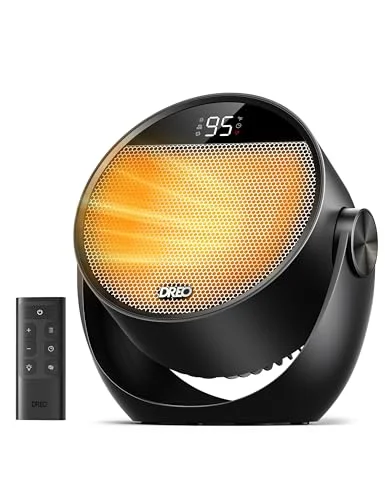
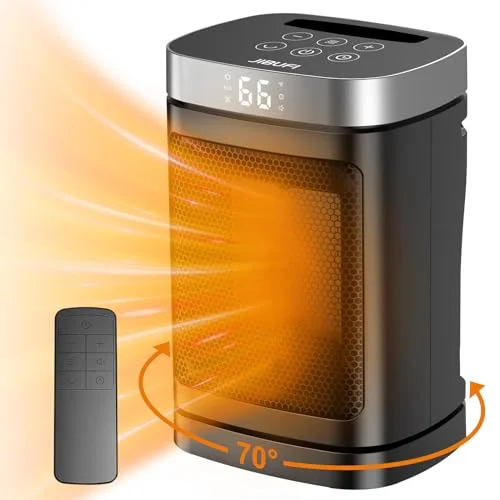
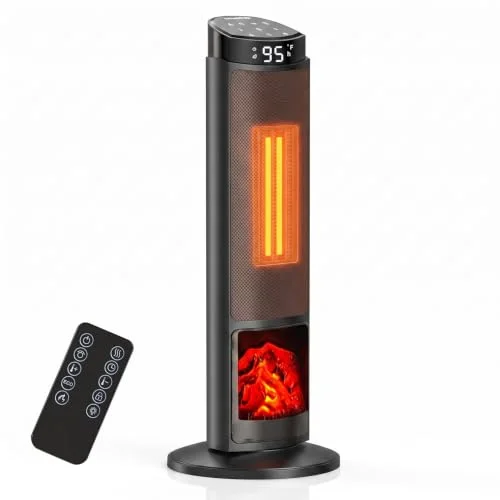
Every heater on this page aims its heat one of two ways, and the two mechanisms behave nothing alike. The JIBUFI Portable Space Heater ($26.56) and the OLIXIS 23” Space Heater ($39.93) both list 70° Oscillation: a motor sweeps the heater head back and forth across that arc, continuously, so the heat moves even if you don't. The DREO 1500W Space Heater ($42.49) does the opposite — it lists a 60° Adjustable Tilt, a fixed angle you set by hand that then holds, aimed at exactly one point until you move it again.
Neither mechanism is better in the abstract. A sweeping heater covers more of a room over time; a tilted one puts all of its output on one spot, continuously, for as long as it runs. The motor driving that sweep is also the part most likely to show wear first — worth knowing before either one.
Oscillation sweeps a room; tilt aims at one spot and holds it
Strip away the branding and a plug-in space heater has exactly two ways to decide where its heat goes after it leaves the element: move the heater's head on a motor, or point it once and leave it alone. Oscillation is the first approach. A small motor inside the base rotates the heater's head back and forth across a fixed arc, continuously, for as long as the heater is switched to that mode. Both the JIBUFI and the OLIXIS state a 70° Oscillation figure, meaning the sweep motor in each one drives the heater's output through a 70-degree arc and back, on a loop, rather than holding still.
Tilt works the other way. Instead of a motor that runs the whole time the heater is on, a tilt mechanism is a hinge: you set the angle once — in the DREO's case, through a range stated as 60 degrees — and it stays there. No motor runs to maintain that angle once it's set, and the heater isn't moving at all during normal operation; only the angle you chose it at is. That's the practical difference buyers tend to miss when they read "oscillating" and "adjustable" as roughly the same kind of flexibility: an oscillating heater is in constant, low-level motion the entire time it runs, and a tilting heater is not moving at all once it's aimed.
The choice between the two isn't really about which one makes more heat — both mechanisms sit on top of whatever heating element and wattage the unit already has. It's about whether you want that output distributed across a swept arc over time, or concentrated on a single point for the duration the heater is on.
The 60-degree tilt: what it's actually for
The DREO lists a 60° Adjustable Tilt on a compact, 10-inch unit built and marketed as a heater "for Office" — context that matters as much as the number itself. An adjustable tilt is a vertical pivot: rather than sweeping side to side across a room, it lets you angle the heater's head up or down relative to wherever it's sitting, and the 60-degree figure is the total range of that pivot, not a single fixed position you're stuck with out of the box.
In an office, that range answers a placement problem oscillation doesn't solve. A heater sitting on the floor beside a desk, tilted downward, can aim its output at your feet and lower legs instead of spraying it forward at a desk panel or toward whoever's at the next workstation. Tilted back up, the same unit can clear a low shelf or the edge of a desk and still reach you at chair height. Either way, the heat lands on the same point for as long as the heater runs, because nothing about the angle changes on its own once it's set.
What we don't have from the listing is the exact increments the tilt adjusts in, or whether it locks at intermediate angles, and we're not going to guess at mechanical detail the product page doesn't give us. What's confirmed is the 60-degree range itself, the stated 1500W rating, and the office-use framing — enough to know this is a heater built to be pointed and left, not one built to cover ground on its own. The 1500W figure is also the rare case on this page of a stated wattage rather than an assumption; it's worth checking against our guide to how many watts your room actually needs before assuming more tilt range adds up to more heat. It doesn't — the angle changes where the watts land, not how many there are.
70 degrees of sweep, twice over: what the angle number means
The JIBUFI and the OLIXIS both state 70° Oscillation, and it's worth being precise about what that number describes, because it's easy to misread it as a room-coverage figure and it isn't one. Seventy degrees is the width of the arc the heater's head sweeps through, side to side; it isn't the square footage that ends up warm. Picture a half-circle in front of the unit — 180 degrees, wall to wall — and a 70-degree oscillation covers a little over a third of that half-circle, centered wherever the heater happens to be aimed when it starts moving.
That's the same angle, stated twice, on two heaters built at two different scales. The JIBUFI lists a compact size of 9.96 inches and ships with a remote, suited to a desk, a nightstand or a corner rather than a full-size tower — worth weighing against our guide to space heaters with a remote control if that convenience is part of the decision. The OLIXIS, by contrast, is a 23-inch tower, with dimensions listed at 9.09 inches deep by 7.87 inches wide by 23.62 inches tall, and the listing adds four selectable modes without detailing what each one does — check the current listing if a specific mode matters to your purchase. Our guide to tower versus compact space heaters covers that height trade-off beyond the oscillation angle alone.
Same 70-degree sweep, delivered from a unit roughly two and a half times the JIBUFI's height, which changes where that arc lands in a room more than the angle number does on its own: starting near floor level from a small unit covers a different slice of a room than the same 70 degrees starting at mid-torso height from a 23-inch tower, even though both listings print the identical figure.
Where a fixed, aimed heater beats a moving one
Oscillation's advantage is also its limitation: for part of every sweep cycle, the heater is pointed somewhere other than at you. A 70-degree arc that takes a few seconds to complete means whatever sits at either edge is only getting direct heat for a fraction of the time, even though the thermostat and the wattage never change. That's a reasonable trade in a room where more than one spot needs some warmth. It's a worse trade when there's exactly one chair, one desk, or one spot that needs the heater's full output continuously rather than shared across an arc spending part of its cycle pointed elsewhere.
A tilt-only heater like the DREO never spends part of its cycle aimed elsewhere, because it has no cycle to begin with — it's aimed once and stays aimed. Under a desk, next to a single reading chair, or anywhere the target doesn't move, that fixed aim puts the heater's full output on the same spot for the entire time it runs.
The same logic matters in rooms where you specifically don't want a heater sweeping past something. Our guide to space heaters for a nursery covers why a fixed, deliberately aimed heater is generally the safer placement decision near a crib than one that moves on its own schedule — the same principle that makes a tilt mechanism the better fit at a desk applies even more directly where a moving heat source near a sleeping baby isn't something you want left to a motor's timing. The same fixed-aim logic holds in a home with animals that nap in predictable spots; our guide to space heaters for homes with pets covers the placement habits that matter more than the model, and a heater that holds one angle is easier to point safely away from a pet bed than one sweeping through 70 degrees on its own schedule.
The motor and the moving parts: what each mechanism risks over time
Every oscillating heater on this page relies on a motor that runs continuously whenever the unit is switched to oscillate, driving a gear or pivot assembly through the same 70-degree arc, back and forth, for as many hours as the heater sees use. That's a moving part under constant mechanical load in a way most of the rest of the heater isn't — the heating element itself has no moving parts to wear, but the sweep motor and whatever drive connects it to the head do. Neither the JIBUFI nor the OLIXIS listing states an expected motor lifespan or cycle count, and we're not going to invent one. What's true of any motorized mechanism is that parts under continuous cyclic motion tend to show wear first, whether that shows up as added noise, a slowing sweep, or the motor eventually not running at all.
A tilt mechanism carries a different, smaller risk. The DREO's hinge isn't driven by a motor during normal operation — it's set once and holds, so there's no continuously running part wearing down while the heater is in use. The trade is that the hinge itself, and whatever friction or locking mechanism holds the angle in place, has to stand up to repeated manual adjustment and to the unit's own fan vibration, rather than to constant rotation. Neither listing gives a stated hinge-durability figure either, so we're noting the mechanical difference, not predicting which one fails first on a specific unit — that's a question the published specs don't answer, and anyone claiming to know it is guessing.
The picks
Three heaters, two mechanisms — not a ranked list, since the right pick depends on whether a sweeping arc or a fixed aim actually matches the spot you're trying to heat.
01Best for a fixed target
DREO Space Heater, 1500W, 60° Adjustable Tilt
The tilt pick: aimed once, held there
1500W·60° Adjustable Tilt·For office·10-inch unit
A 1500W heater built around a hinge rather than a sweep motor: set the tilt once, up to 60 degrees of range, and it holds that angle with no moving parts running during normal operation. Marketed for office use, it's suited to a desk, a single chair, or anywhere the target doesn't move and doesn't need to share the heater's output with the rest of the room. At 10 inches, it's a compact unit that trades a wide sweep for a steady, unchanging aim.
The pick if there's one spot that needs heat and you'd rather it stayed pointed there the whole time.
02Best compact sweep
JIBUFI Portable Space Heater, 70° Oscillation
The small sweep pick: a compact unit with a remote
70° Oscillation·Remote included·9.96” size·Indoor use
A compact, 9.96-inch heater that lists 70° Oscillation and ships with a remote, built to sweep a modest arc from a unit small enough for a nightstand, a corner, or a desk you don't want crowded by a larger tower. The remote means the sweep, and whatever else the unit controls, can be adjusted without getting up — a convenience that matters more the smaller and less reachable the heater's placement is.
The pick if you want the arc to do the work and don't want to get up to adjust it.
03Best tower sweep
OLIXIS 23” Space Heater, 70° Oscillation
The tall sweep pick: a full tower with four modes
70° Oscillation·4 Modes·23” tower·9.09″D × 7.87″W × 23.62″H
The same 70-degree oscillation figure as the JIBUFI, delivered from a full 23-inch tower rather than a compact unit, with dimensions listed at 9.09 inches deep by 7.87 inches wide and four selectable modes the listing doesn't individually break down. The extra height changes where that identical sweep angle actually lands in a room — starting the arc near mid-torso height rather than near the floor, which matters more than the angle number alone once the unit is standing in a real room rather than on a spec sheet.
The pick if you want a tower's height and are comparing oscillation angles rather than mechanisms.
How we picked
We started from our own database of space heaters listed for sale in the US and looked specifically for products that state an oscillation or tilt angle directly in their listing — a surprisingly rare figure to find published at all, since most listings describe movement with an adjective ("wide sweep," "adjustable") rather than a number. These three turned out to be the clearest matched set: two heaters stating the identical 70-degree oscillation figure at two different scales, and one stating a 60-degree tilt instead of any sweep at all, giving a genuine mechanism-versus-mechanism comparison rather than three variations on the same motion.
How we compared
We compared the three heaters on their published titles, listed specifications and current Amazon prices. The 70° Oscillation figure for the JIBUFI and the OLIXIS, the OLIXIS's dimensions and four modes, the DREO's 60° Adjustable Tilt and 1500W rating, and every price above come directly from each product's own listing. Where a listing doesn't state something — a motor cycle count, a hinge-durability figure, what the OLIXIS's four modes individually do — we say so above rather than estimate a number to fill the page.
We do not run a testing lab. We have not stood these three heaters side by side and watched their motors or hinges operate over time, so you will not find an invented cycle count or a score out of ten here. We also don't show star ratings, review counts or paraphrased owner sentiment, because we don't have manufacturer-published figures for these specific listings — a limitation of the data available to us, not a judgment on the heaters themselves.
Frequently asked questions
What does "70° oscillation" actually mean on a space heater?
It's the width of the arc the heater's head sweeps through side to side, not a measure of how much of the room ends up warm. Picture a 180-degree half-circle directly in front of the unit; a 70-degree oscillation covers a little over a third of that half-circle, centered wherever the heater is aimed when the sweep starts. Both the JIBUFI and the OLIXIS state this exact figure, even though one is a compact 9.96-inch unit and the other a 23-inch tower.
What does a 60-degree tilt let you do that oscillation can't?
It lets you set a single vertical angle, by hand, and have the heater hold it with no motor running to maintain the position. The DREO's 60-degree range means you can angle its head up or down — toward your feet under a desk, or up to clear a shelf — and once set, every bit of its 1500W output keeps landing on that same point for as long as it runs, rather than sharing that output across a swept arc.
Does an oscillating heater warm a room faster than a tilting one?
Not necessarily faster — differently. An oscillating heater spreads its output across a 70-degree arc over time, so any single point within that arc gets direct heat for only part of each cycle. A tilt-only heater puts all of its output on one fixed point continuously, so that specific spot can feel the difference sooner, while anywhere outside its aim doesn't change at all.
Which mechanism has more that can go wrong over time?
An oscillating heater has a motor running continuously whenever it's swinging through its arc, driving a gear or pivot assembly under constant mechanical load — the kind of part most likely to show wear first in any motorized mechanism. A tilt hinge isn't motor-driven during use, so it carries no continuously running part, though the hinge itself has to hold up to repeated manual adjustment. Neither listing states a durability figure for its mechanism, so we're describing the difference in design, not predicting a failure rate.
Written by Ilane Tall. Research-based comparisons of published specifications, current prices and public product data — we do not physically test these units and we do not publish invented scores.