By Ilane Tall · Updated October 27, 2026 · Research-based.
Reader-supported: we may earn a commission when you buy through the links on this page, at no additional cost to you. It never changes which product we recommend. Prices quoted below were correct at the time of writing and move often.
Quick answer
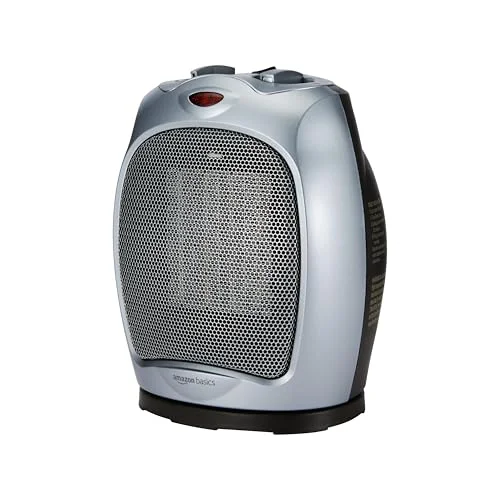
A nursery heater needs three things a living-room heater doesn't: a housing that stays cool to the touch, controls a toddler can't operate, and output steady enough that the room doesn't swing between too warm and too cold. The Amazon Basics Oscillating Ceramic Heater ($32.99) is our pick — it's the only one of the three with an adjustable thermostat, overheat and tip-over protection, and a compact 7.52" x 6.34" x 9.45" footprint small enough to sit on a high shelf, well outside a crib's reach.
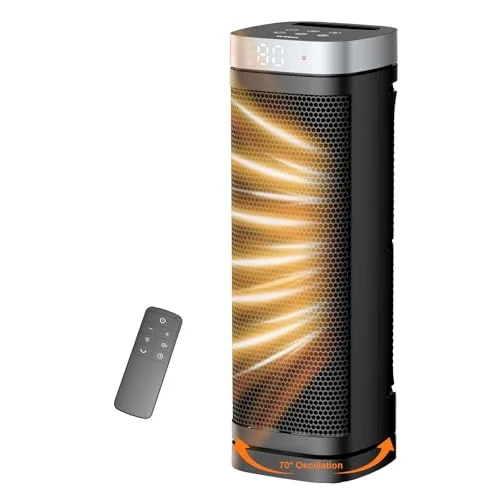
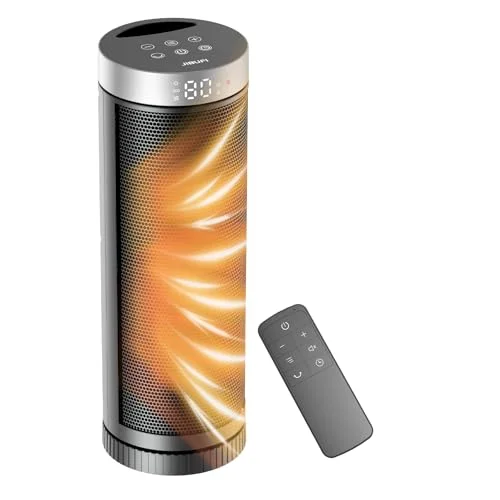
If you want wider, gentler coverage across a bigger nursery, the WINHL 1500W Heater ($37.96) pairs its own thermostat with 70-degree oscillation. The JIBUFI 17-Inch Heater ($37.98) oscillates the same 70 degrees but doesn't list a thermostat in its own specifications — see why that distinction matters below before you buy on size alone.
Why a nursery is a stricter brief than a bedroom
Every space heater sold for a US household outlet runs on roughly the same 1,500 watts, whether it's heating a home office, a bedroom or a nursery. What changes room to room isn't the heat — it's who's in the room and what they can do about a heater that's misbehaving. An adult in a cold bedroom can get up, move the heater, unplug it, or just put on a sweater. An infant or a toddler in a nursery can do none of those things. They can't tell a parent the room feels too warm, they can't step back from a heater that's radiating directly onto a crib, and once they're mobile, they will treat any object at floor height as something to pull themselves up on.
That's the real difference between a bedroom heater and a nursery heater. A bedroom heater has to keep one adult comfortable for a few hours. A nursery heater has to do that for someone who can't report a problem and, within a year or two, can physically reach it. Every buying decision below — housing temperature, control placement, how steady the heat stays, whether there's a real thermostat — follows from that one fact.
Cool-touch housing versus a hot grille
Not every space heater is built the same way on the outside. Some run a bare metal or mesh grille directly over the heating element, which gets genuinely hot to the touch because that's how the heat gets out. Others enclose the element behind a housing engineered to stay cool, relying on airflow or a ceramic plate to move heat into the room without the exterior ever reaching a temperature that would burn a hand resting on it for a moment.
In a nursery, that distinction is the whole safety case. A grille heater placed anywhere a crawling baby or a toddler on their feet can reach is a burn risk the moment they touch it, and small children touch things at exactly the height a floor-standing heater sits at. A cool-touch housing doesn't make a heater safe to leave unsupervised near a child, but it removes one specific failure mode: a curious hand landing flat on the unit for a second doesn't end in a burn.
The Amazon Basics Oscillating Ceramic Heater states overheat and tip-over protection directly in its own listing, alongside its "Fast Heating Technology" ceramic design — the kind of build this category uses specifically to avoid an exposed hot element. The WINHL and JIBUFI listings we have don't state a specific housing-temperature claim, so we're not going to assert cool-touch housing for either one; if that spec matters to you more than any other on this page, confirm it on the current listing before buying. Treat a missing claim as a gap in what we know, not a claim that the unit runs hot.
Placement: outside reach, away from the crib, never behind a curtain
Even the safest heater on paper is only as safe as where it sits. Three placement rules do more for nursery safety than any single spec on the box.
Outside reach. "Out of reach" for an infant means something different every few months. A heater on the floor is out of reach for a newborn and squarely in reach for a nine-month-old pulling up on furniture. The safer default is a stable, high surface — a dresser top, a shelf bolted to the wall — well above where a standing toddler's hands land, with the cord secured so it isn't a reaching hazard either. A heater's own compact footprint helps here: the Amazon Basics model's 7.52" x 6.34" x 9.45" size is small enough to sit comfortably on a shelf rather than needing floor space directly in a child's path.
Away from the crib. Never point a heater, oscillating or not, directly at a crib or bassinet. The goal is a room at a steady, even temperature, not a warm spot aimed at the baby. All three products here oscillate (the WINHL and JIBUFI across a stated 70 degrees, the Amazon Basics across its own ceramic oscillation), which helps distribute heat around the room rather than concentrating it on one point — but oscillation is a reason to place the unit so its arc never crosses the crib directly, not a substitute for distance.
Never behind a curtain. Curtains, blankets, stuffed toys and changing-table clutter are exactly the soft, flammable materials a space heater's overheat protection exists to guard against, and exactly the materials that end up near a heater in a small room where floor space is already tight. Keep a clear zone on every side of the unit, curtains included, regardless of how compact or cool-touch the heater claims to be. This is general placement guidance that applies to any space heater in any room; it is not a substitute for reading your specific model's own safety instructions.
For nurseries with limited floor space, a unit mounted higher up solves the reach problem structurally rather than relying on a parent to remember where it's plugged in every night — see our guide to wall-mounted and tall tower heaters for options built to go up rather than across the floor.
Low and steady beats powerful and cycling
It's tempting to shop for a nursery heater the way you'd shop for a living-room heater: look for the highest wattage, the biggest stated room coverage, the fastest warm-up. That instinct works against you here. A heater that blasts a room from cold to warm and then shuts off, over and over, produces a room that swings in temperature through the night — exactly the instability you don't want next to a sleeping infant, whose own temperature regulation is still developing.
What you want instead is a heater that settles into a low, steady output and holds it, rather than cycling hard between full power and off. All three heaters on this page run at 1,500 watts, the standard ceiling for a plug-in US heater, so none of them is under-powered for a nursery-sized room. The difference between them is how precisely each one can be told to stop climbing once the room reaches a comfortable number — which is really a question about the thermostat, not the wattage.
What a thermostat buys a room that holds one temperature
A heater with only power-level settings — low, medium, high — has no way to know when the room has reached a comfortable temperature. It keeps outputting at whatever level you selected until you walk in and change it yourself, which in a nursery at 2 a.m. is not a realistic plan. A heater with a real thermostat measures the room and cycles the heating element on and off to hold roughly one number, which is the behavior that actually produces a steady nursery rather than a hot one followed by a cold one.
Two of the three products here state a thermostat directly in their own listing. The Amazon Basics heater lists an "Adjustable Thermostat" alongside its overheat and tip-over protection. The WINHL 1500W heater is named explicitly around this feature: "Space Heaters for Indoor Use with Thermostat." The JIBUFI 17-Inch heater's own listing, by contrast, doesn't state a thermostat — its specifications describe a 1,500-watt heater with 70-degree oscillation and nothing more. We're not going to claim it has one it doesn't list. If a thermostat is the single feature that matters most to you in this room, that gap is worth weighing against the JIBUFI's size and price before you buy, and worth confirming directly on the current listing either way.
For a deeper look at how a real thermostat differs from a simple power dial across the rest of our lineup, see Space Heaters With a Real Thermostat (and Why It Matters).
The picks
Three heaters, ranked by how well each matches the nursery brief above — cool-touch build where it's stated, a thermostat that holds a number, and a size that's easy to place well out of reach.
01Best overall for a nursery
Amazon Basics Oscillating Ceramic Heater
The one with a thermostat, overheat protection and a shelf-friendly footprint
1,500W ceramic·Adjustable thermostat·Overheat & tip-over protection·7.52"D x 6.34"W x 9.45"H
This is the only one of the three that states an adjustable thermostat, overheat protection and tip-over protection together in its own listing — the exact combination the nursery brief above calls for. Its ceramic element is built around what the listing calls "Fast Heating Technology," and at 7.52 inches deep by 6.34 inches wide by 9.45 inches tall, it's compact enough to sit on a dresser or a high shelf rather than needing floor space a crawling baby will eventually reach. It oscillates, which helps spread its 1,500 watts evenly around the room instead of aiming a fixed beam at one spot. At $32.99, it's also the least expensive of the three.
The pick if you want one heater that checks every box on this page without compromise.
02Best for a bigger nursery
WINHL Space Heater with Thermostat
Thermostat control with a wider 70-degree sweep
1,500W·Thermostat·70° oscillation·16.4" tall
WINHL names the thermostat right in the product title — "Space Heaters for Indoor Use with Thermostat" — so this is the second unit here you can trust to hold a set temperature rather than run flat out until someone intervenes. At 16.4 inches tall with a 70-degree oscillation sweep, it covers more floor-level width than the Amazon Basics model, which suits a larger nursery or one where the dresser or shelf you're placing it on sits farther from the crib. We don't have a stated housing-temperature or tip-over claim for this specific listing, so confirm those details on the current page if either is a deciding factor for you.
Buy it when the room is too big for a compact unit's reach, and you still want a thermostat holding the number.
03Only if you don't need the thermostat
JIBUFI 17-Inch Space Heater
The same 70-degree oscillation, without a stated thermostat
1,500W·70° oscillation·16.4" tall·No thermostat listed
JIBUFI's own listing describes a 17-inch, 1,500-watt heater with the same 70-degree oscillation as the WINHL unit, at 16.4 inches tall by its stated size specification. What it doesn't include anywhere in its own specifications is a thermostat. That's not a claim that it runs unchecked — it's an honest gap in the data we have, and worth confirming on the current listing before you decide it's the right fit. For the nursery brief in this guide, where a thermostat is what keeps the room from swinging hot and cold overnight, we'd only reach for this one if the WINHL or Amazon Basics models aren't available, or if you've separately confirmed this unit's current listing covers that gap.
The one to pick last of the three, and only after checking the listing yourself on the thermostat question.
A note on dry air and infants
Running any heater continuously in a closed room lowers the relative humidity of that room, because warming air without adding moisture to it reduces how much water vapor the air holds relative to its new capacity. This is general information about how heating works, not medical advice: parents who are concerned about dry air affecting an infant's skin, breathing comfort or congestion should raise it with their pediatrician rather than rely on a buying guide for a space heater. If dry air is a concern in your household, a separate humidifier addresses it directly; a space heater's job is temperature, not humidity, and the two are usually solved with two different appliances.
The same general-information caveat applies to room temperature itself. Guidance on what temperature is appropriate for a sleeping infant varies and changes, and comes from pediatric health authorities, not from a heater's thermostat dial. Set the thermostat to a number you and your pediatrician are comfortable with, and treat the heater as the tool that holds that number steady — not the authority on what the number should be.
How we picked
We started from our own database of space heaters listed for sale in the US and filtered for units whose own published specifications include the details a nursery buyer actually needs to check: a stated thermostat, stated overheat or tip-over protection, and a compact, shelf-friendly size. That filter is deliberately narrow for this category — a nursery is the room on this site where an unverifiable claim matters most, so we'd rather show three well-documented heaters than pad the list with ones we can't speak to honestly.
How we compared
We compared all three heaters on their own published titles, listed specifications and current Amazon prices. Where a listing states a feature directly — the Amazon Basics heater's thermostat and overheat protection, the WINHL heater's thermostat, both units' stated oscillation angle and height — we report it as stated. Where a listing is silent on a feature, as the JIBUFI listing is on a thermostat and all three listings are on exact decibel output, we say so rather than fill the gap with an assumption. We do not run a testing lab, we have not placed these heaters in a nursery ourselves, and you will not find an invented noise rating, a star rating or a review count anywhere on this page — we have no manufacturer-published figures for these specific listings to show you.
Frequently asked questions
Is it safe to run a space heater in a room with a baby?
General safety practice for any space heater applies with extra margin in a nursery: place it on a stable surface well out of reach, away from curtains, bedding and the crib itself, plugged directly into a wall outlet, and never left running unsupervised with an infant alone in the room in a way that contradicts the manufacturer's own instructions. This is general placement guidance, not medical advice, and it doesn't replace reading your specific model's safety information.
Does a nursery heater need a thermostat?
It's the single feature that matters most for steady, even heat overnight. A thermostat measures the room and cycles the heater on and off to hold roughly one temperature; a heater with only power-level settings keeps running at whatever level you chose until someone changes it. The Amazon Basics and WINHL heaters here both state a thermostat; the JIBUFI heater's own listing does not.
What does "cool-touch housing" actually mean?
It means the heater's exterior is built to stay cool enough that a hand resting briefly on it won't be burned, as opposed to a bare grille sitting directly over the heating element. It doesn't make a heater safe to leave within a child's reach unsupervised — it removes one specific failure mode. Only buy based on this claim when a listing states it; we don't assert it for any product on this page that doesn't say so itself.
Will a space heater make the nursery air too dry?
Any heater run continuously in a closed room will lower relative humidity, since warming air reduces how much moisture it holds relative to its new capacity. This is general information about how heating works, not medical guidance — if dry air is a concern for your infant, that's a conversation for a pediatrician and a separate humidifier, not a reason to avoid heating the room to a safe temperature.
Written by Ilane Tall. Research-based comparisons of published specifications, current prices and public product data — we do not physically test these units and we do not publish invented scores.