By Ilane Tall · Updated November 20, 2026 · Research-based.
Reader-supported: we may earn a commission when you buy through the links on this page, at no additional cost to you. It never changes which product we recommend. Prices quoted below were correct at the time of writing and move often.
Quick answer
Most space heaters do one thing. Two in our catalogue do more. The DREO 42" Space Heater and Fan Combo ($169.99) swaps its heating element for a cooling fan mode when the seasons turn, so the same standing cabinet runs in July and January. The DR. INFRARED HEATER DR-998 ($145.55) keeps its dual-element infrared heat and adds an ultrasonic humidifier, aiming to fix the dry air a running heater creates rather than just produce more of it.
Neither is a straight upgrade over a single-function heater. Both cost more up front, and the DR-998's humidifier tank adds a cleaning routine a plain heater never asked for. Whether that trade is worth it depends on which single problem — a fan you'd otherwise buy separately, or air dry enough to notice — you're actually trying to solve.
Why most space heaters do exactly one job
A plug-in electric space heater is, mechanically, a simple device: a heating element, a fan or a radiating surface to move that heat into the room, a thermostat, and a shut-off timer as a safety backstop. The differences between a ceramic tower, an infrared quartz panel and an oil-filled radiator come down to how that heat reaches you, not what else the unit can do. Most manufacturers build to that single job on purpose — it keeps the cabinet small, the price low, and the list of things that can fail short.
The DREO 42" Space Heater and Fan Combo and the DR. INFRARED HEATER DR-998 both break from that pattern, and they break from it in opposite directions. The DREO adds a second climate function — cooling airflow — so the same base earns its floor space twelve months a year instead of four or five. The DR-998 adds a function that has nothing to do with temperature at all: an ultrasonic humidifier, built into the same cabinet as its two heating elements, meant to counteract the side effect of running a heater for hours rather than add a new one.
Both are also, not coincidentally, the two most expensive single-zone heaters this site covers that aren't purpose-built fireplace stoves. A second function is rarely free, and the rest of this guide is about exactly what each one buys, in dollars and in day-to-day upkeep, over the plain single-purpose heaters that make up most of this category.
A heater and a standing fan on one base: what you gain in summer
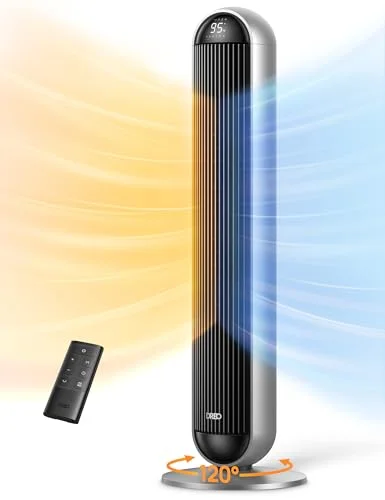
The DREO 42" is built as a tall standing tower with a 1800 RPM upgraded DC motor behind it. DREO states that motor moves 1,585 CFM of air volume, reaching up to 40 feet away, through a 120° oscillation sweep — figures aimed squarely at replacing a separate pedestal or tower fan, not just supplementing one. In winter, the same cabinet switches to a 5-level, 1,500-watt PTC heating mode, with DREO citing a 2-second heat-up and a thermostat that holds a set room temperature from 41°F to 95°F within ±1.5°F through what the brand calls ECO mode. A remote, a 12-hour timer, 17 total levels across 6 modes, and 8 stated safety protections round out the control set, and DREO rates the fan noise at 25 dB.
The pitch is straightforward: a household typically owns a standing fan and a space heater as two separate purchases, used in two separate seasons, taking up two separate footprints of closet space the other eight months of the year. The DREO 42" collapses that into one object. If you already have the heater half of this covered and are shopping specifically for a heater built for a room with real seasonal swing, like a sunroom or an enclosed porch, that single footprint is the actual selling point, not a marginal bonus.
What it isn't is a heater first and a fan second, or the reverse — it's genuinely both, switched by mode rather than run simultaneously. You get one unit's worth of floor space and one unit's worth of cord and outlet, in exchange for a single device that has to do mechanical double duty: the same motor, oscillation hardware and housing carry both the summer airflow and the winter heat cycle, rather than splitting that wear across two simpler, cheaper machines.
A humidifier built into a heater: solving dry winter air without a second appliance
The DR-998 solves a different problem. Running any space heater for hours in a closed room lowers the relative humidity of the air in that room — a well-documented side effect of continuous resistance or infrared heating, independent of which brand or heat type is doing the warming. The usual fix is a separate humidifier, bought, filled and placed as its own appliance alongside the heater. The DR-998 folds that fix into the heater itself: Dr. Infrared Heater markets it explicitly as an "all-in-one comfort solution" that replaces both a space heater and a cool-mist ultrasonic humidifier.
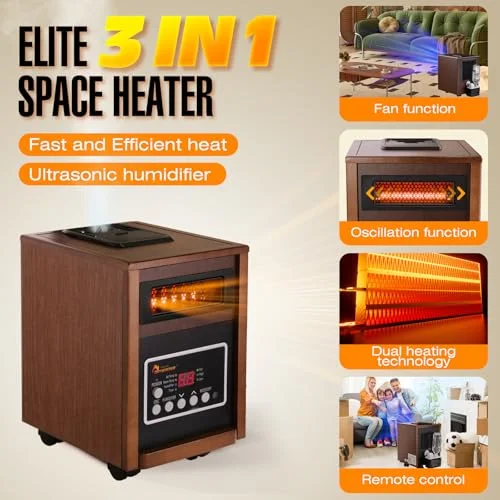
The heating side is itself already a two-element design: an infrared quartz tube paired with a PTC ceramic element, which Dr. Infrared Heater states together deliver "60% more warmth than standard 1500W heaters" for a given wattage, by warming objects and people directly through the infrared element while the PTC side warms the surrounding air. Oscillation spreads that output across an arc of the room rather than holding it fixed on one spot, a remote and thermostat handle control, and the whole cabinet sits on wheels for moving it between rooms. It's sold under the "With Humidifier" size variant specifically, at $145.55, in a walnut-finish cabinet.
The humidifier itself runs as a cool mist, not a warm mist — it adds moisture to the air without adding its own heat on top of what the quartz and PTC elements are already producing. That's a deliberate split: the heating stays with the two dedicated heating elements, and the humidity function stays mechanically separate, rather than trying to warm and humidify through the same path. For a household already weighing an infrared quartz heater against other heat types, or dealing with a dry, dust-sensitive room where moisture levels are already a concern, that's the specific gap the DR-998 is built to close: heat and moisture from one plug, one cabinet, one cord.
What each combo adds to the price over a single-purpose heater
Neither extra function arrives free. A basic single-element ceramic or PTC tower heater in this category, with no fan mode and no humidifier, commonly sells for somewhere in the $20 to $70 range — a simple heating element, a thermostat, and a shut-off timer, and not much else to manufacture. Against that baseline, both of these units sit well above the floor of the category.
The DREO 42" is priced at $169.99. Framed against a basic single-function heater, that premium buys genuine dual-season hardware: the upgraded 1800 RPM DC motor, the 120° oscillation mechanism, and the control electronics needed to run both a 5-level heating mode and a separate multi-speed cooling mode through the same unit, plus the 42-inch standing cabinet itself. Framed against buying a standing fan and a space heater separately, the comparison runs the other way — one $169.99 purchase against two smaller ones that, combined, could land anywhere from roughly even to meaningfully less.
The DR-998 is priced at $145.55, for a unit doing the job of a dual-element infrared heater and a cool-mist ultrasonic humidifier combined. A humidifier alone is a real line item most households already budget for every winter; folding it into the heater cabinet is the DR-998's actual value argument, not simply "a heater that costs more." What that price doesn't buy is a top-tier standalone humidifier's dedicated tank capacity or run-time — the listing doesn't publish a tank size or hours-per-fill figure, so we're not going to invent one.
The maintenance a humidifier tank adds that a plain heater never needed
A single-purpose space heater, once it's plugged in and the thermostat is set, asks almost nothing of you between seasons beyond the basic checks any heater needs — a clear area around it, a cord that isn't frayed, a filter or intake kept free of dust. Adding a humidifier tank to that same cabinet adds a second, separate maintenance routine on top, because a water reservoir and an ultrasonic misting element behave nothing like a dry heating coil.
Any tank that holds standing water for days at a time is a place where mineral deposits and biological growth can build up, which is why cool-mist ultrasonic humidifiers in general — not specific to this unit — are generally recommended for regular emptying, rinsing and periodic descaling rather than topping off indefinitely. Hard tap water tends to leave a fine white mineral residue on the ultrasonic plate and tank walls over time, standard across the whole appliance category and not a defect unique to any one brand. The DR-998's own listing doesn't specify a cleaning interval, so treat "clean it on a regular schedule, more often with harder water" as the safe general rule rather than a number we're inventing.
None of that is a reason to avoid a built-in humidifier — it's the same upkeep a standalone humidifier would ask for anyway. The honest framing is additive, not comparative: the DR-998 doesn't need more maintenance than a separate heater-plus-humidifier pairing would, but it needs meaningfully more than a heater with no tank at all, which never has standing water to think about.
The fan combo makes sense when
You want one standing cabinet that earns its floor space year-round, you already run a fan through the warmer months, and you don't need the unit to do anything beyond move air and produce heat.
The humidifier heater makes sense when
Dry winter air is a real, noticed problem in the room you're heating, you'd otherwise be buying a separate humidifier anyway, and you're willing to take on a tank-cleaning routine in exchange for one fewer appliance on the floor.
The picks, and who each one is actually for
01Best for year-round use
DREO 42" Space Heater and Fan Combo
The fan pick: one cabinet, two seasons
1,500W PTC heat·120° oscillation·25 dB stated·17 levels, 6 modes
A 1800 RPM DC motor rated to move 1,585 CFM up to 40 feet, behind a wide 120° oscillation sweep, switching between a 5-level 1,500-watt PTC heating mode and 12 cooling fan speeds through the same base. DREO states a 2-second heat-up, an ECO thermostat holding 41°F to 95°F within ±1.5°F, a 12-hour timer, a remote and 8 stated safety protections. It's a genuinely dual-season appliance rather than a heater with a fan setting bolted on — the trade is one unit's mechanical wear carrying both jobs instead of splitting them across two simpler machines.
The pick if the closet space a standing fan takes up the other eight months of the year bothers you more than a slightly higher price tag does.
02Best for dry winter air
DR. INFRARED HEATER DR-998
The humidifier pick: heat and moisture from one cabinet
Dual heating infrared + PTC·Cool-mist humidifier·Oscillation·Remote · thermostat · wheels
Two heating elements — an infrared quartz tube and a PTC ceramic element — that Dr. Infrared Heater states deliver 60% more warmth than a standard 1,500-watt heater, paired with a cool-mist ultrasonic humidifier built into the same walnut-finish cabinet. Oscillation spreads the heat across an arc instead of a fixed point, a remote and thermostat handle control, and wheels move the whole unit between rooms. The humidifier runs cool rather than warm, so it adds moisture without stacking extra heat on top of what the two elements already produce — and it adds a tank to clean on a regular schedule, which a plain heater never asked of you.
The pick if you'd be buying a humidifier this winter regardless, and would rather it share a plug and a cabinet with the heater than sit as a second appliance on the floor.
Neither pick is "better" than the other in general terms, because they're not solving the same problem. If your actual complaint most winters is a room that feels stuffy and dry by the second hour of heating, the DR-998 is addressing that directly. If your actual complaint is that a space heater and a standing fan are two purchases, two cords and two storage spots for what amounts to one corner of one room, the DREO 42" is the one collapsing that down to one. A household that wants both functions solved is better served buying both of these than expecting either one to cover the other's job — the DREO doesn't humidify, and the DR-998 doesn't move cooling air in summer.
How we picked
We started from our own catalogue of space heaters listed for sale in the US and looked specifically for the units that add a genuinely separate function to the standard heating job, rather than a heater that simply oscillates or ships with a remote — features common enough across the category that they don't constitute "more than heating." That filter narrowed the field to exactly two products: a heater built to also run as a standing fan, and a heater built to also run as a humidifier. We did not pad the list with a third pick that doesn't genuinely clear that bar.
How we compared
We compared the two heaters on their published titles, manufacturer-stated features and current Amazon prices. Where a brand states a specific figure — DREO's 1,585 CFM, 1800 RPM, 25 dB and 120° oscillation, or the DR-998's 1,500-watt rating and "60% more warmth" claim — we cite it as the manufacturer's own stated figure, not an independently measured one. Neither listing publishes a humidifier tank capacity or run-time, and we have not filled in that gap with a guessed number.
We do not run a testing lab. We do not own either of these units and have not run them in a room ourselves, so you will not find an invented decibel reading, a tank-life estimate, or a score out of ten anywhere on this page. We also do not publish star ratings, review counts or paraphrased owner sentiment for these two listings, because we do not have manufacturer-published figures for them. We do not physically test these units; every claim above traces back to a published spec, a stated feature, or a current price.
Frequently asked questions
Does adding a fan or a humidifier change how much heat these units produce?
No. The DREO 42" runs its heating mode at 1,500 watts across 5 levels, the same practical ceiling most plug-in US heaters are built to, with the fan function switched in as a separate cooling mode rather than running alongside the heat. The DR-998's dual elements are rated as delivering more warmth per watt than a standard single-element 1,500-watt heater, by Dr. Infrared Heater's own figure, but that's a function of the two-element design, not the humidifier — the cool-mist humidifier adds moisture, not heat output.
Does the DREO 42" replace a separate box fan in summer?
That's the function it's built for. DREO states a 1800 RPM upgraded DC motor moving 1,585 CFM of air up to 40 feet away, through 120° oscillation and 12 cooling fan speeds, switched in through the same control panel that runs the winter heating modes. It's marketed specifically as a 2-in-1 heater-and-fan for year-round use rather than a heater with a basic fan-only setting added on.
Will the DR-998's humidifier make the room feel colder?
It's designed not to. The humidifier runs as a cool mist rather than a warm mist, so it adds moisture to the air independently of the two heating elements, which keep producing the room's warmth on their own. The two functions run through separate mechanisms in the same cabinet rather than one system trying to do both jobs at once.
How often does a humidifier tank built into a heater need cleaning?
Dr. Infrared Heater's listing for the DR-998 doesn't publish a specific cleaning interval, so we won't invent one. As a general rule for any standing-water, ultrasonic-mist appliance, regular emptying and rinsing, with periodic descaling if your tap water is hard, keeps mineral buildup and residue from accumulating on the misting plate and tank walls — the same routine a separate standalone humidifier would need, not an extra burden unique to this unit.
Written by Ilane Tall. Research-based comparisons of published specifications, current prices and public product data — we do not physically test these units and we do not publish invented scores.