By Ilane Tall · Updated November 19, 2026 · Research-based.
Reader-supported: we may earn a commission when you buy through the links on this page, at no additional cost to you. It never changes which product we recommend. Prices quoted below were correct at the time of writing and move often.
Quick answer
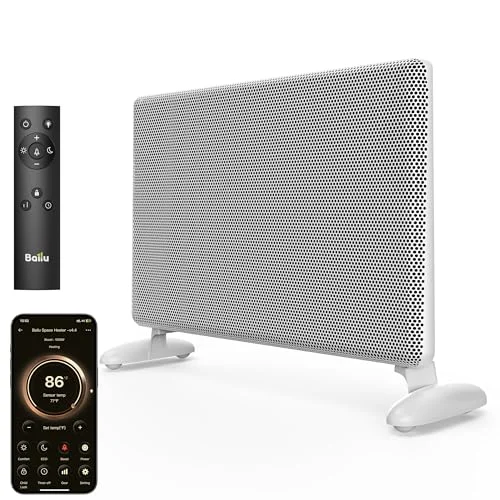
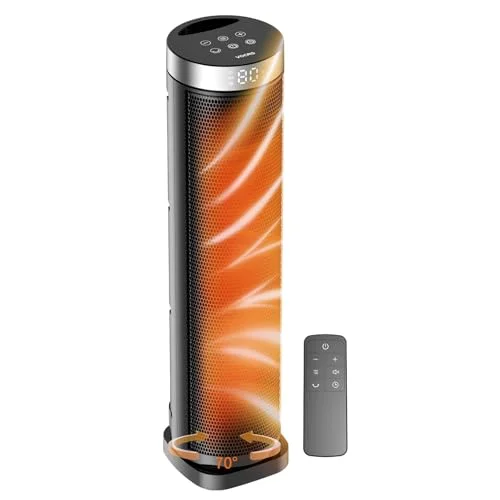
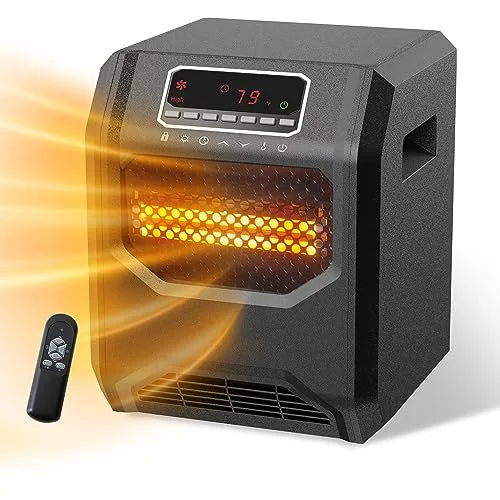
All three of these heaters draw on the same roughly 1,500-watt ceiling as everything else in this category, so the real difference is in how that heat leaves the unit. The Ballu Mica Infrared Space Heater ($151.99) is a flat radiant panel that can stand on the floor or mount directly to a wall, controlled over WiFi from a phone app with a programmable thermostat. The 23.42-inch oscillating ceramic tower with remote ($47.16) is the only one of the three that uses a fan, sweeping warm air across a 70-degree arc. The WEWARM quartz infrared heater ($56.09) sits between the other two in format: six glowing quartz elements in a cabinet, adjusted mainly through a 50-to-90-degree thermostat dial rather than an app.
None of the three is simply "the infrared one" or "the quiet one" — and even the quietest of them still loses on total silence to a heater that isn't in this comparison at all.
Why a mica panel is not the quartz infrared you already know
Say "infrared heater" to most shoppers and the picture that comes to mind is a glass quartz tube glowing orange inside a metal cabinet. That mental image is accurate for one of the two radiant heaters on this page and wrong for the other, because mica and quartz infrared are two different heating technologies that both happen to fall under the same marketing word.
A quartz infrared element works by running a resistive filament inside a sealed quartz-glass tube. The filament gets hot enough to glow visibly, and that glowing tube radiates heat in a fairly direct line toward whatever it's aimed at — the same basic physics as an old-fashioned electric bar heater, refined into a cleaner, more efficient package. The WEWARM Infrared Space Heater in this comparison uses six of these quartz elements inside its cabinet, which is the format most people picture when the word "infrared" comes up, and the reason this category's name has become shorthand for "the glowing one."
A mica panel heater is built differently from the ground up. Instead of a glowing filament inside a glass tube, the heating element is a resistive wire laminated between thin sheets of mica — a naturally occurring mineral prized for centuries in electrical and heat-resistant applications because it insulates well and tolerates high temperatures without degrading. That mica sheet itself becomes the radiating surface, spread across a flat panel rather than concentrated along a glowing tube. The practical result is a heater that radiates without visibly glowing, at a lower surface temperature for the same wattage, in a shape that can be built thin and flat. The Ballu Mica Infrared Space Heater on this page is built around exactly that flat panel, finished in white and marketed for large-room use. For a closer look at three heaters that use the quartz-tube approach specifically, our guide to the best infrared quartz space heaters covers that side of the category in more depth.
Both of these heaters radiate rather than blow air, which puts them on the same side of the ledger against the ceramic tower covered below. But "radiant" and "infrared" are not interchangeable with "quartz," and a buyer who wants the flat, low-profile, wall-mountable shape of a mica panel is shopping for something meaningfully different from a buyer who wants the familiar glowing-tube cabinet, even though a listing page might file both under the same category tab.
A flat panel on the wall versus a tower in the corner
Set the heating technology aside for a moment and look at the shape each of these three products actually takes in a room, because the footprint matters just as much as the mechanism when you're deciding where one goes.
The Ballu Mica Infrared Space Heater is explicitly built to do double duty: the listing describes it as a portable stand or wall-mount panel heater, which means it can either stand freely on the floor the way most space heaters do, or sit flat against a wall with almost no floor footprint at all. That wall-mount option is the clearest practical advantage of the mica panel format over either of the other two heaters here — neither the ceramic tower nor the quartz cabinet is designed to be fixed to a wall. For a large room where floor space near outlets is already tight, that's a real difference, not a marketing detail.
The 23.42-inch oscillating ceramic tower, by contrast, is a tower in the literal sense: a tall, slim cabinet meant to stand on the floor, typically tucked into a corner or against a wall, with clearance in front of it to sweep its 70-degree oscillation without the airflow being blocked by furniture. It needs floor space, and it needs that space kept clear in an arc, not just directly in front of the unit.
The WEWARM quartz infrared heater sits in between those two in practical terms. It's a cabinet heater meant to stand on the floor and face a fixed direction, the way a quartz heater is traditionally used — aimed at a seating area rather than mounted anywhere. It doesn't offer the wall-mount option the mica panel does, but it also doesn't need the oscillation clearance the tower does, since it isn't moving air in an arc. Three different floor plans, in other words, for three heaters that might otherwise look interchangeable on a spec sheet.
Ceramic and a fan: the only one of the three that moves air
Here's the split that matters most once you get past shape and technology: of these three heaters, only the ceramic tower has a fan. Its listing describes a 1,500-watt PTC ceramic heating element paired with 70-degree oscillation, which only makes sense as a feature if there's a fan behind it pushing that heated air out and sweeping it side to side. Neither the Ballu mica panel nor the WEWARM quartz heater lists a fan at all — both heat by radiating toward whatever sits in front of them, with no moving air involved in the mechanism itself.
That difference changes how each heater actually feels in a room, independent of wattage. A fan-driven heater like the ceramic tower delivers warmth by mechanically pushing already-heated air at you, which is why it tends to feel warm fastest directly in its airflow path, and why the oscillation exists at all — spreading that moving air across a wider arc rather than concentrating it on one spot. A radiant heater like the mica panel or the quartz cabinet does the opposite: it warms whatever sits in its direct line of sight without moving the air in the room, so you feel warmth the moment you're in that line of sight and little change in the air itself behind you.
The fan also has a consequence that has nothing to do with heat: moving air moves whatever's suspended in it, including the dust and pet hair that settle on a floor. A fan-driven heater stirs that up every time it runs; a heater with no fan at all doesn't. If that trade-off matters more to your household than the speed a fan provides, our guide to space heaters for allergies and dust-sensitive homes looks specifically at fan-free options for that reason.
App on the panel, remote on the tower, dial on the quartz unit
The way you actually adjust each of these three heaters day to day is as different as the way they heat. The Ballu Mica Infrared Space Heater is the most connected of the three: its listing specifies WiFi app control that works with Alexa, alongside a programmable thermostat, so the panel can be scheduled, checked and adjusted from a phone whether you're in the next room or out of the house entirely.
The 23.42-inch ceramic tower takes the more conventional route: it ships with a physical remote control paired with its own built-in thermostat, so you can change the heat setting, start the 70-degree oscillation or check the 12-hour timer from across the room without an app, an account or a WiFi network standing between you and the controls.
The WEWARM quartz infrared heater is built around a 50-to-90-degree Fahrenheit thermostat — a dial-style range you set and let the unit hold, rather than a scheduled program. It also ships with its own remote, so the thermostat dial isn't the only way to adjust it, but there's no app layer here the way there is on the Ballu panel: you're picking a temperature, not setting a weekly schedule from your phone. For readers deciding how much that gap in speed and convenience actually matters day to day, our guide to how fast space heaters actually heat up looks at the seconds-and-minutes claims these listings make, separate from how you tell the unit to start.
None of these three control schemes is objectively better. An app adds scheduling and remote access at the cost of a WiFi setup step and an account; a physical remote is instant and offline but limited to whatever buttons it has; a thermostat dial is the simplest of the three to use correctly on day one, with no pairing process to get wrong.
Which one suits a room you want to walk past without feeling a draft
There's a specific scenario worth separating from "which heater is best," and that's the room you pass through rather than sit in — a hallway, a doorway, the edge of a home gym or a kitchen you're moving around rather than parked in. In that kind of space, the fan on the ceramic tower works against it: oscillating or not, a fan-driven heater is actively moving air, and anyone walking past it at close range is going to feel that moving air as a draft, on top of whatever actual warmth it's delivering.
Both radiant heaters avoid that specific sensation, because neither one moves air at all. Walk past the Ballu mica panel or the WEWARM quartz heater and you'll feel direct warmth only while you're in their line of sight, with no gust of moving air trailing behind either effect. That makes a radiant heater the more comfortable choice for a transitional space you cross repeatedly, even though it won't raise the ambient air temperature of that space the way a fan-driven heater eventually can.
This same trade-off gets more pronounced in rooms that already have more airflow to contend with — a space with more windows, a door that opens to the outside, or a less sealed envelope than a typical interior room. Our guide to space heaters for a sunroom or enclosed porch covers that draftier end of the spectrum in more depth, including why a fan heater's own airflow is rarely the deciding problem in a room that's already drafty to begin with.
The picks
Three heaters, three different answers to "how should the heat get to me" — not a ranked list, since the right one depends on the wall, the floor plan and the control style you actually want, not on a single winner.
01Best for a wall, not a floor
Ballu Mica Infrared Space Heater
The panel pick: stands or mounts flat, runs from an app
Mica infrared panel·Large Room·WiFi app control·Programmable thermostat, works with Alexa
A flat mica sheet radiates heat instead of a glowing quartz tube, and this panel is built to take advantage of that shape: the listing specifies a portable stand or wall mount, so it can sit nearly flush against a wall in a large room where floor space is already spoken for. A programmable thermostat and WiFi app control, compatible with Alexa, mean it can be scheduled and checked from a phone rather than adjusted at the unit. At $151.99 it's the most expensive of the three here, and that price buys the format and the connectivity, not more wattage.
The pick if the wall is where you want the heater to live, and your phone is where you want the controls.
02Only one that moves air
23.42-Inch Oscillating Ceramic Tower with Remote
The tower pick: a fan, a 70° sweep, and a remote in hand
1500W PTC ceramic·70° oscillation·12H timer·23.42 in, remote & thermostat
The only heater in this comparison with a fan, and the only one that spreads its warmth across a 70-degree arc instead of radiating in a fixed direction. A PTC ceramic element, a 12-hour timer and a thermostat are all adjustable from the included remote, and at 23.42 inches tall it's built as a corner or wall-adjacent tower rather than something you'd mount flat. At $47.16, it's the least expensive of the three by a wide margin — the honest trade for a fan and audible moving air instead of a silent radiant panel.
The pick if you want heat distributed across a room you're sitting in, and don't mind hearing the fan that's doing it.
03Best for a direct, focused glow
WEWARM Infrared Space Heater
The quartz pick: six glowing elements, adjusted by dial
6 quartz elements·ECO Mode·50–90°F thermostat·Child lock, 12H timer, remote
Six quartz elements provide the familiar glowing-tube look this category is best known for, radiating warmth directly at whatever's in front of the cabinet rather than filling the room's air the way a fan heater does. A 50-to-90-degree Fahrenheit thermostat is the main way to set it, with a remote, a 12-hour timer, an ECO mode and a child lock rounding out the feature list, plus stated overheat and tip-over protection. At $56.09, this is the middle-priced and middle-sized ("Middle") variant of the listing — worth checking the current listing if you want a different size option.
The pick if you want the classic glowing-infrared look and a simple dial instead of an app to learn.
Where all three still lose to an oil-filled radiator: total silence
Dropping the fan, as both the mica panel and the quartz heater do, removes the most obvious source of noise in this category. Neither listing states a decibel figure, and we're not going to invent one, but it's a safe mechanical conclusion that a heater with no fan in its design has no fan noise to produce — that part of the comparison is settled by the absence of a part, not by a published number.
Fan noise isn't the only sound a heater can make, though, and this is where even these two radiant, fan-free heaters still fall short of true silence. Both the mica panel and the quartz cabinet use a thermostat that cycles the heating element on and off to hold a set temperature, and that cycling typically involves a relay or switch clicking as the element engages and disengages. It's a small sound, far quieter than a fan, but it's not nothing, and it's a mechanical reality of how any thermostat-controlled resistive heater works, regardless of brand or price.
An oil-filled radiator sidesteps that cycling in a way neither mica nor quartz can, because it's working with a completely different kind of thermal mass. Oil sealed inside steel fins takes a long time to heat up and, just as importantly, a long time to cool back down, which means the thermostat on an oil radiator cycles far less frequently and far more gently than one holding a lightweight mica sheet or a quartz tube at temperature. Combined with having no fan at all, that's the closest this broader category gets to genuine, continuous silence. If that's the deciding factor over everything covered on this page — the technology, the shape, the app or the dial — our guide to the best oil-filled radiator heaters covers three heaters built specifically around that trade-off.
How we picked
We started from our own database of space heaters listed for sale in the US and deliberately chose three products that don't fit neatly into the ceramic-infrared-oil framing most comparisons use. Two of the three — the mica panel and the quartz cabinet — are both commonly labeled "infrared" despite using different heating technologies, and we picked them specifically to show that split rather than picking two near-identical quartz heaters that differ mainly in price. The ceramic tower rounds out the comparison as the only one of the three that moves air at all.
How we compared
We compared these three heaters on their published titles, available specifications and current Amazon prices. Where we cite a specific figure — the ceramic tower's 23.42-inch height and 70-degree oscillation, the WEWARM's 50-to-90-degree thermostat range and six quartz elements, the Ballu panel's WiFi app control and Alexa compatibility — it comes directly from that product's own listing. None of the three listings we worked from states a decibel figure, so we don't cite one for any of them, and we say so plainly rather than estimate a number to fill a gap.
We do not run a testing lab. We do not own these three heaters and have not run them side by side in a room ourselves, so you will not find an invented decibel reading or a score out of ten anywhere on this page. We also don't show star ratings, review counts or paraphrased owner sentiment here, because we don't have manufacturer-published figures for these specific listings — a limitation of the data available to us, not a judgment on the heaters themselves.
Frequently asked questions
Is a mica panel heater the same thing as an infrared quartz heater?
No, even though both are commonly marketed under the broader "infrared" label. A quartz heater radiates from a glowing filament sealed inside a glass tube; a mica panel radiates from a resistive wire laminated between sheets of mica, a heat-resistant mineral, spread across a flat panel that doesn't visibly glow. Both warm objects directly in their line of sight rather than blowing air, but they're built on different heating elements inside different shapes.
Can the Ballu mica panel heater be mounted on a wall, or does it need to stand on the floor?
Its listing specifies both options: it's built as a portable stand or wall-mount panel heater, so it can either stand freely on the floor the way a typical space heater does, or sit flat against a wall with almost no floor footprint. That's a shape neither the oscillating ceramic tower nor the quartz cabinet in this comparison offers.
Which of these three heaters is quietest?
Between these three, the mica panel and the quartz heater are the quieter pair simply because neither has a fan, unlike the oscillating ceramic tower. Neither radiant heater's listing states a decibel figure, so we can't rank one above the other on noise, but both avoid the fan noise that's unavoidable on the tower. For a heater built around near-total silence rather than just the absence of a fan, an oil-filled radiator still goes further than either radiant heater here.
Do I need WiFi to use any of these heaters?
Only the Ballu mica panel offers WiFi app control, and it's an added capability rather than a requirement — its programmable thermostat and basic controls still work at the unit itself. The ceramic tower is controlled by its included remote and onboard thermostat, and the WEWARM quartz heater by its 50-to-90-degree thermostat dial and its own remote. None of the three requires a smartphone to turn on and run.
Written by Ilane Tall. Research-based comparisons of published specifications, current prices and public product data — we do not physically test these units and we do not publish invented scores.