By Ilane Tall · Updated November 22, 2026 · Research-based.
Reader-supported: we may earn a commission when you buy through the links on this page, at no additional cost to you. It never changes which product we recommend. Prices quoted below were correct at the time of writing and move often.
Quick answer
“Energy Saving” on a space heater box is never describing the heating element itself — a resistance coil already converts electricity to heat at close to 100 percent efficiency, so there's no more-efficient version of the same watt. The label is shorthand for a control feature sitting on top of that element: an ECO mode that cycles output instead of running flat out, a programmable timer that limits how long it runs, or an adjustable thermostat that lets you stop well short of full power. All three heaters below still carry a 1,500-watt rating on the same label.
The clearest example is the DREO Radiator Heater with ECO, 4 Modes and a 24-hour timer ($105.28): ECO changes the average wattage pulled over an hour, not the ceiling the element can reach. The De’Longhi Dragon Digital ($189.95) pairs the same label with a programmable timer — a scheduling tool, not a lower-draw coil. See why the element itself can't be made more efficient, then skip straight to where the actual savings come from.
Why a resistance heating element can't really be more or less efficient
Start with the part of this that isn't marketing and isn't up for debate: how a plug-in electric heater makes heat in the first place. Current flows through a resistive element — a coil, a ceramic plate, or in these three heaters, oil sealed inside a finned metal body — and resistance converts that electrical energy directly into thermal energy. Virtually none of it goes anywhere else. There's no combustion to run incompletely, no flue gas carrying energy out of the building, no refrigerant cycle that can be tuned for a better coefficient of performance. A 1,500-watt resistance heater draws 1,500 watts and returns essentially 1,500 watts of heat into the room it's sitting in, every time, for as long as the element is on.
That's a meaningfully different situation from the appliance categories where “energy efficient” actually describes the core mechanism. A gas furnace can genuinely run at 80 percent efficiency or 95 percent efficiency, because combustion is an imperfect process and some designs waste less heat up the flue than others. A heat pump can move three or four units of heat for every unit of electricity it consumes, because it's relocating heat rather than generating it from scratch. Neither comparison applies to a plug-in resistance heater. There's no second, more-efficient way to convert electricity to heat through a wire — the physics is already running close to its ceiling on every unit in this category, the cheap ones included.
This is also why every heater in this piece runs on the same electric-resistance principle as the rest of the catalogue: current through a conductor, nothing burned, nothing to tune for a cleaner reaction. The DREO Radiator Heater with Dual Knobs states “1500W” directly in its title alongside “Energy Saving.” Those two facts sit next to each other because neither one changes the other. A 1,500-watt radiator with an “Energy Saving” label still draws 1,500 watts when its element is actually heating oil — the label is describing something that happens around that number, not a revision to the number itself.
What ECO mode actually changes: the average, not the ceiling
The DREO Radiator Heater with Digital Thermostat, Remote Control and ECO is the cleanest example on this page of what an “eco” setting really does, because its own listing names the feature directly: ECO alongside 4 Modes, a digital thermostat and a 24-hour timer, on the same 1,500-watt radiator. ECO mode doesn't lower the element's maximum output — it changes how often that maximum gets used.
Picture a thermostat-controlled heater set to hold a room at a target temperature. Left in a standard heating mode, it might run at full output more aggressively to reach that number quickly, then cycle. In ECO mode, the control logic typically holds a gentler curve around the setpoint — shorter bursts at full wattage, longer pauses, a slower climb back to temperature once it drifts. Averaged over an hour, that pattern pulls fewer total watt-hours than running wide open the entire time. But at any single instant the element is actually on, it's still drawing toward that same 1,500-watt ceiling. ECO reshapes the on/off rhythm; it does not invent a lower-wattage version of the heating element underneath it.
That distinction matters because it's easy to read “ECO” as a claim about the heater being inherently lighter on electricity, the way a more efficient refrigerator compressor might be. It isn't that. It's a scheduling decision made by the thermostat's control board, applied to an element whose physical output ceiling never moves. The savings ECO mode produces are real, but they come from running the full-power element less often, not from a version of that element that uses less power while it runs.
A programmable timer is a usage strategy, not a property of the element
The De’Longhi Dragon Digital Oil Filled Radiator pairs its “Energy Saving” label with a programmable timer, and it's worth being precise about what a timer actually is: a scheduling tool, functionally no different from a smart plug or a person remembering to flip a switch. It decides when the heater runs and when it doesn't. It has no mechanism for changing how many watts that heater draws, or how efficiently those watts become heat, during the hours it's actually switched on.
Set a programmable timer to run a radiator for four hours overnight instead of eight, and the electric bill for that heater drops roughly in proportion to the hours removed — not because the heater got more efficient, but because it simply ran less. The same arithmetic applies to the 24-hour timer on the ECO-equipped DREO radiator discussed above: a long timer window exists so an oil-filled radiator can run through a full night without anyone resetting it, which is a convenience and a usage decision, not an efficiency upgrade to the coil inside.
This is the single most common substitution in space heater marketing: a usage feature standing in for an efficiency claim. A timer that stops the heater from running unattended, or an app that lets someone switch it off from another room, genuinely reduces total electricity used — by reducing total runtime. That's a legitimate way to save money. It is not evidence that the heating element inside is doing anything differently while it runs, and the two claims shouldn't be read as the same thing.
Reading “Energy Saving” against the watts printed on the same label
The simplest fact-check available on any of these three listings is also the most reliable one: read the wattage figure printed in the same title as the “Energy Saving” claim. All three heaters here state 1500W. If “Energy Saving” meant the element itself drew less power for the same heat, that number would have to be lower than a comparable non-“Energy Saving” radiator of similar size — and it isn't. These are full-output 1,500-watt heaters wearing the same label a half-wattage desk heater could wear just as honestly, because the label was never about the wattage ceiling in the first place.
What the label is actually pointing at, across all three listings, is the bundle of controls sitting next to that wattage figure: dual knobs and an adjustable thermostat on the first DREO radiator, ECO and a 24-hour timer on the second, a programmable timer on the De’Longhi. Each of those features gives a person a way to run less than the full 1,500 watts continuously — by holding a lower target temperature, by cycling instead of running flat out, or by limiting the hours the unit operates at all. None of them change what happens inside the element during the minutes it's actually drawing power.
That isn't a reason to distrust these three listings specifically; it's a reason to read “Energy Saving” on any space heater the same way. The honest translation is closer to “has a control feature that can reduce how much you use it” than “generates heat more efficiently than other heaters at the same wattage.” Once a reader knows to check the watts next to the claim, the label stops being a mystery and starts being a pointer to which feature to go look at.
The picks, and what each one's claim is actually describing
Three heaters that carry the “Energy Saving” language, chosen because each one anchors the claim to a different feature — a thermostat, an ECO mode, and a timer — which makes it easier to see that the phrase isn't one consistent promise. All three happen to be oil-filled radiators, the slow, fan-free heat-delivery type, which is a coincidence of this particular comparison rather than a rule about which heater type gets the label.
01The thermostat claim
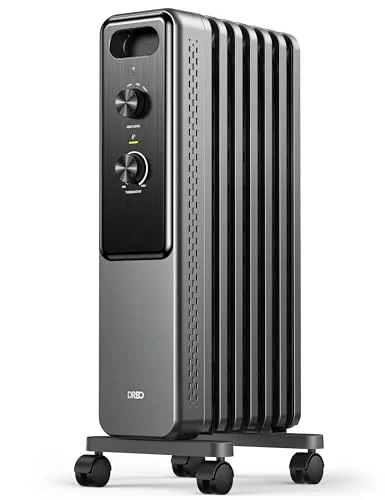
DREO Radiator Heater, Dual Knobs, Energy Saving
What it's claiming: an adjustable thermostat, not a lower-wattage element
1500W oil-filled·Dual knobs·Adjustable thermostat·8 safety protections
This listing pairs “Energy Saving” with dual knobs and an adjustable thermostat rather than a named ECO mode or a programmable schedule — the simplest version of the claim on this page. Two physical knobs set the heat level and the target temperature directly, and the thermostat's job is to stop calling for full output once the room reaches that number, rather than running the 1,500-watt element continuously regardless of how warm it already is. The “Energy Saving” language here is best read as pointing at that dial, not at anything happening inside the element: dial in a lower target, and the heater simply calls for full power less often.
The claim to take from this one: you decide the target, the thermostat decides how often 1,500 watts gets used to hold it.
02The ECO-mode claim
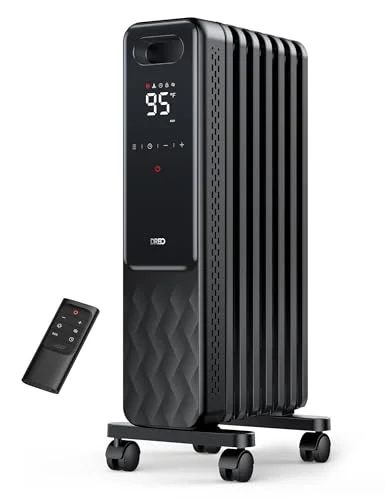
DREO Radiator Heater, Digital Thermostat, ECO, 4 Modes
What it's claiming: a gentler cycling pattern, averaged over time
1500W·ECO + 4 Modes·24h timer·Child lock
This is the listing where “Energy Saving” has the most specific feature backing it: a named ECO mode among four heat modes, run by a digital thermostat rather than a mechanical dial, plus a 24-hour timer and a child lock. ECO is the feature discussed above in detail — it adjusts the on/off cycling pattern around a target temperature so the heater spends less time pulling its full 1,500 watts, not a setting that makes the element itself draw less while it's actually running. The 24-hour timer is a separate, usage-level feature: it bounds how long the unit runs unattended, which is a scheduling decision layered on top of whatever mode is active.
The claim to take from this one: ECO changes the rhythm of a 1,500-watt element, not the number on the element.
03The timer claim
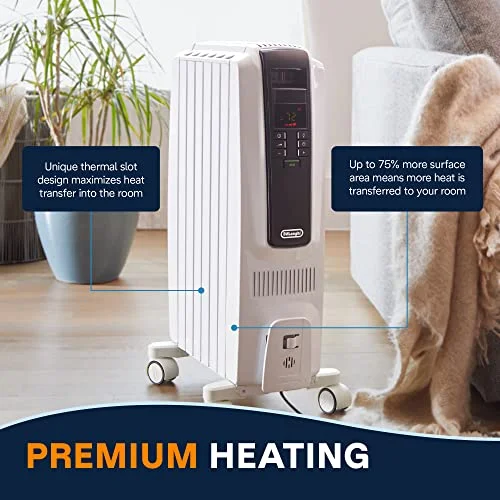
De’Longhi Dragon Digital Oil Filled Radiator
What it's claiming: a schedule, not a different element
1500W·Programmable timer·Full room heater·16"w x 10"d x 26"h
The De’Longhi Dragon's own title puts “Energy Saving” directly next to “programmable timer,” and that pairing is the whole claim: a schedule a person sets, deciding which hours the 1,500-watt element is allowed to run at all. A programmable timer doesn't touch the rate at which electricity becomes heat while the unit is on — it only changes the total hours it's on. For a radiator specifically, which already takes real time to warm up and keeps radiating after it switches off, scheduling it to start before you need the room and stop before you leave it is a genuinely useful way to cut runtime, independent of anything the element itself is doing.
The claim to take from this one: the savings come from fewer hours running, not from a different watt.
Where real savings actually come from: the thermostat, the room, and the hours
None of this means a space heater's running cost is fixed and unchangeable — it means the variables that actually move it aren't the ones printed as a badge on the box. Three things determine what any of these heaters costs to run, and all three sit outside the element itself.
The thermostat
How accurately it holds a target temperature, and how aggressively it cycles around that target, decides how often the full 1,500 watts actually gets called for. A thermostat (or an ECO mode riding on top of one) that stops calling for heat the moment a room reaches its setpoint saves real electricity — the dial, not the coil, is doing the work.
The room
A small, enclosed, well-insulated room reaches and holds a target temperature with far less total runtime than a large or drafty one at the identical wattage. The heater doesn't change; how much work it has to do to satisfy the thermostat does.
The third variable is simply the hours: how long the heater runs and how often, which is exactly what a programmable timer or a habit of switching it off controls. Run a 1,500-watt heater for four hours instead of eight and the electricity consumed roughly halves, regardless of which badge is printed on the box. That's arithmetic any heater in this category is subject to equally — the ones with a timer simply make it easier to act on.
Put together, the honest savings story for any of these three heaters is: set the thermostat to the lowest temperature that's actually comfortable, run it in the smallest enclosed space that makes sense for the job, and don't run it longer than the room needs it. “Energy Saving” on the label is, at best, a shorthand for having the controls to do exactly that — it was never a claim about the watt itself being any different.
How we picked
We looked for heaters that put “Energy Saving” or equivalent language directly in their own product titles, then specifically chose three that anchor the claim to three different features — an adjustable thermostat, a named ECO mode, and a programmable timer — rather than three near-identical radiators that would make the same point only once. All three are oil-filled radiators rated at 1,500 watts, which let us hold the heating mechanism constant and isolate the actual variable: which control feature the “Energy Saving” language is standing in for on each listing.
How we compared
We compared these three heaters on their published product titles, listed specifications and current Amazon prices, reading each “Energy Saving” claim against the wattage figure printed in the same title. Where a listing names a specific feature — ECO mode and a 24-hour timer on one DREO radiator, dual knobs and an adjustable thermostat on the other, a programmable timer on the De’Longhi — we traced the claim to that feature rather than to the heating element, because the underlying physics of resistance heating doesn't vary between these three units or any other plug-in heater at the same wattage. We did not run any of these heaters ourselves or measure their actual electricity draw; the wattage and feature claims here come directly from each product's own listing, and the physics explanation of resistance heating reflects general, widely published electrical principles rather than a claim specific to any one brand.
We don't run a testing lab, we don't own these three heaters, and you won't find an invented efficiency score or a tested watt-hour figure anywhere on this page. We also don't show star ratings, review counts or paraphrased owner sentiment, because we don't have manufacturer-published figures for these specific listings — a limitation of the data available to us, not a judgment on the heaters themselves.
Frequently asked questions
Does “Energy Saving” mean this heater uses less electricity than a plain 1,500-watt heater?
Not while it's running at full output — both draw the same 1,500 watts, because a resistance element doesn't have a more-efficient setting. What “Energy Saving” is actually pointing at is a control feature, like an adjustable thermostat, an ECO mode or a programmable timer, that lets you run less often or at a lower target than flat-out continuous heat. The savings come from using the heater differently, not from the heater converting electricity to heat any more efficiently than another 1,500-watt unit.
What does ECO mode actually do on a space heater?
It changes the cycling pattern a thermostat uses to hold a target temperature — typically shorter bursts at full power and longer pauses, which pulls fewer total watt-hours over an hour of use. It does not lower the maximum wattage the element can reach; at any moment it's actually heating, the element is still working toward the same ceiling. ECO reshapes the average, not the peak.
Is a programmable timer the same thing as an energy-efficient heater?
No. A timer is a scheduling tool that decides when a heater runs and when it doesn't — functionally the same as a smart plug or a reminder to switch it off. It reduces total electricity used by reducing total runtime, which is a legitimate saving, but it has no effect on how efficiently the element converts electricity to heat during the hours it's actually on.
Where do the real savings on a space heater's electric bill actually come from?
Three places, all of them outside the heating element: the thermostat's accuracy and cycling behavior, which decides how often full wattage gets used; the room itself, since a small, enclosed, well-insulated space needs far less runtime than a large or drafty one; and the hours, meaning how long and how often the heater actually runs. A badge on the box doesn't change any of those three variables — the controls underneath it do.
Written by Ilane Tall. Research-based comparisons of published specifications, current prices and public product data — we do not physically test these units and we do not publish invented scores.