By Ilane Tall · Updated November 4, 2026 · Research-based.
Reader-supported: we may earn a commission when you buy through the links on this page, at no additional cost to you. It never changes which product we recommend. Prices quoted below were correct at the time of writing and move often.
Quick answer
DREO sells at least three 10-inch space heaters that share the same brand name and close to the same cabinet, and the only reliable way to tell them apart is the control scheme named in the product title — not the price, and not the photo. The $39.99 model (ASIN B0D9KBQ3PG) is titled around a remote. The $39.99 model (ASIN B0C6FCKQML) is titled around a thermostat, with no remote mentioned at all. The $42.49 model (ASIN B0FBRW761D) swaps the oscillating base most 10-inch heaters use for a fixed 60-degree tilt.
None of that ordering is what you'd guess from price alone — the cheaper heater here is the one with the remote, and the one in the middle is the one that's manual by comparison, aside from its thermostat. That's exactly why reading the actual listing matters more than trusting the brand name or the price tag to sort these for you.
All three heaters in this comparison are sold under the DREO name, and all three list the same 10-inch size variant. That's not a coincidence of us picking similar-looking products to compare — it's the actual constraint a shopper runs into on Amazon when they search "DREO space heater" and get three listings back with near-identical product photography, the same compact tower-free cabinet shape, and prices that only differ by ten or fourteen dollars. If you're scrolling search results on a phone, the thumbnails alone will not tell you which one you're about to buy.
What does differ, and differs enough to change how the heater behaves once it's plugged in, is the control scheme named in each product title. One is built around a remote. One is built around a thermostat and nothing else. One drops oscillation in favor of a fixed, adjustable tilt. A 10-inch heater is a 10-inch heater regardless of which of the three you own — the wattage math for the room you're heating doesn't change between them — but how you operate it, and what it can and can't do unattended, changes a lot depending on which listing you actually read before buying.
This is the trap specific to a single brand selling several near-identical SKUs: the name on the box stops being useful information. "It's a DREO" tells you the footprint and, roughly, the build quality tier. It tells you nothing about whether you'll be walking across the room to adjust it by hand, pointing a remote at it from the couch, or tilting its head by six inches before you plug it in. That's the part worth reading before you add to cart, not after it arrives and the control panel doesn't match what you pictured.
The $39.99 version: what a remote adds, and what it does not
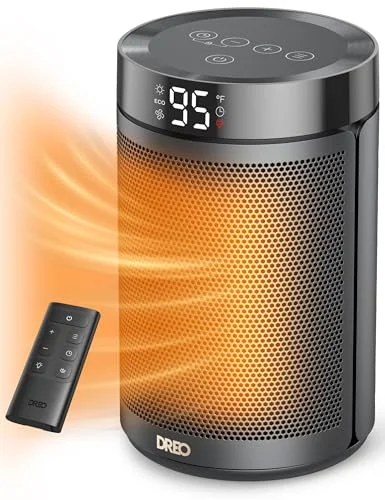
The least expensive of the three, DREO's $39.99 10-inch heater (ASIN B0D9KBQ3PG), is titled around a remote — "Portable Electric Heaters for Indoor Use with Remote." That's the entire feature distinction the listing leads with, and it's worth being precise about what a remote actually buys you, because it is easy to assume it implies more automation than it does.
A remote adds exactly one thing: the ability to change the heater's settings without walking over and pressing a button on the unit itself. That's genuinely useful if the heater is across the room, under a desk you don't want to crawl under, or on the far side of a bed. What a remote does not inherently add is a thermostat's core behavior — holding a room at a set temperature and cycling the heating element on and off on its own to maintain it. A remote can be paired with a thermostat, or it can simply be a wireless version of the same buttons on the front panel, letting you pick a heat setting or a timer length from a distance without the unit doing any temperature-sensing of its own in between. The listing title here tells you a remote ships with the unit; it does not, on its own, tell you the unit holds a number the way a dedicated thermostat model does. If automatic temperature holding specifically is the feature you're shopping for, that's a detail worth confirming on the current listing rather than assuming from the word "remote" alone.
Where this model earns its place at the bottom of the three prices is straightforward: convenience from a distance, at the lowest price of the three, with the same 10-inch cabinet and presumably the same heating output as its two siblings. The honest caveat is the one above — a remote is a control surface, not a promise about what's happening inside the unit when nobody's pressing a button.
The $39.99 version: a thermostat and nothing else
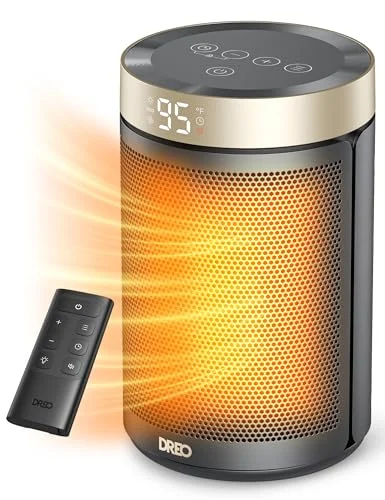
DREO's $39.99 10-inch heater (ASIN B0C6FCKQML) is titled the opposite way — "Portable Electric Heaters for Indoor Use with Thermostat," with no remote named anywhere in the listing title. If the $39.99 model's whole pitch is operating it from across the room, this one's whole pitch is the inverse: you'll be at the unit itself to change a setting, but once it's set, the thermostat is doing the ongoing work of holding that setting rather than running the heating element flat out until you intervene.
That's a real functional trade, not a downgrade dressed up as one. A thermostat that cycles the heater on and off to hold a temperature is, for a lot of rooms, more useful day to day than a remote with no temperature-sensing behind it — it's the difference between "I can change this without getting up" and "I don't have to think about this once I've set it." For a space you occupy for hours at a stretch, like a nursery or a home office, holding a steady temperature automatically arguably matters more than remote convenience, since the alternative to a working thermostat is walking over periodically to check whether the room's gotten too warm or too cold.
What you're giving up, per the listing we have, is the remote. There's no feature in this title suggesting wireless control is included, so operating it means walking to the unit, same as any manual heater, with the difference that once you've dialed in a temperature, the thermostat keeps it there without further input. At four dollars more than the remote version, that's a genuinely different bet on what matters more in daily use, not simply "a few more dollars for a few more features."
The $42.49 version: adjustable tilt instead of oscillation
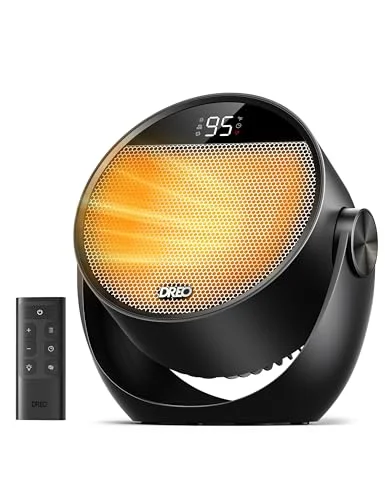
The most expensive of the three, DREO's $42.49 1500W heater (ASIN B0FBRW761D), breaks from the other two in a different way entirely. Its title specifies "60° Adjustable Tilt, Portable Heater for Office" — and that single phrase describes a meaningfully different mechanism than either of the cheaper models, which, absent any stated oscillation feature of their own, are built as fixed, forward-facing units you'd point by positioning the whole heater.
Oscillation and tilt solve a similar-sounding problem — getting heat to more of a room than whatever's directly in front of the unit — in two different ways, and the distinction is worth understanding before you buy on the word "adjustable" alone. An oscillating heater sweeps side to side on a timer, continuously covering an arc of the room rather than a single fixed point. A tilt mechanism does the opposite: it lets you set one fixed angle, up to 60 degrees of adjustment on this model, and then the heater stays locked on that angle until you physically change it again. One spreads heat across a moving arc automatically; the other aims it at one spot you choose and leaves it there.
That makes this version's pitch specifically about aim, not coverage. The listing's own framing — "Portable Heater for Office" — matches a fixed-tilt mechanism well: a desk heater usually needs to warm one person at one fixed position, not sweep a beam across an open floor hoping to catch whoever's in the room. If you want a heater that keeps re-covering a wider arc on its own while you move around a room, oscillation is the feature to look for instead, and this specific DREO listing does not claim it. The $42.49 price buys a 1500-watt unit with a deliberately aimable head, not a wider sweep — worth knowing before assuming "adjustable" means "covers more of the room automatically."
The picks, matched to what each control scheme is for
Not a ranked list — all three share the same 10-inch footprint and, as far as the data we have shows, the same basic heating approach. The only thing that should decide which one you buy is which control scheme actually matches how you'll use it.
01Best for across the room
DREO Space Heater with Remote
The remote pick: change settings without getting up
10-inch footprint·Remote included·Lowest price of the three
The cheapest of the three DREO listings here, and the one built around distance control: a remote to adjust settings from the couch, the bed or across a home office without crossing the room. The listing title doesn't name a dedicated thermostat function, so don't buy this one specifically for unattended temperature holding — buy it because you want to change the setting without standing up, at the lowest price of the three.
The pick if the heater will sit somewhere you don't want to walk over to every time you adjust it.
02Best for hands-off holding
DREO Space Heater with Thermostat
The thermostat pick: set it once and let it hold the number
10-inch footprint·Thermostat, no remote·Mid-price of the three
No remote named in this listing — you'll be at the unit to change the setting, same as any manual heater. What you get instead is a thermostat doing the ongoing work: set a temperature once, and the heater cycles itself on and off to hold it, rather than running at a flat output until someone intervenes. For a room you're in for hours at a time rather than passing through, that's arguably the more useful mechanism of the two, even without wireless control.
The pick if you'd rather set a number once than adjust a remote repeatedly through the evening.
03Best for aiming at one spot
DREO Space Heater 1500W, 60° Adjustable Tilt
The tilt pick: a fixed, aimable head instead of a sweeping one
10-inch footprint·1500W·60° adjustable tilt·Highest price of the three
Built and marketed for office use, and the mechanism backs that framing: a 60-degree tilt you set once to aim the heater at a fixed point, rather than an oscillating sweep that covers a wider arc automatically. That's a feature for warming one desk position precisely, not for covering a whole room while you move around it — the two mechanisms solve different problems, and this listing names tilt specifically, not oscillation.
The pick if you want heat aimed at exactly where you sit, not swept across a room you're moving through.
Price does not track features in order
The cheapest of the three ($39.99) is the one with the remote. The middle one ($39.99) is the one without a remote, running on a thermostat instead. Going by price alone, in either direction, gets the feature set backwards.
Size does not change between them
All three list the same 10-inch footprint. If floor space or desk space is the constraint, that constraint is satisfied by any of the three — it's the control scheme, not the size, that should decide which one you order.
Reading the actual listing instead of the brand name
The practical lesson from putting these three side by side isn't really about DREO specifically — it's about what happens whenever one brand sells several close variants of the same product at adjacent price points, which is common across the space heater category and well beyond it. The brand name on a product tells you about build quality tier and general design language. It does not tell you which specific control features are in the box you're about to order, and — as these three show — it doesn't even reliably tell you that the pricier option has strictly more features than the cheaper one.
The fix is mechanical rather than clever: read the actual title and bullet points of the specific listing you're about to buy, every time, even when you've bought from the same brand before and even when the product photo looks identical to one you already own. "With Remote," "With Thermostat," and "60° Adjustable Tilt" are three different promises printed in three different listing titles, and none of them is implied by the other two. A shopper comparing three tabs open side by side, rather than trusting memory of which DREO heater does what, is the only reliable way through this particular trap — and it's a habit worth keeping for any category where a single brand runs several near-identical SKUs, not just this one.
It's also worth checking the current listing directly for anything this comparison doesn't cover. We've stuck to what's stated in each product title and the size variant on file for all three; wattage, exact dimensions, cord length and certification marks beyond what's named above should be confirmed on the live Amazon page before you buy, since those can change between when this was written and when you're reading it.
How we picked
We started from our own product database and pulled three listings sold under the DREO name that share a 10-inch size variant and sit at distinct, nearby price points, specifically because that combination — same brand, same rough size, different prices — is exactly the scenario where a shopper is most likely to confuse one model for another. The point of this guide isn't to crown a single best DREO heater; it's to make the actual differences between three easily-confused listings legible before you add one to cart.
How we compared
We compared the three listings on their published titles, their listed size variant and their current Amazon prices — the specific, checkable details available to us for each ASIN. Where a listing names a feature, such as the remote on the $39.99 model, the thermostat on the $39.99 model, or the 60-degree tilt on the $42.49 model, we report it as stated. Where a listing doesn't name a feature — a remote on the thermostat model, oscillation on the tilt model, a thermostat on the remote model — we treat that as the listing not claiming it, rather than guessing at a capability it might quietly have.
We do not run a testing lab. We have not plugged in these three heaters and compared them by hand, and nothing on this page is a measured result from doing so. What we can do honestly is read what each listing actually states, compare those statements to each other, and flag where the price order and the feature order don't match — which, in this case, they don't.
Frequently asked questions
Does the $39.99 DREO heater with a remote also have a thermostat?
The listing title names a remote and doesn't name a thermostat function, so we're not going to claim one that isn't stated. A remote lets you change settings from a distance; it doesn't by itself mean the unit is sensing and holding a room temperature the way a dedicated thermostat model does. If automatic temperature holding is the specific feature you want, check the current listing's full description before buying, or consider the $39.99 thermostat model instead.
Is a 60-degree tilt the same as oscillation?
No. Oscillation sweeps the heater side to side on a timer, continuously covering an arc of the room. A 60-degree tilt lets you set one fixed angle and leaves the heater pointed there until you manually change it again. The $42.49 DREO model in this comparison names tilt, not oscillation, which fits its own framing as an office desk heater aimed at one position rather than a room-sweeping unit.
If all three are the same size, does it matter which one I buy?
Yes, because the 10-inch footprint is the one thing that doesn't change between them. What does change is how you'll operate it day to day: from a distance with a remote, hands-off once set with a thermostat, or aimed at a fixed spot with an adjustable tilt head. Matching that control scheme to how you'll actually use the heater matters more here than the size or the brand name.
Why is the cheapest DREO model the one with the remote instead of the one with the thermostat?
Based on the listings we have, that's simply how these three happen to be priced and featured — it isn't a rule that remotes cost less than thermostats in general, and it's a reminder not to assume a feature hierarchy from price alone. The only way to know what a specific listing includes is to read that listing's own title and description, which is the habit this whole comparison is built around.
Written by Ilane Tall. Research-based comparisons of published specifications, current prices and public product data — we do not physically test these units and we do not publish invented scores.