By Ilane Tall · Updated November 23, 2026 · Research-based.
Reader-supported: we may earn a commission when you buy through the links on this page, at no additional cost to you. It never changes which product we recommend. Prices quoted below were correct at the time of writing and move often.
Quick answer
Lasko's 16-inch CT16450 console ($37.99) is the plainest of the three: two heat settings, widespread oscillation and overheat protection, with nothing to program and nothing to pair. Lasko's own 24-inch Ellipse CT24950 ($74.67) is the upgrade from inside the same company — a digital display, a thermostat, a remote and a timer stacked onto the same 1,500-watt element. PELONIS's 30-inch tower ($64.98) matches most of that feature list, adds six more inches of height and a stated 75-degree oscillation, and undercuts Lasko's own digital model by roughly ten dollars.
None of the three connects to a phone, a router or a voice assistant — see why that's a feature of the category these two brands built, not a gap either one forgot to fill.
Two brands that predate the smart-heater wave
Lasko has made fans and heaters under its own name since 1906, which puts the company in business for well over a century before "Wi-Fi enabled" or "works with Alexa" appeared on a space heater box. PELONIS has built its reputation the same way, on small kitchen and home-comfort appliances sold on function and price rather than connectivity. Both brands are still selling tower heaters today, and neither one has rebuilt its lineup around an app the way some newer entrants in this category have.
That matters for what you're actually comparing here. These are not three generations of the same smart product with different feature tiers unlocked by a subscription or a firmware update. They're three physical control schemes — a manual console, a digital tower with a remote, and a second digital tower with a bit more height — built by companies that have been refining the same basic tower-heater format for a long time, long before "smart" was a selling point in this category at all.
The practical result is a comparison that's really about hardware and controls you can see and touch, not about software. There's no account to create, no app to update, and no cloud service that could stop working in five years and leave a perfectly good heater's remote features useless. If you want a plain mechanical read on how these heaters warm a room before you weigh brand or features at all, our guide to how fast space heaters actually heat up looks at the seconds-and-minutes claims that apply to ceramic towers like all three of these.
A basic console at 16 inches versus a 24-inch digital display
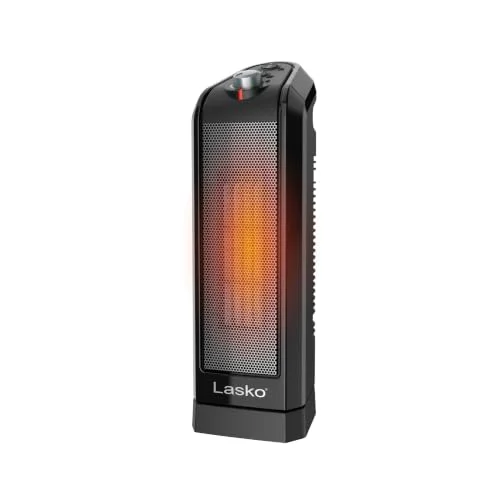
Start with the plainest of the three, because it sets the baseline for everything the other two add. Lasko's CT16450 is a 16-inch (stated as 15.7 inches) ceramic console heater with exactly two heat settings and widespread oscillation. Its own listing doesn't mention a timer, a remote or a thermostat dial of any kind — just a console you switch on, pick one of two heat levels, and switch off yourself when you're done. Lasko states overheat protection on this model specifically, which is the one safety feature we can confirm for it beyond the basic on/off switches.
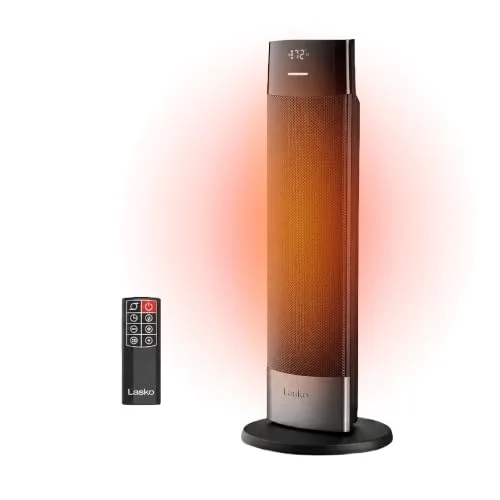
Lasko's own Ellipse CT24950 is a different kind of product wearing the same brand name. At 24 inches tall, it adds a digital display, a thermostat, wide oscillation, a remote and a timer — five features the 16-inch console doesn't list at all. It also specifies a tip-over switch, which the console's listing does not call out by that name. In other words, the jump from the 16-inch model to the 24-inch model isn't really about height first; it's Lasko selling two different tiers of the same ceramic tower heater, one built to be adjusted by hand at the unit and one built to be set, scheduled by its own thermostat and left alone.
Both run on the same 1,500-watt ceramic element, which Lasko states on both listings. That's worth repeating because it's easy to assume the pricier, taller model with the digital display must also put out more heat. It doesn't. The wattage ceiling on a standard US household circuit applies to both heaters equally; what changes between them is how precisely you can hold a temperature and how little you have to walk over and touch the unit to do it.
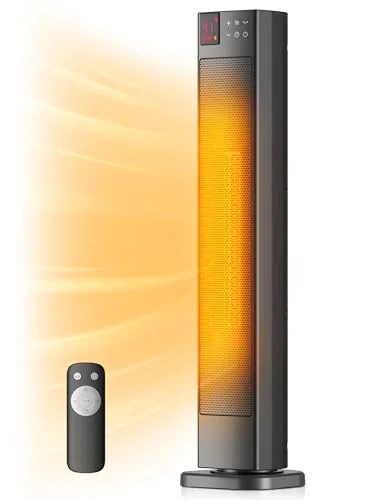
Set the 16-inch console aside and compare the two digital towers directly, because that's where the more interesting trade-off sits. PELONIS's 30-inch tower is six inches taller than Lasko's own Ellipse, and its listing states a specific 75-degree oscillation figure — a number Lasko's Ellipse listing doesn't give for its own "wide oscillation," describing the sweep in general terms rather than a stated angle.
That's a meaningful gap in what each brand is willing to commit to in writing. PELONIS tells you the exact arc its tower sweeps; Lasko tells you only that the Ellipse's oscillation is wide. We won't guess at Lasko's actual angle to make a cleaner comparison — a listing that doesn't state a figure is a gap in the data, not evidence the feature is worse. What we can say honestly is that PELONIS is the only one of these three listings to put a number on its oscillation at all.
One figure PELONIS's listing does not state, by contrast, is wattage. Both Lasko models specify 1,500 watts directly in their titles; the PELONIS listing we're working from describes "effective ceramic heating technology" and "comprehensive protection" without naming a wattage figure. We're treating that as a gap rather than assuming it matches the Lasko units, even though 1,500 watts is the practical ceiling for almost any plug-in heater built for a standard US outlet. If an exact wattage number matters to your decision, check PELONIS's current listing directly rather than relying on an assumption, from us or anyone else.
Height and oscillation angle aside, PELONIS undercuts Lasko's own digital tower by close to ten dollars at the prices we have on file — $64.98 against $74.67 — while matching the Ellipse's thermostat, remote and 12-hour timer. That's the real headline of the extra six inches: more stated precision on the oscillation spec, a taller cabinet, and a lower price than the brand that's been building ceramic towers the longest.
Timer, remote and thermostat: which model has which
Laid out side by side, the control feature split is cleaner than the price tags suggest. Lasko's 16-inch console has none of the three: no stated timer, no remote, no thermostat. It's a two-setting switch and an oscillation button, full stop. Both digital towers — PELONIS's 30-inch model and Lasko's own 24-inch Ellipse — add all three: a thermostat to hold a set temperature automatically, a remote to adjust it from across the room, and a timer to shut the unit off on a schedule rather than running it until someone remembers to switch it off by hand.
PELONIS states its timer runs 12 hours and pairs it with an ECO mode, a detail that doesn't appear on either Lasko listing we have. Lasko's Ellipse states a timer and a thermostat without giving the specific hour count for the timer, the way it leaves its oscillation angle unstated. Again, that's a gap in what the listing tells us, not a claim that the Ellipse's timer is shorter or longer than PELONIS's 12 hours — check the current listing if the exact interval decides your purchase.
| Model | Height | Oscillation | Timer | Remote | Thermostat | Price | Get it |
|---|
 Lasko CT16450 |
15.7 in |
Widespread, no stated angle |
Not stated |
Not stated |
Not stated |
$37.99 |
Get it |
 PELONIS 30-Inch Tower |
30 in |
75° stated |
12H + ECO mode |
Yes |
Yes |
$64.98 |
Get it |
 Lasko Ellipse CT24950 |
24 in |
Wide, no stated angle |
Stated, no hour count |
Yes |
Yes |
$74.67 |
Get it |
Fourteen inches separate the shortest model here from the tallest, and that difference is mostly about where the warm air leaves the cabinet, not how much heat the unit produces. A 16-inch console sits low, closer to the floor, which puts its airflow near ankle height in most rooms — fine next to a desk or a side of a bed, less useful if you want warm air reaching a seating area across the room. A 24-to-30-inch tower releases air from higher up, closer to where a person is actually sitting or standing, which is the main practical argument for choosing a taller model over a shorter one at the same wattage.
Floor footprint tells a similar story in miniature: a short console tucks under a desk or beside a nightstand with less visual presence, while a 24-to-30-inch tower needs enough floor clearance to stand upright and, in PELONIS's case, enough open space in front of it for a 75-degree sweep not to be blocked by furniture. None of the three listings states a base diameter, so we won't invent one — but taller towers of this style generally ask for a bit more clear floor around the base than a squat console does, simply to stay stable.
The honest takeaway: buy height for reach, not for heat. All three run on the same wattage ceiling that governs this entire category, and a taller cabinet doesn't move more watts through the room — it just releases the same wattage from a point closer to where people actually are. If floor space and furniture layout are already tight, our guide to space heaters for a laundry room or mudroom covers the opposite end of that trade-off, where a smaller footprint wins out over reach.
The picks
Three heaters, three different answers to how much control is worth paying for — not a ranked list, since the right one depends on whether you want a dial-free console or a programmable tower.
01Best if you want nothing to program
Lasko 16" Ceramic Space Heater with Console (CT16450)
The basic pick: two settings, one oscillation button, overheat protection
1,500 Watt·2 heat settings·Widespread oscillation·15.7 in, overheat protection
No timer, no remote, no thermostat dial — just a console with two heat settings and a widespread oscillation button, built for a bedroom or an office where you're within arm's reach of the unit. Lasko states 1,500 watts and overheat protection directly on the listing, which covers the one safety claim we can confirm without reading more into the box than it says. At $37.99 it's the least expensive of the three by a wide margin, and that price buys exactly the feature list above and nothing more.
The pick if you want a tower heater that asks nothing of you beyond flipping a switch.
02Best value with a thermostat
PELONIS 30" Ceramic Tower Space Heater with Thermostat, Remote & 12H Timer
The tall pick: a stated 75° sweep, a 12-hour timer and an ECO mode
Thermostat & remote·12H timer, ECO mode·75° oscillation·30 in
Six inches taller than Lasko's own digital tower, with a 75-degree oscillation figure PELONIS states outright where Lasko's comparable model does not. A thermostat and remote put this on the same control tier as Lasko's Ellipse, and the 12-hour timer pairs with an ECO mode PELONIS calls out specifically. PELONIS's listing doesn't state a wattage figure, which we're not papering over — check the current listing if an exact number matters to you. At $64.98, it's roughly ten dollars cheaper than Lasko's own 24-inch digital model.
The pick if you want a programmable tower and don't need it to carry Lasko's name on the front.
03Best if you want it from Lasko
Lasko Ellipse Ceramic Tower Heater (CT24950)
The in-house upgrade: digital display, thermostat, remote, timer, tip-over switch
1,500 Watt·Digital display·Thermostat, remote, timer·24 in, tip-over switch
The same brand as the 16-inch console, with every control feature that console skips: a digital display, a thermostat, wide oscillation, a remote and a timer, plus a stated tip-over switch the console's own listing doesn't call out. Lasko states 1,500 watts directly, matching the console, so the extra $36.68 over the CT16450 buys controls and a taller cabinet, not more heat. It's also the only one of the three without a stated exact oscillation angle or timer-hour figure, both left as general terms in the listing we have.
The pick if staying with the same brand across both tiers matters more than squeezing out the lowest price or the most precisely stated spec sheet.
Why neither brand needed an app to stay on the shelf this long
None of these three heaters connects to Wi-Fi, pairs with a phone or answers to a voice assistant. That's not an oversight on Lasko's or PELONIS's part — it's a reflection of how long both brands have been selling this exact category of product and how little a tower heater's core job has changed in that time. A ceramic element, a fan, an oscillation motor and, on two of these three, a thermostat chip that cycles the element to hold a set temperature: that's the entire mechanism, and an app doesn't make any part of it work better.
What an app typically adds to a heater is remote scheduling from outside the room and integration with a smart-home routine — genuinely useful for some buyers, and entirely replaceable here by the physical timer and remote that PELONIS's tower and Lasko's Ellipse already include. A 12-hour timer set by hand before bed does the same job as an app-scheduled shutoff for most households, without a cloud account that could go away, an update that could break the pairing, or a router outage that could leave the heater stuck in whatever state it was last in.
That's the throughline across all three of these models, from the plainest console to the taller digital tower: Lasko and PELONIS have kept selling variations on the same mechanical formula because the formula works, and because a thermostat chip and a remote cover what most buyers actually want from a "smart" feature without the overhead of a phone app standing between a cold room and a working heater.
How we picked
We picked three current listings specifically to span one brand's own feature tiers alongside a direct competitor at a similar size: Lasko's least-featured console, Lasko's own most-featured ceramic tower, and PELONIS's comparable tower at a taller height. The goal was to separate what changes because of brand from what changes because of feature tier, which is why two of the three products share a manufacturer.
How we compared
We compared these three heaters on their published titles, available specifications and current Amazon prices. Where we cite a specific figure — Lasko's 1,500 watts on both of its models, PELONIS's 75-degree oscillation and 12-hour timer, the stated heights of 15.7, 24 and 30 inches — it comes directly from that product's own listing. Where a listing leaves a figure out, such as PELONIS's wattage or the exact oscillation angle and timer length on Lasko's Ellipse, we say so rather than filling the gap with a guess.
We do not run a testing lab. We do not own these three heaters and have not run them side by side in a room ourselves, so you will not find an invented decibel reading or a score out of ten anywhere on this page. We also don't show star ratings, review counts or paraphrased owner sentiment here, because we don't have manufacturer-published figures for these specific listings — a limitation of the data available to us, not a judgment on the heaters themselves.
Frequently asked questions
Does the Lasko CT16450 console have a timer or thermostat?
No. Its listing specifies two heat settings, widespread oscillation and overheat protection, with no stated timer, remote or thermostat. It's built as a manual on/off console rather than a programmable tower, which is also why it's the least expensive of the three models compared here.
What does PELONIS's extra six inches over the Lasko Ellipse actually change?
Mainly reach and one stated spec: PELONIS's 30-inch tower releases warm air from a higher point than Lasko's 24-inch Ellipse, and PELONIS states a specific 75-degree oscillation figure where the Ellipse's listing describes its sweep only as "wide" without a number. Both still run on the same roughly 1,500-watt ceiling common to this heater category.
Why don't Lasko or PELONIS tower heaters connect to WiFi or an app?
Both brands have sold this style of ceramic tower heater for years using a thermostat chip, a timer and a physical remote to cover scheduling and temperature control, which is most of what an app-based smart heater offers anyway. Neither brand has rebuilt these specific models around phone or voice-assistant connectivity.
Which of these three heaters comes with a remote control?
PELONIS's 30-inch tower and Lasko's 24-inch Ellipse both include a remote, along with a thermostat and a timer. Lasko's 16-inch CT16450 console does not list a remote; it's adjusted by hand at the unit using its two heat settings and oscillation button.
Written by Ilane Tall. Research-based comparisons of published specifications, current prices and public product data — we do not physically test these units and we do not publish invented scores.