By Ilane Tall · Updated November 6, 2026 · Research-based.
Reader-supported: we may earn a commission when you buy through the links on this page, at no additional cost to you. It never changes which product we recommend. Prices quoted below were correct at the time of writing and move often — check the current price before buying.
Quick answer
Three figures doesn't buy more heat. Every heater on this page is built around the same roughly 1,500-watt ceiling a standard US outlet allows, the same ceiling a $23 personal heater shares. What the extra money buys instead is one of three specific things: a second heating element, a furniture-grade cabinet rated for a much larger room, or a permanent wall installation. The Dr Infrared Heater DR-968 ($98.80) is the pick if you want the first of those — an infrared quartz tube added to a PTC ceramic element, in a cherry-finish cabinet, for one large room you sit in.
The duraflame Freestanding Electric Fireplace Stove ($258.99) is a different category of object entirely: a stove-style cabinet rated for 1,000 square feet, built to look like a working fireplace as much as to heat a room. The DREO Smart Wall Heater ($110.49) skips the floor altogether, at the cost of a permanent mounting decision. Before paying for any of the three, read why a $70 heater from the bracket below sometimes does the identical job.
What the $50-to-$100 tier already covers, and what it still skips
Before paying over $100 it's worth knowing exactly what the bracket directly below already gets you, because the two tiers aren't separated by a vague sense of quality — they're separated by specific, nameable features. We've covered the $50-to-$100 bracket in full elsewhere, but the short version: once a heater crosses roughly $50, it typically adds a digital thermostat that holds a target temperature instead of three fixed settings, a stated noise figure in decibels instead of silence on the spec sheet, a named flame-retardant housing grade, and layered auto-off protection beyond a single tip-over switch. A heater selling for $67 to $70 in that bracket usually has all of that already.
What the $50-to-$100 bracket does not add, no matter how close to $100 it gets, is a change in the basic shape of the product. It's still a single heating element, still a portable cabinet or tower you set on the floor and plug in, and still built around the same 1,500-watt ceiling as a $23 personal heater — the practical limit of a 15-amp residential circuit, a number that doesn't move with price. That wattage ceiling is the arithmetic behind every heater on this site, cheap or expensive, and it's the reason the real differences above $100 aren't about more heat. They're about three structural changes that a $50-to-$100 heater, by design, doesn't make.
What $50–$100 already buys
A digital thermostat instead of fixed settings, a stated decibel figure, a named flame-retardant housing grade, and layered shut-off protection — all on a single heating element in a portable cabinet.
What crossing $100 adds
A second heating element working alongside the first, a furniture-class cabinet rated for a much bigger room, or a wall-mounted installation that removes the heater from the floor entirely.
A cherry-finish cabinet and a dual heating element: where the first $100 goes
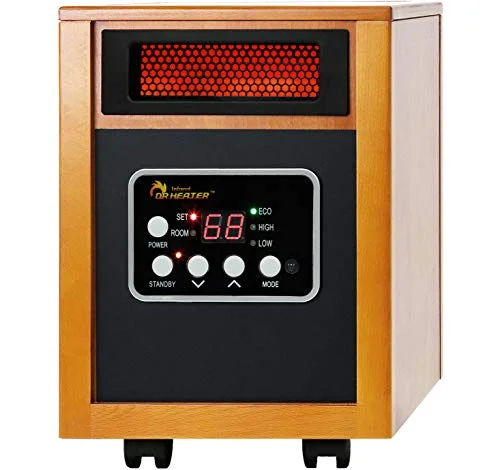
The Dr Infrared Heater DR-968 is the clearest example of what the first real jump past $100 buys, because it states the change directly in its own design: two heating elements sharing one cabinet, rather than the single PTC ceramic or quartz element you'll find in almost everything priced below it. An infrared quartz tube handles the objects and people directly in front of the unit, while a PTC ceramic element warms the air moving through the cabinet at the same time. A $70 heater from the bracket below picks one of those two jobs. The DR-968, at $98.80, does both at once.
That combination is also why the DR-968 reads less like a tower and more like a piece of furniture: the 1,500-watt unit ships in a cherry wood-tone cabinet rather than the matte plastic housing most heaters in this catalog use. The finish isn't cosmetic padding stacked on top of the price — it's consistent with the rest of the product's pitch, a heater meant to sit in a room you're furnishing rather than one you're hiding behind a chair. It asks for real floor space in exchange, since a cabinet this size doesn't tuck into a corner the way a slim tower does.
None of this changes the electrical ceiling. At a stated 1,500 watts, the DR-968 draws roughly the same 12.5 amps as any other full-power plug-in heater on this page, close enough to a 15-amp circuit's rating that it wants an outlet of its own. The extra money here buys a second heating mechanism and a cabinet finish, not more watts — the same honest math that applies to every heater in this roundup.
A stove rated for 1,000 square feet: what that rating assumes
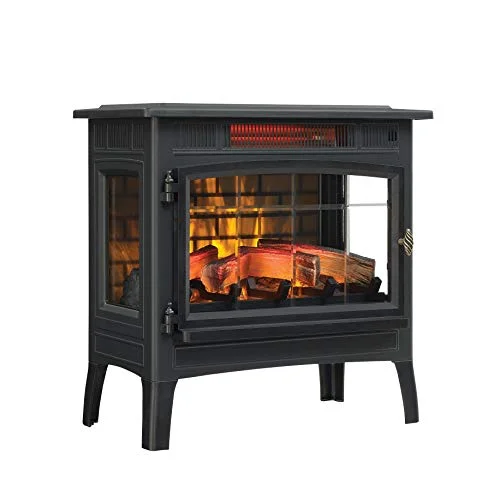
The duraflame Freestanding Electric Fireplace Stove is priced well above either of the other two picks here, at $258.99, and the reason isn't a bigger heating element — its own listing doesn't state a wattage figure at all, which is a gap in the published data rather than a claim we're going to fill in. What the price buys instead is a different class of object: a freestanding stove cabinet with a 3D flame effect behind glass, built around an infrared element, and rated by duraflame for a room up to 1,000 square feet. Compare that to the DR-968's single room and the jump in stated coverage is the headline number on the box.
That 1,000-square-foot figure deserves the same scrutiny any square-footage rating deserves. Manufacturer coverage claims are typically measured in a closed, single-story room with a standard ceiling height, solid insulation and no major drafts — favorable conditions chosen to showcase the unit, not necessarily the conditions in your home. A vaulted ceiling adds air volume the rating doesn't account for. An open floor plan connecting to a hallway or kitchen isn't a sealed 1,000 square feet; it's 1,000 square feet with doorways bleeding heat into rooms nobody asked to warm. None of that makes the figure dishonest — it makes it a best case, worth discounting against your actual room before the box arrives.
What you're genuinely paying for, beyond the rating, is the cabinet itself: a glass door, a brick-style back panel, a 3D flame effect, and a finished footprint of 13.07 inches deep by 24 inches wide by 23.4 inches tall — the largest of the three products on this page by a wide margin, so check that against your actual floor space before assuming the square-footage rating is the only number that matters. If your priority is purely heat per dollar, a radiant unit without the stove furniture does the thermal job for less. If the room needs to look like it has a working fireplace while it's warm, that's the $258.99 this product is actually charging for.
A wall-mounted smart heater: paying for installation and control, not wattage
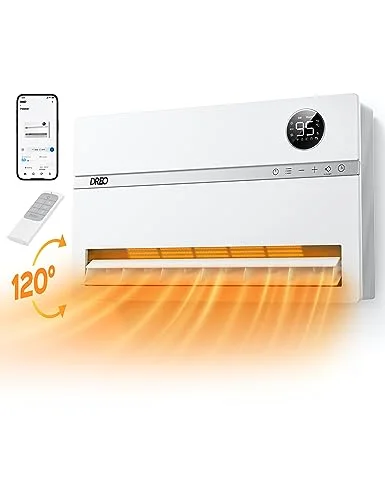
The DREO Smart Wall Heater takes a third approach entirely, and it's the one that has the least to do with heat output. At 1,500 watts, it draws the same roughly 12.5 amps as any other heater on this page at full output — the identical electrical ceiling as a $23 personal heater. What $110.49 buys here is the one thing neither of the other two products offers: a heater that leaves no cabinet on the floor at all, because it's designed to be fixed permanently to a wall rather than set down and plugged in.
That's a real trade, not a marketing flourish. Removing the floor footprint means no cord stretched across a doorway, nothing at ankle height for a pet or a child to tip over, and a fixed, repeatable spot the heat comes from every time. It also means an installation step a plug-in cabinet never asks for — mounting hardware, a chosen height, and a decision about which wall you're committing to, which the current listing is the authority on since we don't have exact hardware specifications to pass along here.
The "Smart" in the name is worth being precise about. DREO sells this unit in white, in a "Standard" size, marketed for bedroom use — and that's the specification data we have for this listing. We don't have a stated control feature set, app connectivity figure, or thermostat spec to itemize beyond the name itself, so we're treating that as a gap rather than inventing a feature list to match the price. DREO sells several heaters under similar naming, and the wall-mounted format is what separates this one from the brand's towers, not a difference in wattage. If a specific control feature is the reason you're buying it, verify the current listing before you drill into a wall over it. And if you're renting, a permanent wall mount is worth weighing against your lease before you commit to one spot for good.
The picks
Three heaters, three different reasons to cross $100 — not a ranked list, since the right one depends on which of the three structural changes you actually need: a second heating element, a stove-rated cabinet, or a wall installation.
01Best dual-element pick
Dr Infrared Heater DR-968
Two heating elements in a cherry-finish cabinet
Infrared quartz + PTC·1,500 Watt·Cherry, Original·12.5 amps
The entry point into three figures, and the most direct answer to what the extra money buys: a second heating element sharing one cabinet with the first, so it warms the air moving through the room and the objects and people in front of it at the same time. The cherry wood-tone finish matches the pitch — a heater meant to be furniture, not hidden behind a chair. It's a cabinet rather than a slim tower, so it asks for real floor space, and at a stated 1,500 watts and roughly 12.5 amps it wants an outlet of its own.
The pick if you want one large room done properly with a single heater, and you're willing to give it floor space.
02Best for a wall, not the floor
DREO Smart Wall Heater
The installation pick: no floor footprint at all
1,500 Watt·Wall-mounted·White, Standard·Marketed for bedroom use
The only one of the three that removes the floor from the equation entirely. Fixed permanently to a wall, it leaves no cabinet to walk around and nothing at ankle height. DREO markets it for bedroom use in a white "Standard" size, and at 1,500 watts it draws the same roughly 12.5 amps as any plug-in heater in this class — the price here is for the installation and the fixed placement, not for extra heat. Confirm the exact mounting hardware and height against the current listing before committing to a wall.
The pick if you can commit to one fixed spot and never want a cord on the floor again.
03Best for the biggest rated room
duraflame Freestanding Electric Fireplace Stove
The stove-class pick, rated to 1,000 sq ft — read that rating first
Infrared·3D flame effect·Rated for 1,000 Sq. Ft.·13.07"D x 24"W x 23.4"H
The biggest jump in both price and stated coverage of the three, because it's a different category of object: a freestanding stove cabinet with a glass door and a 3D flame effect, rated by duraflame for a 1,000-square-foot room. Treat that number as a best-case ceiling measured under favorable conditions, not a promise about a vaulted ceiling or an open floor plan. At 13.07 inches deep by 24 inches wide by 23.4 inches tall, it's also the largest footprint here by a wide margin — worth checking against your floor space before the rating decides the purchase.
The pick if the room needs to look warm as much as it needs to be warm, and you're reading the rating as a ceiling, not a guarantee.
When $70 does the same job as $130
Here's the question worth asking before any of the three picks above go in the cart: does your room actually need one of the three structural changes that justify crossing $100, or would a $67-to-$70 heater from the bracket below do the identical job? The honest answer, for a lot of buyers, is the cheaper heater. A thermostat-equipped heater in the $50-to-$100 bracket already holds a target temperature, already states a noise figure, and already carries the same safety certifications as anything on this page. If none of the three reasons below apply to your situation, the extra money past $100 isn't buying you anything you'll notice.
- You don't need a second heating element if one room, one zone, and a fan-driven or radiant heater alone already keeps you comfortable. The DR-968's dual-element design earns its price in a room you sit in for hours; it's redundant in a hallway or a small office.
- You don't need a stove-rated cabinet if looking like a fireplace isn't part of what you're buying. A plain radiant or ceramic heater supplies the same watts for a fraction of the duraflame's $258.99, once you subtract the glass door and the flame effect from the purchase.
- You don't need a wall installation if you're not committed to one fixed spot for the long term — particularly in a rental, where drilling into a wall is a different decision than plugging in a cabinet you can move or take with you.
Where the math flips is specific, not general: a large living room with real seating zones genuinely benefits from a second heating element; a room you want to look like it has a working fireplace genuinely needs the stove's glass and flame effect, not just its infrared coil; a permanently cold corner near an entryway genuinely benefits from a wall unit that never occupies floor space. Outside those three specific cases, the $130 heater and the $70 heater are drawing the same 1,500 watts through the same size outlet, and the cheaper one is doing the job just as completely.
How we picked
We started from our own database of space heaters listed for sale in the US and looked specifically for the handful of products that cross into three-figure pricing, then asked what, specifically, justified the jump for each one. The three heaters here represent three distinct, checkable reasons — a second heating element, a stove-class rated cabinet, and a wall-mounted installation — rather than three near-identical towers that happen to cost more.
How we compared
We compared the three heaters on their published titles, available specifications and current Amazon prices, and against the $50-to-$100 bracket directly below them to establish what, if anything, the extra money changes. For the duraflame stove, the listing data we worked from does not include a stated wattage figure, and we say so plainly above rather than estimate one. For the DREO Smart Wall Heater, we have a size variant, a color, and a marketed use case, but no itemized control-feature list beyond the product name — another gap we're naming rather than filling in.
We do not run a testing lab. We do not own these three heaters and have not installed or run them ourselves, so you will not find an invented decibel reading, a fabricated control-feature list, or a score out of ten anywhere on this page. We also don't show star ratings, review counts or paraphrased owner sentiment here, because we don't have manufacturer-published figures for these specific listings — a limitation of the data available to us, not a judgment on the heaters themselves.
Frequently asked questions
Does a space heater over $100 produce more heat than a cheaper one?
No. Virtually every plug-in electric space heater sold for a standard US outlet, including every heater on this page, runs at roughly 1,500 watts — the practical ceiling of a 15-amp residential circuit. A $258.99 stove and a $23 personal heater share that same electrical limit. The extra money above $100 buys a structural change to the product, not additional wattage.
What exactly do you get for crossing the $100 line?
One of three specific things, based on the three products here: a second heating element working alongside the first (the Dr Infrared DR-968), a furniture-grade cabinet rated for a much larger room (the duraflame stove), or a permanent wall installation that removes the heater from the floor (the DREO Smart Wall Heater). None of the three adds more heat output than a well-specified $70 heater.
Is the duraflame's 1,000-square-foot rating realistic for my room?
Treat it as a best-case figure, not a guarantee. Manufacturer square-footage ratings are typically measured in a closed, single-story test room with standard ceiling height and no major drafts. A vaulted ceiling, an open floor plan, or a room connected to a drafty hallway will pull real-world performance below the rated number.
Should I buy a wall-mounted heater if I rent my apartment?
Think it through before you drill. A wall-mounted heater like the DREO Smart Wall Heater trades portability for a fixed, permanent installation, which is a bigger commitment in a rental than in a home you own. Our guide to heaters for rental apartments covers the lease and security-deposit questions worth answering first; a free-standing heater you can take with you when you move is often the simpler choice.
Written by Ilane Tall. Research-based comparisons of published specifications, current prices and public product data — we do not physically test these units and we do not publish invented scores.